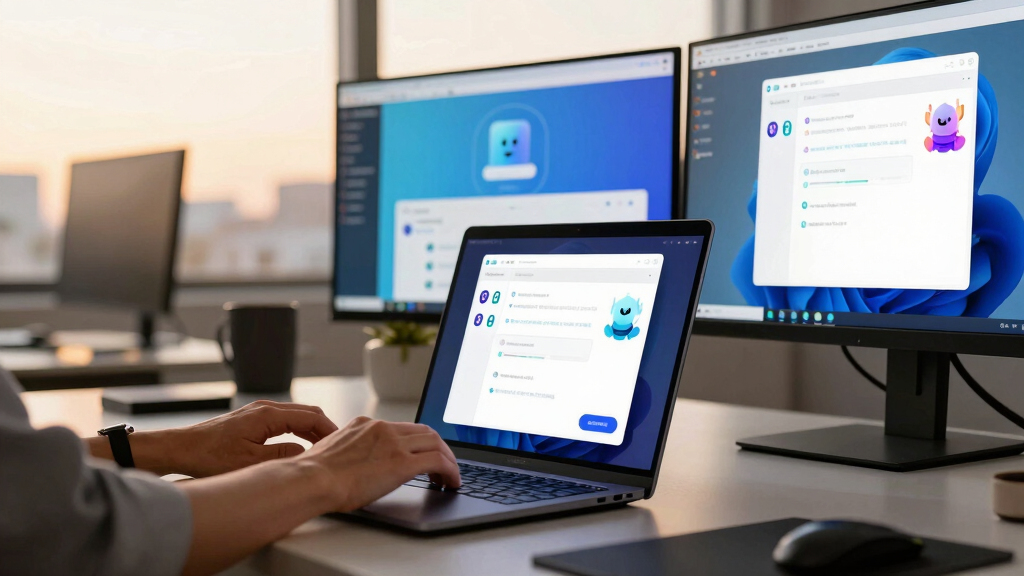

📊 Full opportunity report: When One Agent Isn’t Enough: Claude Now Builds Its Own Team of Agents on the Fly on ThorstenMeyerAI.com — validation score, market gap, and execution plan.
TL;DR
Claude has introduced a new feature called dynamic workflows, allowing it to create and orchestrate its own team of agents on the fly. This development aims to improve handling of complex, high-value tasks by overcoming limitations of a single-agent approach.
Anthropic’s Claude has launched a new feature called dynamic workflows, enabling the AI to autonomously assemble and manage a team of agents tailored to complex tasks in real-time. This development addresses known limitations of single-agent models, such as incomplete work, bias, and goal drift, by orchestrating multiple specialized subagents to work collaboratively.
The feature allows Claude to generate a custom orchestration script—a small JavaScript program—that spawns, coordinates, and manages multiple subagents, each with its own focused brief and context window. These subagents can be assigned different roles, such as classifiers, verifiers, or specialists, depending on the task’s requirements. The process can dynamically decide which model to use for each subtask, and whether to run agents in isolated environments to prevent interference.
According to Anthropic, this capability is particularly useful for complex, high-value tasks such as code refactoring, research synthesis, or large-scale verification, where a single agent might underperform due to laziness, bias, or goal drift. The system can also resume interrupted workflows, making it suitable for long or iterative projects. The feature is built into Claude’s latest models, including Claude Opus 4.8, and is triggered via a command keyword, “ultracode.”
When one agent isn’t enough: Claude now builds its own team on the fly
Skills package what you know; loops decide how far you delegate over time. Dynamic workflows are the third axis — within a single task, Claude writes its own harness and assembles a temporary team of subagents. Think of it as Claude drawing an org chart for one job.
The shift is from prompting a worker to commissioning a team — more output, more cost, and a manager’s judgment required. Reach for a workflow when a task is big, parallel, adversarial, or judgment-heavy — and when you can feel a single agent getting lazy, grading its own homework, or losing the plot. Bound it (token budgets, pilot first) — workflows can spawn hundreds of agents and burn far more tokens. For everything else, don’t hire five people to change a lightbulb.
Implications of Autonomous Agent Team Building
This development represents a significant advancement in AI orchestration, enabling Claude to perform tasks that require multiple specialized perspectives and checks. It reduces reliance on human oversight for complex projects, potentially improving accuracy and efficiency in fields like research, software development, and quality assurance. However, it also raises questions about control, transparency, and the potential for unintended interactions among autonomous subagents.
The AI-Driven Software Team: A Practical Guide for Developers, Leaders, and Businesses Preparing for AI in Engineering
As an affiliate, we earn on qualifying purchases.
As an affiliate, we earn on qualifying purchases.
Evolution of AI Workflow Capabilities
Prior to this, AI models like Claude operated as single agents, executing tasks within a fixed context window. Limitations became evident in long or complex projects, where issues like incomplete work, bias, and goal drift occurred. Anthropic’s development of dynamic workflows builds on earlier efforts to improve AI modularity and orchestration, following the release of Claude’s skills package and looping capabilities. The new feature completes a trilogy of innovations aimed at making AI more adaptable and reliable for high-stakes tasks.
While static multi-agent setups were possible via manual SDK configurations, the new dynamic workflow allows Claude to generate and run custom orchestration scripts automatically, greatly simplifying complex task management and expanding AI’s practical utility.
“This feature allows Claude to write its own harness, creating tailored agent teams on the fly for complex, high-value tasks.”
— Thorsten Meyer, AI researcher at Anthropic
Building AI Agents for Network Operations: Design LLM-powered NetOps workflows with Python, Ollama, MCP, and tool calling
As an affiliate, we earn on qualifying purchases.
As an affiliate, we earn on qualifying purchases.
Unanswered Questions About Workflow Reliability
It is not yet clear how reliably Claude can manage complex workflows in practice, especially in unpredictable or adversarial scenarios. The system’s safety, transparency, and control mechanisms are still being evaluated, and real-world testing will determine its robustness and limitations.

AI Orchestration Systems: AI Orchestration Guides | Business Process Automation | AI in Business Transformation | Adaptive Workflow Systems | Modern AI Technologies | Scalable Automation Platforms
As an affiliate, we earn on qualifying purchases.
As an affiliate, we earn on qualifying purchases.
Next Steps for Deployment and Evaluation
Anthropic plans to deploy the dynamic workflow feature in more applications and gather user feedback. Further research will focus on refining the orchestration patterns, improving safety controls, and assessing performance across diverse high-stakes tasks. Broader adoption may follow once reliability and transparency are demonstrated.

The Agentic Enterprise: A Leader's Guide to Orchestrating, Governing, and Scaling AI Agent Systems
As an affiliate, we earn on qualifying purchases.
As an affiliate, we earn on qualifying purchases.
Key Questions
How does Claude build its own team of agents?
Claude generates a small JavaScript program that spawns and manages multiple subagents, each with specific roles and goals, tailored to the task at hand.
What types of tasks benefit most from dynamic workflows?
Complex, high-value tasks such as research synthesis, code refactoring, large-scale verification, and multi-step decision-making benefit most, as they require specialized perspectives and checks.
Are there safety concerns with autonomous agent teams?
Safety and control mechanisms are still under evaluation. The system’s ability to manage interactions among subagents and prevent unintended outcomes is a focus of ongoing testing.
Will this feature be available to all users?
Initially, it is likely to be limited to advanced users and specific applications, with broader access contingent on further stability and safety assessments.
Source: ThorstenMeyerAI.com