
📊 Full opportunity report: The Critical Role Of Pesticide-Residue Controls In Food Import Safety on IdeaNavigator AI — validation score, market gap, and execution plan.
TL;DR
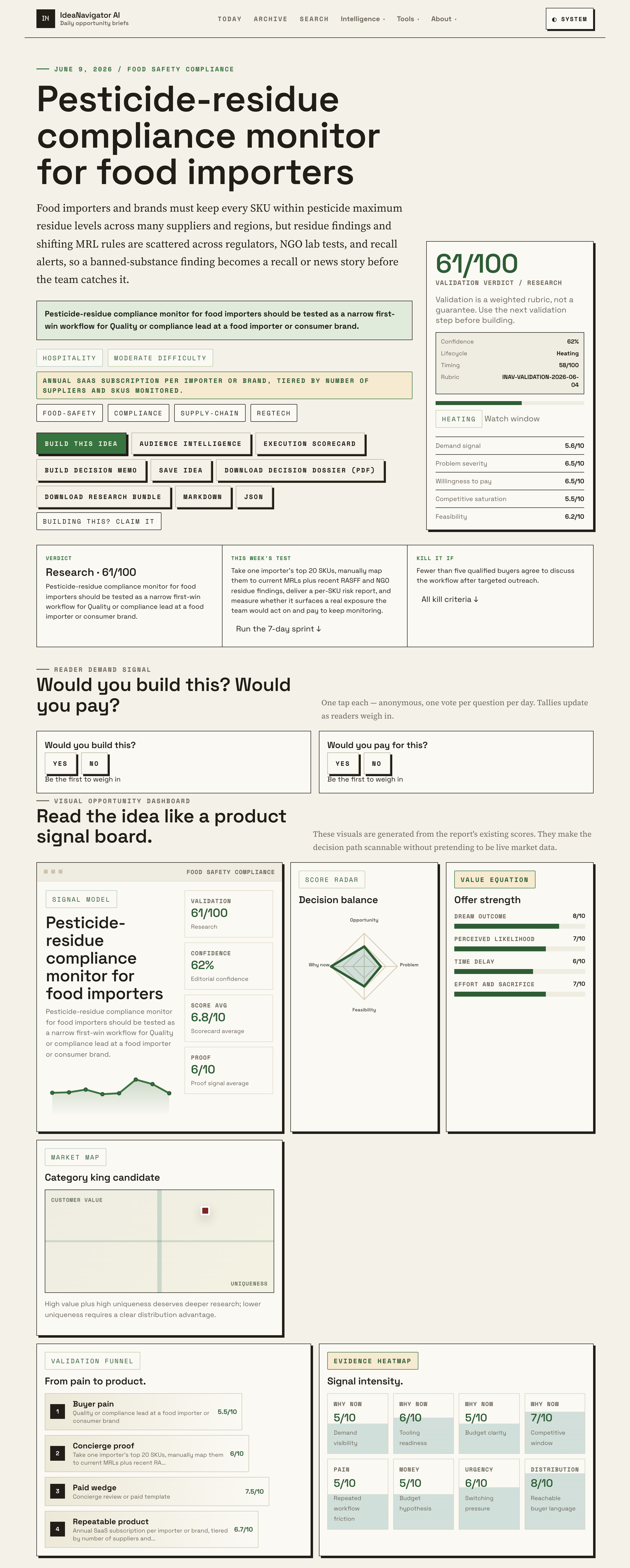
Food importers are adopting pesticide-residue monitoring systems to meet stricter regulations and prevent recalls. These tools map supplier SKUs to current residue limits and alert to risks, improving import safety.
Food importers and brands are increasingly adopting pesticide-residue monitoring tools to ensure compliance with evolving regulations and prevent product recalls. These tools, which map SKUs to current pesticide maximum residue levels (MRLs) and public residue findings, are seen as a critical step toward improving import safety amid rising concerns over pesticide residues in staples like rice, tea, and spices.
Recent reports show that NGO testing and regulatory agencies continue to identify EU-banned pesticides in imported foods, prompting retailers to demand documented residue compliance. The monitoring systems under development aim to provide importers with real-time mapping of their suppliers’ products against regional MRLs and residue alerts from sources such as the Rapid Alert System for Food and Feed (RASFF) and NGO tests. This approach offers a proactive measure to identify at-risk SKUs before they reach consumers, potentially avoiding costly recalls and reputational damage.
Initial validation involves mapping a sample of top SKUs for a food importer to current MRLs and recent residue findings, then generating risk reports to assess whether the system can detect genuine exposure risks. The product is designed as a SaaS subscription, tiered by the number of monitored SKUs and suppliers, providing an ongoing compliance management tool for importers and brands.
Impact of Residue Monitoring on Import Safety
This development is significant because it addresses a critical gap in food safety compliance — the difficulty for importers to keep track of diverse pesticide regulations and recent residue findings across multiple regions. As MRLs tighten globally and NGO reports reveal banned pesticide use, these tools help prevent contaminated products from entering markets, reducing the risk of recalls, legal penalties, and damage to brand reputation. The ability to produce audit-ready briefs also supports transparency and regulatory reporting, aligning with increasing retailer demands for documented compliance.
As an affiliate, we earn on qualifying purchases.
Rising Incidents of Pesticide Residues in Imports
Over recent years, NGO testing organizations and regulatory authorities have repeatedly identified EU-banned pesticides in imported staples such as rice, tea, and spices. This has led to increased scrutiny from retailers and consumers, with many demanding transparent documentation of pesticide compliance. Meanwhile, the patchwork of regional MRLs and shifting regulations complicate compliance efforts for importers, who must manage multiple suppliers across different markets. The emergence of dedicated monitoring tools aims to streamline this process, providing a centralized way to verify residue levels and avoid non-compliance issues.
“Monitoring systems that map SKUs to current MRLs and residue alerts can significantly reduce the risk of contaminated imports reaching consumers.”
— an anonymous researcher
food import pesticide residue monitor
As an affiliate, we earn on qualifying purchases.
As an affiliate, we earn on qualifying purchases.
Unresolved Questions About Implementation and Effectiveness
It is still unclear how widely these pesticide-residue monitoring tools will be adopted across the industry and whether they will prove effective in real-world scenarios. Validation efforts are ongoing, and the ability of the systems to accurately flag genuine risk versus false positives remains to be seen. Additionally, questions remain about how quickly these tools can be updated to reflect new residue findings and evolving regulations, and whether they will be accessible to smaller importers with limited resources.
MRL compliance software for food importers
As an affiliate, we earn on qualifying purchases.
As an affiliate, we earn on qualifying purchases.
Next Steps for Adoption and Validation of Monitoring Tools
Moving forward, developers plan to pilot the monitoring systems with select importers, focusing on validating risk detection accuracy and integration with existing compliance workflows. As these tools mature, broader industry adoption is expected, supported by ongoing updates to residue databases and regulatory data feeds. Regulatory bodies and NGOs may also increasingly endorse or incorporate such systems into their compliance frameworks, further driving adoption.
pesticide residue detection device
As an affiliate, we earn on qualifying purchases.
As an affiliate, we earn on qualifying purchases.
Key Questions
How do pesticide-residue monitoring tools work?
They map a company’s SKUs to current regional MRLs and residue findings from sources like NGO tests and regulatory alerts, flagging products at risk of non-compliance.
Who benefits most from these monitoring systems?
Food importers, brands, and retailers seeking to ensure compliance, avoid recalls, and meet consumer demand for transparency benefit most from these tools.
Are these systems effective against all pesticide residues?
Effectiveness depends on the quality of data inputs and system validation; ongoing testing aims to improve accuracy and reduce false positives.
Will smaller importers be able to afford these tools?
The subscription model is designed to be tiered, making it accessible to smaller companies, though adoption costs remain a consideration.
What regulations are driving the need for these tools?
Stricter regional MRLs, increased NGO testing, and retailer demands for documented compliance are key drivers behind the development and adoption of pesticide-residue monitoring.
Source: IdeaNavigator AI