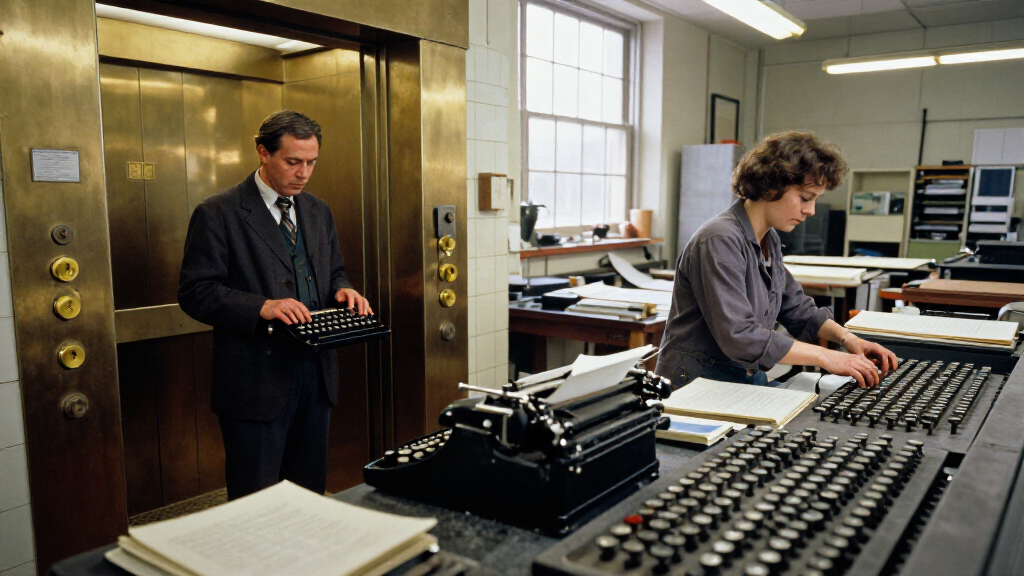
🔍 Read the full analysis: Elevator Operators, Typists, Typesetters: Work Before AI on ThorstenMeyerAI.com

Get the latest gadgets delivered free with Prime
- Fast, free delivery on millions of items
- Prime Video, Amazon Music and more included
- Member-only deals all year
TL;DR
A November 21, 2026, article from ThorstenMeyerAI.com examines elevator operators, typists and typesetters as examples of how automation changes work. It cites economist James Bessen’s finding that only one of 271 occupations tracked from 1950 to 2010 largely disappeared because of automation, while noting that task-based jobs can still decline sharply.
ThorstenMeyerAI.com published a historical report on November 21 examining how automation changed the work of elevator operators, typists and typesetters, and what those changes may suggest about AI’s effects on jobs. The report cites economist James Bessen’s analysis of 271 occupations in the 1950 U.S. census, which found that only one largely disappeared because of automation by 2010: elevator operator.
The report distinguishes between a whole occupation disappearing and technology taking over some of its tasks. Bessen, an economist at Boston University, followed the 271 detailed occupations used in the 1950 census through 2010, accounting for occupations that were renamed or merged. He concluded that elevator operator was the only occupation in his review whose decline and disappearance could be largely attributed to automation. Most automation, he wrote, was partial: machines performed some tasks while the broader job remained.
The report says the elevator operator occupation grew as American cities built upward, reaching about 97,000 workers in 1950. Automatic elevators were already possible, but passenger trust remained a concern. Otis’s company history says it offered recorded voices for automatic Autotronic elevators in 1948 while attendants were still present. In 1950, an Otis system without attendants opened in the Atlantic Refining Building in Dallas.
For typists, the report points to a sharp employment decline after the arrival of word processors and personal computers. It gives a figure of 985,000 U.S. word processors and typists in 1988, falling to about 40,400 in 2025. It says official forecasters had expected a 6% decline by 2000, while the reported actual decline was 51%. The report also describes German typesetters’ 1978 strike and says the occupation’s apprenticeship was merged into the media designer trade in 1998.
Infographic 01 · The number to remember
The one job automation wiped out
Elevator operators rose with the skyscrapers and fell with the automatic elevator. Of 271 occupations in the 1950 census, it is the only one that automation largely wiped out.
US elevator operators · census · thousands
Story vs. evidence
- Documented (TIME, 8 Oct 1945): 16,600 elevator operators and building workers on strike in 2,100 Manhattan buildings for five and a half days.
- Documented (Otis, company account): 1948 a recorded voice to help passengers trust automatic elevators; 1950 the first building with Otis high-speed, no-operator elevators (Dallas).
- Not documented: that the strike made owners switch to automatic elevators. A popular story; no source we found shows it.
Census figures: economically active persons 14 and over, each census in its own classification (1950 in the 1950 classification). Today the BLS publishes no separate count of elevator operators; installers and repairers are a different occupation.
Sources: US Census Bureau, Historical Statistics of the United States (1975), series D 233-682 (row D 587); J. Bessen, How Computer Automation Affects Occupations (2016); TIME, 8 Oct 1945; Otis company history; BLS Employment Projections 2025-35 (27 Aug 2026).
Powered by Thorsten Meyer AI
How Automation Changes Jobs
The cases matter because they show that automation does not affect every occupation in the same way. Bessen’s finding suggests whole-job disappearance was unusual across the occupations he studied, but the typist example shows how employment can still contract sharply when technology takes over a job’s central task. For workers and policymakers, the distinction matters: a job can persist while its duties change, or shrink when its defining work becomes easy to automate.
The report connects that history to current employment concerns. It says the U.S. Bureau of Labor Statistics projected in August 2026 that office and administrative support would be the fastest-shrinking occupational group by 2035, partly because of AI tools. About one in nine U.S. jobs remains in that group, according to the report. The projection is a forecast, not a count of jobs already lost, and the scale and timing of AI’s effects remain unsettled.
Products Worth Considering

Amazon Kindle Scribe Colorsoft 64GB with Premium Pen

Bose Lifestyle Ultra Wireless Home Speaker, White Smoke

Samsung Odyssey OLED G8 34-Inch Curved Ultra WQHD Gaming Monitor
As an affiliate, we earn on qualifying purchases.
From Elevator Cars to Office Pools
The report places the elevator strike of 1945 alongside the later adoption of automatic elevators, but cautions against treating the strike as the proven cause of that change. TIME reported on October 8, 1945, that 16,600 elevator operators and building service workers walked out across 2,100 Manhattan buildings over a War Labor Board wage ruling. The strike lasted five and a half days and ended after Gov. Thomas Dewey called for an impartial arbitrator.
Later accounts often present the strike as the moment building owners decided to replace operators. ThorstenMeyerAI.com says it found no document establishing that causal link, and advises treating it as a popular story rather than a documented fact. Census figures do show a subsequent decline: about 77,000 elevator operators in 1960 and 37,000 in 1970. The current BLS category does not count elevator operators separately; it lists elevator and escalator installers and repairers, a different occupation.
Typing work expanded during the 20th century as offices grew. The report says the census counted 134,000 stenographers, typists and secretaries in 1900 and 3.9 million in 1970. The typewriter helped create office roles that later faced new tools. Typesetters, meanwhile, organized against changes to control over text design; the German strike and training changes show that technological shifts can also involve disputes over skills and who performs the work.
“In only one case—elevator operators—can the decline and disappearance of an occupation be largely attributed to automation.”
— James Bessen, Boston University economist, as quoted in the report
What the Historical Record Cannot Prove
The report does not establish that the 1945 strike caused building owners to adopt operator-free elevators. It says it found no document proving that connection, despite the story’s continued use in later retellings. The strike’s scale and end are attributed to contemporary TIME coverage; the causal explanation should not be treated as confirmed.
The report’s employment figures also refer to different periods and occupational definitions, so they do not form a single continuous measure of the same work. It does not specify the underlying source for every typist figure in the supplied material. And the BLS projection about office and administrative support is a forecast: the extent to which AI, rather than other economic changes, will drive future losses is not yet known.
Tracking Office Work Through 2035
The next measurable development will be how U.S. employment in office and administrative support changes against the BLS projection through 2035. Future BLS employment estimates and census data can show whether the decline matches forecasts, although they may not isolate AI as the cause. The historical cases offer questions to track—whether tools replace tasks or entire roles, how quickly employers adopt them, and whether workers move into related jobs—but do not settle what will happen to current office workers.
Key Questions
What is the main finding in the report?
The report cites James Bessen’s study of 271 occupations from the 1950 U.S. census through 2010. In that analysis, only elevator operator largely disappeared because of automation.
Did the 1945 elevator strike lead to automatic elevators?
That connection is often repeated, but the report says it found no document proving the strike caused the switch. The strike is documented; the proposed cause-and-effect link is not.
How much did the number of typists decline?
The report gives 985,000 U.S. word processors and typists in 1988 and about 40,400 in 2025. It also says forecasters expected a 6% decline by 2000, while the actual decline was 51%; those figures describe different time frames and should be read as reported in the article.
Does the report predict that AI will eliminate office jobs?
No. It cites a BLS projection that office and administrative support will be the fastest-shrinking occupational group by 2035, partly because of AI tools. That is a forecast, not a confirmed outcome, and the specific contribution of AI remains uncertain.
Source: ThorstenMeyerAI.com