
📊 Full opportunity report: A Task-Centered Approach To Social Media Management on IdeaNavigator AI — validation score, market gap, and execution plan.

Get the latest gadgets delivered free with Prime
- Fast, free delivery on millions of items
- Prime Video, Amazon Music and more included
- Member-only deals all year
TL;DR
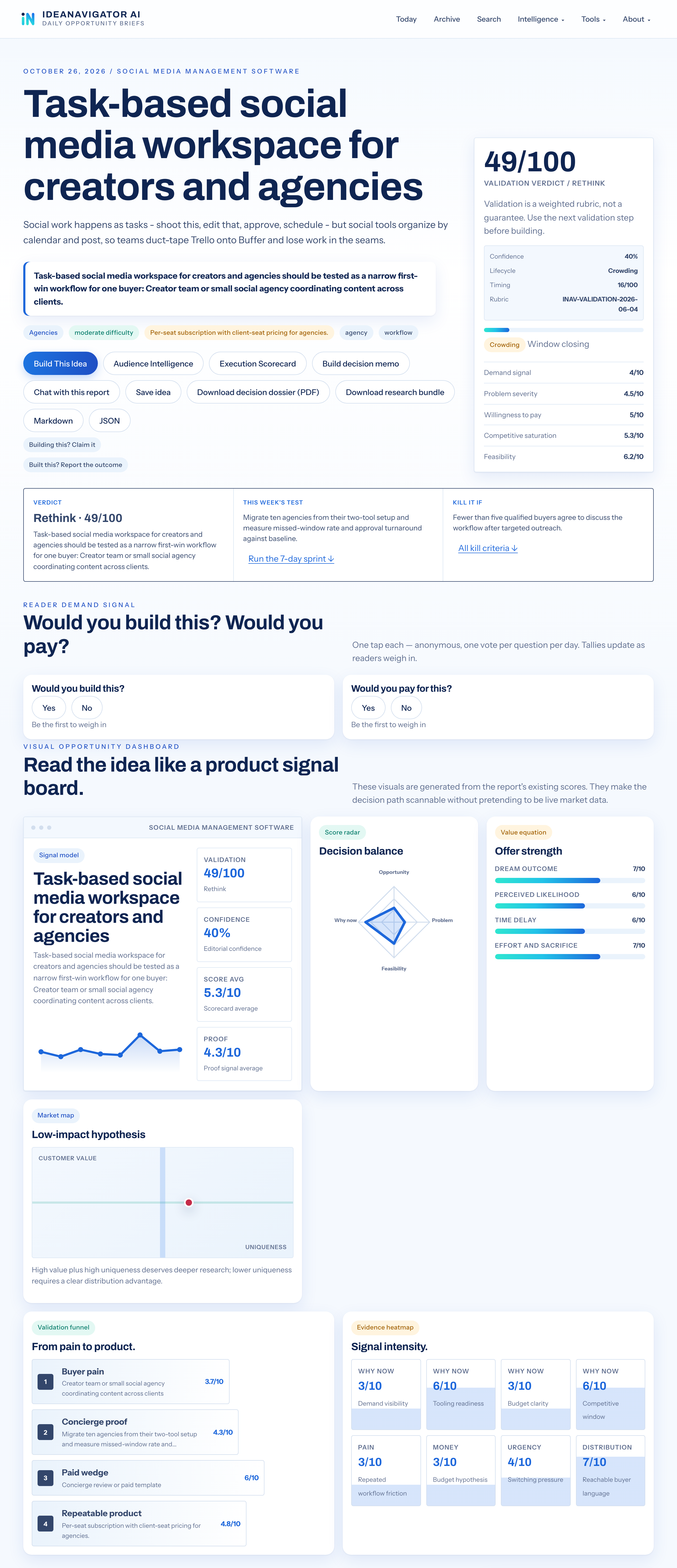
IdeaNavigator AI outlines a proposed task-centered workspace for creator teams and small social agencies, where each post moves through a shared production and approval pipeline. The concept is not a confirmed product launch; its proposed test is to migrate ten agencies and compare missed publishing windows and approval turnaround with their existing setup.
IdeaNavigator AI has outlined a proposed task-centered social media workspace for creator teams and small agencies coordinating posts across clients, with each post moving through briefing, asset preparation, editing, approval and scheduling. The concept is a product opportunity, not an announced release: no finished service, launch date or validation results are provided.
The proposal targets a specific coordination problem: teams handle social content through a sequence of tasks, while many existing tools are organized around calendars and published posts. The concept argues that teams may bridge that gap by combining a social scheduler with a general project-management tool, creating handoffs where updates or approvals can be missed. This is the opportunity’s stated premise, rather than a finding supported by published usage data.
The suggested minimum product would give each post a place in a shared pipeline with stages for brief, asset, edit, approval and scheduled. It would include client-facing approval links and asset versioning, then schedule content natively once approval is complete. The intended workflow runs from idea to publication in one workspace instead of requiring teams to coordinate across separate systems.
The initial customer is defined as a creator team or small social agency managing content for multiple clients. The suggested business model is a per-seat subscription, with pricing for client seats at agencies. To test whether the workflow solves a measurable problem, the proposal recommends moving ten agencies from their current two-tool setup and comparing missed-window rates and approval turnaround against each agency’s baseline. No agencies are named, and no results from such a test are reported.
Testing the Case for One Workflow
The idea matters because it frames social media management as a production and coordination problem, not only a matter of planning when posts go live. For small teams handling multiple client accounts, briefs, asset revisions, sign-off and scheduling are linked steps. If those steps are scattered across tools, staff may have to repeat information or check separate systems to find the current status. The proposal identifies these handoffs as a potential source of delay and missed publishing windows.
That potential is not yet evidence that a dedicated workspace would improve results. The proposed ten-agency pilot could supply a practical comparison: whether posts miss their intended windows less often and whether client approvals arrive faster than under each agency’s existing setup. Those measures matter to buyers assessing whether another subscription and migration are worthwhile. Without baseline figures, results or details on how the test would account for differences among agencies, the product’s likely impact and commercial demand remain unknown.
social media management software for agencies with client approval workflows
As an affiliate, we earn on qualifying purchases.
As an affiliate, we earn on qualifying purchases.
From Calendars to Content Tasks
The concept responds to a distinction between publishing tools and work-management tools. Social platforms and scheduling products commonly present content as posts arranged on a calendar, while a team producing a post must also manage earlier work: writing a brief, collecting files, editing and getting approval. The proposal says this leaves some teams pairing a scheduler such as Buffer with a general tool such as Trello. Those examples illustrate the described two-tool setup; no usage survey or market-wide measurement is supplied.
The rationale for acting now is that rising content-velocity expectations have increased the number of workflows teams coordinate, while established scheduling products have, according to the proposal, left the work-management layer to generic project tools. That is the concept’s market assessment, not an independently documented account of all providers. Its proposed response is narrower than a broad platform for every social-media user: it focuses on client work and the handoffs between producing, approving and scheduling a post.
social media scheduling tool with content calendar and approval features
As an affiliate, we earn on qualifying purchases.
As an affiliate, we earn on qualifying purchases.
Product Demand and Results Unverified
No product launch, operating company, pricing figure or customer commitment is identified in the proposal. It does not say that the recommended ten-agency test has begun or provide baseline measures, results, or a timetable. It is also unclear how missed-window rates would be defined, how agencies’ existing workflows would be documented, or how differences in client volume and approval practices would affect comparisons.
The concept also leaves product details open, including which social networks would be supported, how native scheduling would work across them, and what permissions clients would receive through approval links. The stated per-seat model with client-seat pricing is a suggested revenue approach, not confirmed pricing. Until those questions are answered and agencies test the product, claims of faster approvals or fewer missed posts would be premature.
project management software for social media content production teams
As an affiliate, we earn on qualifying purchases.
As an affiliate, we earn on qualifying purchases.
A Ten-Agency Pilot Is Proposed
The next step described is to recruit ten agencies, move their work from a two-tool setup into the proposed workspace, and track missed-window rates and approval turnaround against existing baselines. For that test to establish a useful comparison, organizers would need to define the measurement period and metrics and report the agencies’ starting conditions alongside any results. No timeline, recruitment plan or follow-up announcement is supplied.
For prospective buyers, the practical next development to watch for is evidence that the core workflow can handle client approvals, asset revisions and scheduling across the channels they use. Until a pilot or product release is documented, the proposal should be understood as a testable market idea rather than a service available to agencies.
Source: IdeaNavigator AI
digital asset management software with version control for creative teams
As an affiliate, we earn on qualifying purchases.
As an affiliate, we earn on qualifying purchases.
Key Questions
Has the task-centered workspace launched?
No launch is reported. The material describes a proposed product concept and an MVP outline, without a release date or evidence that the workspace is available.
Who is the proposed product for?
It is aimed at creator teams and small social agencies coordinating content across multiple clients, rather than being presented as a tool for every social-media user.
What would the workspace include?
The proposed workflow would track each post through briefing, asset preparation, editing, approval and scheduling, with client-facing approval links, asset versioning and native scheduling after approval.
How would the concept be tested?
IdeaNavigator AI proposes moving ten agencies from their existing two-tool setups and comparing missed-window rates and approval turnaround with baseline performance. No test results are provided.
What would pricing look like?
The suggested model is a per-seat subscription with pricing for agency client seats. No actual prices or confirmed commercial terms are given.
Source: IdeaNavigator AI
Halloween Picks
halloween
As an affiliate, we earn on qualifying purchases.