📊 Full opportunity report: Record Your TRT Symptoms And Lab Results As You Go on IdeaNavigator AI — validation score, market gap, and execution plan.

Get the latest gadgets delivered free — and shop member deals
- Fast, free delivery on millions of items
- Access to Prime Big Deal Days deals on October 6–7
- Prime Video, Amazon Music and more included
TL;DR
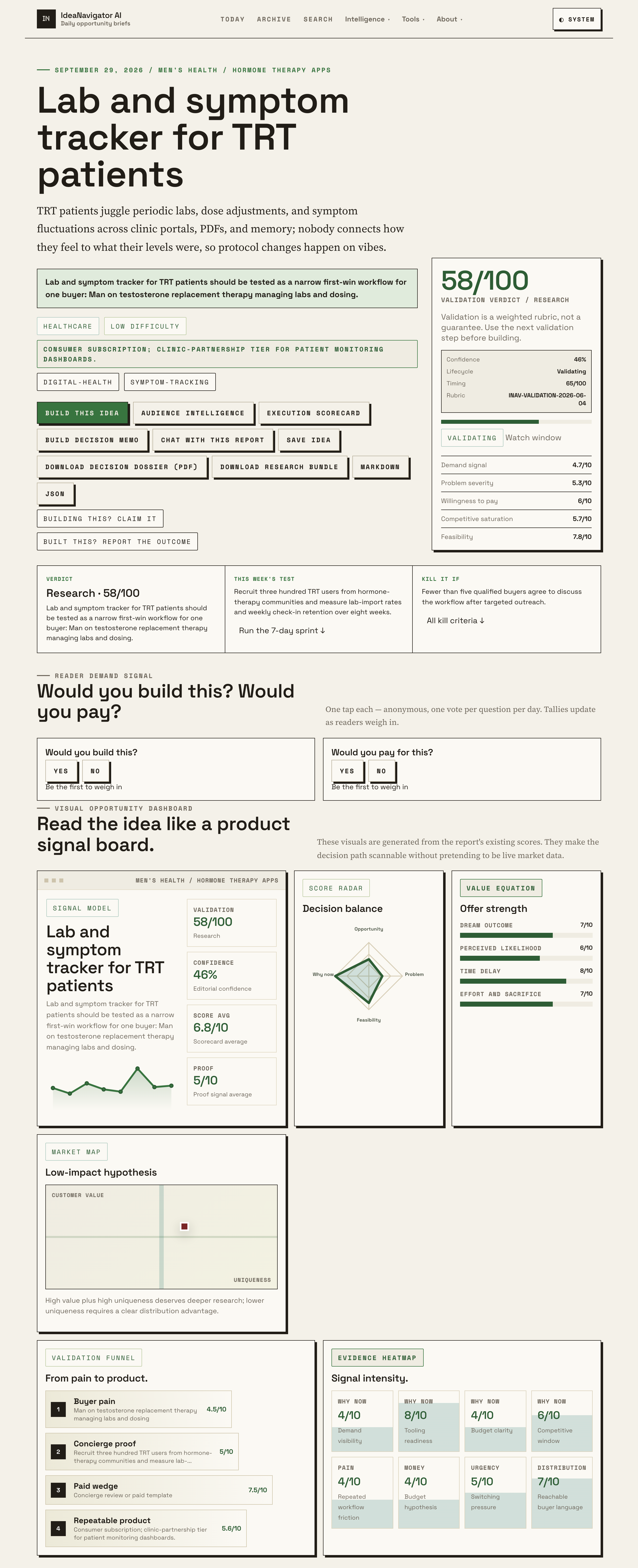
IdeaNavigator AI has outlined a product concept for a lab and symptom tracker aimed at men on testosterone replacement therapy. The proposed app would import lab PDFs, chart hormone panels against dose changes and symptom check-ins, and generate visit summaries, but it remains an unvalidated idea.
A new product concept from IdeaNavigator AI proposes a dedicated lab and symptom tracker for men on testosterone replacement therapy (TRT), arguing that this patient group is underserved by fragmented clinic portals, scattered PDF lab reports, and memory-based self-reporting. The concept, framed as a narrow “first-win” workflow for a single buyer — a man managing his own TRT labs and dosing — calls for an app that charts hormone panels over time against dose changes and daily symptom check-ins, generates trend summaries for clinic visits, and flags values drifting outside target ranges.
According to the concept analysis, the core problem is that TRT patients must coordinate periodic lab work, dose adjustments, and fluctuating symptoms across multiple systems that do not talk to each other. Lab results typically live in clinic portals or PDF downloads, dose history sits with the prescribing provider, and how a patient actually feels day to day is tracked nowhere at all — or only in memory. The result, the analysis argues, is that protocol changes happen “on vibes” rather than on connected data linking subjective wellbeing to measured hormone levels.
The proposed minimum viable product has four concrete components: import of lab PDFs; charting of hormone panels over time alongside dose changes and daily symptom check-ins; generation of trend summaries that patients can bring to clinic visits; and automatic flagging of values drifting outside target ranges. The revenue model would combine a consumer subscription with a clinic-partnership tier offering patient-monitoring dashboards for providers.
The analysis also specifies a validation plan: recruit 300 TRT users from hormone-therapy communities and measure lab-import rates and weekly check-in retention over an eight-week period. These figures are proposed benchmarks, not results — no product has been built or tested under this plan as far as the published concept indicates.
Why Fragmented TRT Care Creates an Opening
The concept matters because of its timing argument: TRT prescriptions and telehealth clinics have surged, producing a large population of men who effectively self-manage a hormone protocol between infrequent clinic touchpoints. According to the analysis, this population’s care is “fragmented across providers by design” — telehealth models often separate the prescribing clinic, the lab vendor, and the follow-up cadence, leaving the patient as the only common thread.
For readers, the practical stakes are concrete. Men on TRT routinely make decisions about how they feel — energy, mood, libido, sleep — without being able to correlate those symptoms against the lab values and dose changes that preceded them. A tool that connects these two data streams could change the quality of conversations at clinic visits, replacing anecdotal recall with longitudinal charts and printed summaries. It could also surface out-of-range values earlier than the next scheduled appointment. Whether that translates into better outcomes is unproven and would depend on validation and clinical uptake.
There is also a commercial angle: the men’s health and hormone-therapy app market is already active, and a clinic-facing monitoring tier would give the product a second revenue path beyond consumer subscriptions, aligning it with telehealth providers who want visibility into patients between visits.
Telehealth Boom Behind the TRT Tracking Idea
The concept sits inside a broader shift in men’s hormone care. Over the past several years, telehealth platforms specializing in TRT have expanded access to testosterone therapy, lowering barriers to prescription and follow-up while shifting day-to-day management onto the patient. That shift is the stated “why now” for the proposal: the population of self-managing TRT patients is large and growing, but the tooling around them has not kept pace.
Existing alternatives — clinic portals, generic health trackers, spreadsheets, and community forum threads — each capture a fragment of the picture. None, according to the analysis, connects how a patient feels to what his levels were. The proposed tracker is positioned deliberately as a narrow “first-win” workflow rather than a broad health platform, targeting one buyer type with one job: keeping labs, doses, and symptoms in one visual record.
Unproven Demand and Unbuilt Product
The concept is a proposal, not a launched product. No app has been built, no team or company has been identified, and the market opportunity is asserted in the analysis rather than demonstrated with adoption data. The claim that TRT patients will reliably import lab PDFs and sustain weekly check-ins is exactly what the proposed eight-week study is designed to test — and those retention and import figures remain unknown.
Several practical questions are also unresolved in the published concept: how lab PDF parsing would handle the varied formats used by different lab vendors; how target ranges would be set and whether they would be patient-configured or clinic-defined; and how the product would handle health-data privacy obligations once real lab results are uploaded. The clinic-partnership tier is described only at the revenue-model level, with no detail on provider integration, and there is no evidence yet that telehealth clinics would pay for such dashboards. Claims about the size of the TRT patient population are presented without cited figures.
Validation Study Before Any Build
According to the analysis, the immediate next step is validation before construction: recruiting 300 TRT users from hormone-therapy communities and running an eight-week measurement of lab-import rates and weekly check-in retention. Those two metrics would determine whether the core behavior — bringing labs into the app and logging symptoms consistently — actually occurs in practice.
If validation succeeds, the outlined path is a minimal build focused on PDF import, panel-over-time charting against dose changes, and clinic-visit summaries, followed by a consumer subscription and a clinic-partnership tier. If import or retention rates prove weak, the concept would need revision — for example, simpler check-ins or automated lab connections — before any market entry. For now, the idea exists only as a published concept awaiting someone to run the validation, and readers should treat it as a market hypothesis rather than an available product.
Source: IdeaNavigator AI
Key Questions
Is this TRT tracking app available now?
No. The tracker exists only as a published product concept from IdeaNavigator AI. No app has been built, no company has been named, and no release date exists.
What would the proposed app actually do?
Per the concept, it would import lab PDFs, chart hormone panels over time against dose changes and daily symptom check-ins, generate trend summaries for clinic visits, and flag values drifting outside target ranges.
How would the idea be validated?
The proposed method is to recruit 300 TRT users from hormone-therapy communities and measure lab-import rates and weekly check-in retention over eight weeks. These are planned metrics, not reported results.
Why is this idea being floated now?
The analysis argues that TRT prescriptions and telehealth clinics have surged, creating many self-managing patients whose lab data, dosing history, and symptoms are scattered across providers and tools.
Would the app replace a TRT clinic’s guidance?
No. The concept positions the tracker as a record-keeping and visit-preparation tool that shows trends and out-of-range values. Dosing decisions would still rest with the prescribing clinician.
Source: IdeaNavigator AI
Fall Picks
fall essentials
As an affiliate, we earn on qualifying purchases.