
📊 Full opportunity report: Retirement Care Planner on IdeaNavigator AI — validation score, market gap, and execution plan.

Get the latest gadgets delivered free — and shop member deals
- Fast, free delivery on millions of items
- Access to Prime Big Deal Days deals on October 6–7
- Prime Video, Amazon Music and more included
TL;DR
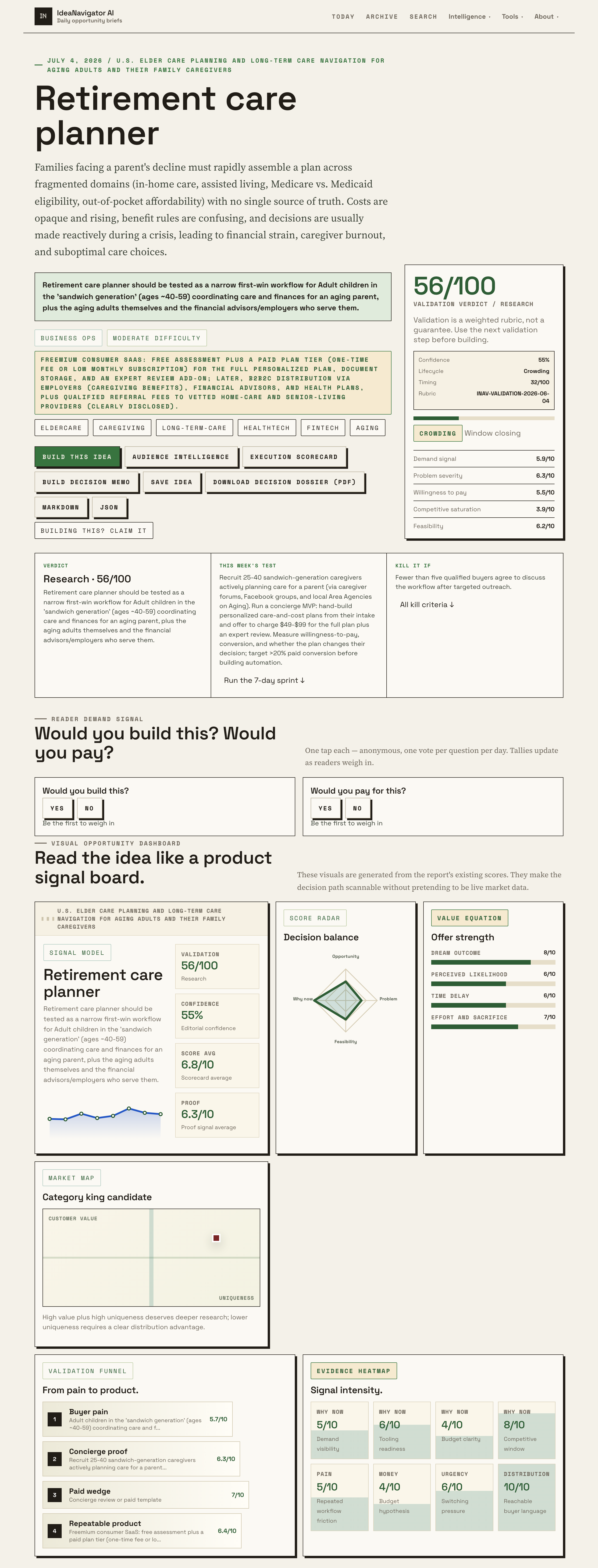
A pilot of a retirement care planning web app is being tested to assist adult children managing aging parents’ care. It aims to streamline decision-making amid rising costs and complex eligibility rules. The initiative targets the ‘sandwich generation’ and could reshape elder care planning.
A new web-based tool is being tested to help caregivers in the ‘sandwich generation’ develop personalized long-term care plans for their aging parents. The pilot aims to address the widespread challenge of fragmented, opaque, and reactive elder care decision-making, which often leads to financial strain and caregiver burnout. You might find our Appointment no-show recovery planner for therapy practices useful for managing caregiver appointments.
The proposed retirement care planner is a guided web app that, after a brief intake on the parent’s health, location, and finances, generates a customized care and cost plan. It includes localized cost comparisons between in-home care, assisted living, and nursing homes, as well as explanations of Medicare and Medicaid eligibility, affordability projections, and a prioritized action checklist with vetted local providers. The pilot is initially focusing on a high-cost state to manage data complexity.
This initiative is currently in a testing phase, with a small group of 25-40 actively planning caregivers recruited through forums and local agencies. The MVP involves a manual, concierge-style process where personalized plans are created and offered for a fee of $49-$99, with the goal of measuring willingness to pay, plan impact, and decision changes before automating the service. Consider using our When-to-replace planner for data center equipment to optimize your operational planning.
Why a Retirement Care Planner Could Transform Elder Care
This project addresses a critical gap in elder care, where families face rising costs—such as median assisted living costs of $6,200/month and nursing home expenses exceeding $115,000 annually—and complex benefit rules. The lack of a unified planning tool often results in reactive decisions made during crises, leading to financial hardship and caregiver burnout. A structured, accessible planning solution could improve decision quality, reduce emotional stress, and potentially lower costs by enabling earlier, more informed choices.
medicare Medicaid eligibility guidebook
As an affiliate, we earn on qualifying purchases.
As an affiliate, we earn on qualifying purchases.
Growing Demand for Structured Elder Care Planning Solutions
The U.S. population aged 65 and older is projected to reach approximately 73 million by 2030. With nearly 70% of those turning 65 expected to need long-term care, the demand for effective planning tools has surged. Costs for elder care services have increased sharply in recent years, intensifying the financial burden on families. Currently, most families rely on reactive decision-making, often during emergencies, due to fragmented information and opaque pricing. This pilot aims to address these issues by providing a comprehensive, user-friendly planning resource.
“Families need a reliable way to navigate the complex landscape of elder care costs and eligibility, especially as expenses continue to rise.”
— an anonymous researcher
in-home elder care monitoring devices
As an affiliate, we earn on qualifying purchases.
As an affiliate, we earn on qualifying purchases.
Uncertainties About the Pilot’s Effectiveness and Adoption
It is not yet clear how many caregivers will be willing to pay for the full personalized plans or how significantly the plans will influence their decision-making. The pilot’s success depends on user engagement, the accuracy of local cost data, and the app’s ability to deliver clear, actionable guidance. Additionally, broader adoption across states and integration with existing elder care resources remain uncertain at this stage.
assisted living cost comparison book
As an affiliate, we earn on qualifying purchases.
As an affiliate, we earn on qualifying purchases.
Next Steps for Scaling and Validating the Care Planning Tool
The team plans to complete the initial testing phase within the next few months, gather feedback from participants, and analyze willingness-to-pay and decision impacts. If results are positive, they aim to automate the platform, expand to additional states, and develop partnerships with employers, financial advisors, and elder care providers. Further validation through larger user cohorts and integration with existing healthcare systems is also anticipated.
As an affiliate, we earn on qualifying purchases.
Key Questions
What is the main goal of the retirement care planner pilot?
The primary goal is to test whether a guided web app can help caregivers create personalized, cost-effective care plans for aging parents, reducing reactive decisions and financial strain.
Who is the target user for this tool?
Adult children aged approximately 40-59 in the ‘sandwich generation’ who are coordinating care and finances for their aging parents.
How will the service generate revenue?
The pilot will initially charge a one-time fee or low monthly subscription for full plans, with future revenue streams including B2B distribution via employers and financial advisors, and referral fees to vetted elder care providers.
What are the main challenges the project faces?
Key challenges include validating willingness-to-pay, ensuring accurate local cost data, and achieving broad adoption across different states and care settings.
When will the full automation of the platform be available?
The timeline depends on pilot results; if successful, automation is expected within the next year or two, following further development and validation.
Source: IdeaNavigator AI
Halloween Picks
halloween
As an affiliate, we earn on qualifying purchases.