
📊 Full opportunity report: Why Immediate Business Closure Notifications Matter For Asset Buyers on IdeaNavigator AI — validation score, market gap, and execution plan.
TL;DR
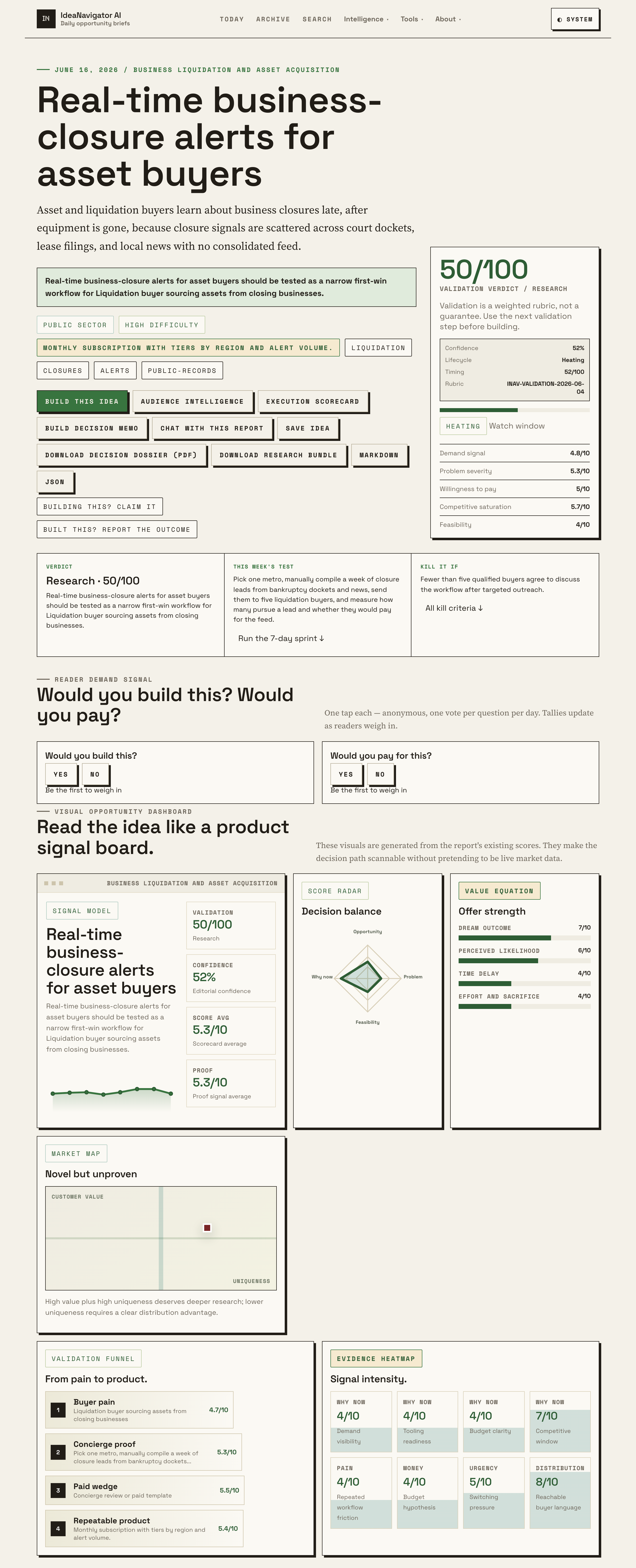
Real-time business closure notifications are being tested to help asset buyers act quickly on liquidation opportunities. This development could improve asset acquisition efficiency, but the approach is still in early stages.
Liquidation and asset buyers are exploring the use of real-time business closure alerts to improve their response times when businesses shut down. This initiative, currently in a testing phase, aims to address the longstanding problem of delayed information, which often causes buyers to miss out on valuable assets. The development is significant because it could reshape how liquidation markets operate, making asset acquisition more efficient and timely.
Real-time alerts for business closures are being tested as a way to streamline the process for liquidation buyers sourcing assets from shutting companies. Currently, information about business closures is scattered across court dockets, lease filings, and local news, often arriving too late for buyers to act. The proposed solution involves a manually curated daily alert system, where a buyer specifies a region and asset category, and a human analyst scans bankruptcy dockets and news outlets to identify relevant closures. These alerts would include details such as the type of business, estimated asset value, and closure timeline.
According to an anonymous researcher involved in the project, the initiative aims to validate whether timely information leads to increased pursuit of liquidation opportunities. The plan is to test this approach in one metro area by compiling a week of closure leads and distributing them to five liquidation buyers, measuring their response and willingness to pay for such a feed. The model proposes a subscription-based revenue stream, with tiers based on region and alert volume.
Impact of Real-Time Closure Alerts on Asset Acquisition
This development could significantly improve the efficiency of asset acquisition for liquidation buyers by providing faster and more reliable information about business closures. Currently, delays in learning about closures often result in missed opportunities, especially for high-value equipment and assets. If successful, real-time alerts could lead to more timely purchases, increased market liquidity, and better pricing for sellers. For buyers, this means a competitive edge in acquiring assets before they are removed or sold through other channels.

Epson Workforce ES-50 Compact & Lightweight Mobile Document Scanner
- Portability: Lightweight, mobile document scanner
- Fast Scanning: Scans a page in 5.5 seconds
- Compatibility: Works with Windows and Mac
As an affiliate, we earn on qualifying purchases.
As an affiliate, we earn on qualifying purchases.
Growing Need for Timely Closure Data in Liquidation Markets
The post-pandemic economic environment has seen elevated levels of small-business closures and bankruptcies, creating a larger pool of assets available for liquidation. Historically, information about these closures has been scattered and delayed, limiting the ability of asset buyers to act promptly. With bankruptcy filings and lease terminations now electronically filed and publicly accessible, the opportunity to aggregate this data in real time is emerging. Previous efforts relied on manual searches and news monitoring, which are time-consuming and inconsistent. The current testing initiative aims to leverage this digital accessibility to create a more proactive approach for liquidation markets.
“The goal is to see if timely, consolidated closure signals can increase the pursuit rate among liquidation buyers.”
— an anonymous researcher
Data Recovery Stick for Windows Data Recovery Software – Photos, Files
- Easy to Use: Plug and recover files automatically
- Wide Compatibility: Supports Windows Vista to 11
- Supports Multiple File Types: Photos, documents, music, PDFs, and more
As an affiliate, we earn on qualifying purchases.
As an affiliate, we earn on qualifying purchases.
Uncertainties Surrounding the Effectiveness and Scalability
It is not yet clear how effective the manual alert system will be in practice or whether buyers will find enough value to pay for the service. The pilot is limited to one metro area, and broader scalability remains untested. Additionally, questions about automation, data accuracy, and integration with existing procurement workflows are still unresolved. The long-term commercial viability of the model depends on these factors, which are still being evaluated in the ongoing testing phase.

Medical Alert System for Seniors – Advanced Mini Device with Automatic Fall Detection, 24/7 Monitoring, GPS Tracking, Emergency Alert Pendant Necklace, SOS Button, Caregiver App, Waterproof | Black
- Easy Activation and Subscription: Simple setup with $39.99/month plan
- 24/7 Emergency Monitoring: Round-the-clock assistance with rapid response
- Nationwide Cellular Coverage: Works on Verizon and AT&T networks
As an affiliate, we earn on qualifying purchases.
As an affiliate, we earn on qualifying purchases.
Next Steps for Validating and Expanding the Alert System
The immediate next step is to complete the pilot in the selected metro area, analyze buyer responses, and assess the willingness to pay for the alerts. If the results are positive, the developers plan to refine the process, potentially incorporate automation, and expand to additional regions. Further validation will involve larger sample sizes, more sophisticated data aggregation, and integration with other liquidation platforms. The goal is to establish a scalable, reliable system that can become a standard tool for liquidation asset sourcing.
liquidation asset management tools
As an affiliate, we earn on qualifying purchases.
As an affiliate, we earn on qualifying purchases.
Key Questions
How do the real-time alerts work?
Currently, a human analyst manually scans bankruptcy dockets and local news based on a buyer’s specified region and asset category, then compiles relevant closure leads into a daily alert email.
What assets are targeted by this system?
The focus is on assets from businesses that are closing, including equipment, inventory, and other liquidation-ready items, within a specified region and industry.
Will this system be automated in the future?
Automation is a planned development, but currently, the pilot relies on manual curation. Future iterations may incorporate data scraping and machine learning to improve speed and accuracy.
How much will the subscription cost?
The proposed model includes tiered subscriptions based on region and alert volume, but exact pricing has not yet been finalized and will depend on pilot results.
When will this system be available at scale?
If the pilot proves successful, broader rollout could occur within the next 12 to 18 months, with phased expansion to additional markets and automation features.
Source: IdeaNavigator AI