📊 Full opportunity report: Workflow Audits Can Help SMBs Prioritize Automation on IdeaNavigator AI — validation score, market gap, and execution plan.

Get the latest gadgets delivered free with Prime
- Fast, free delivery on millions of items
- Prime Video, Amazon Music and more included
- Member-only deals all year
TL;DR
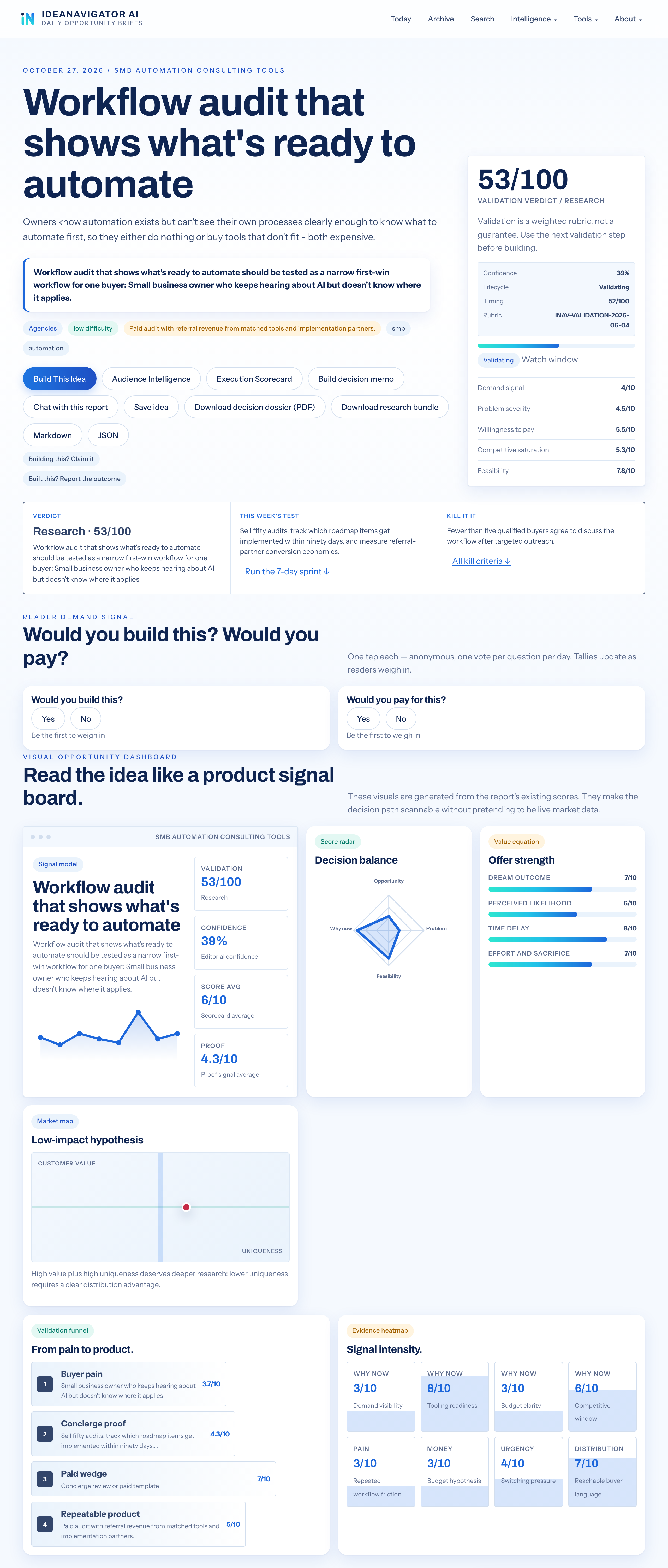
A proposed service would interview small-business owners, map their workflows and rank tasks by automation readiness, potential return and difficulty. Its commercial case remains unproven; the suggested test is to sell 50 audits and track implementation and referral results over 90 days.
IdeaNavigator AI has proposed a paid workflow-audit service intended to help small-business owners decide which tasks, if any, are ready for automation. According to the company’s proposal, the concept would map business processes, score potential projects and provide a sequenced 90-day roadmap; its demand and effectiveness have not yet been demonstrated.
According to IdeaNavigator AI’s proposal, the service would use a guided interview to ask an owner how the business operates. It would turn the answers into a process map and assess candidate tasks by automation readiness, return on investment and difficulty. The proposed output would include recommended next steps and tool suggestions matched to each step.
IdeaNavigator AI identifies the intended customer as an owner who hears about AI and automation but cannot identify where the technology fits in their own operations. The proposal frames two risks: doing nothing because the choices feel unclear, or buying software that does not suit the business. It provides no data on how common either outcome is or how much money businesses lose as a result.
The proposed business model combines a paid audit with referral revenue from recommended software tools and implementation partners. IdeaNavigator AI proposes validating the idea by selling 50 audits, then recording which recommendations are implemented within 90 days and measuring conversion economics for referral partners. The proposal reports no sales, implementation or revenue results.
A Path From AI Interest to Action
For owners with limited time and budgets, choosing what not to automate can matter as much as finding a promising tool. A process map and ranked list could make an unfamiliar technology decision more concrete by connecting recommendations to specific work, rather than presenting a catalogue of software. That is the potential value described in IdeaNavigator AI’s proposal, not an outcome established by evidence so far.
The approach also highlights a commercial question for the wider small-business automation market: whether customers will pay for guidance before buying implementation tools. If owners follow the roadmap, audits could help direct spending toward practical projects. If they do not, the service may identify interest without resolving barriers such as cost, staff capacity, data quality or integration needs.
Referral income introduces another consideration. Tool recommendations may generate revenue for the service, so customers would need clear information about how those recommendations are selected and whether paid partnerships affect them. IdeaNavigator AI’s proposal does not specify disclosure practices, scoring criteria or safeguards against recommending a tool because it pays a referral fee.
Products Worth Considering

LG UltraGear 27-Inch QHD OLED Gaming Monitor, 240Hz, 0.03ms, G-SYNC Compatible, FreeSync Premium Pro, HDMI 2.1

LG UltraGear 32GX850A-B 32-Inch 4K UHD Glossy OLED Gaming Monitor

DJI Osmo Mobile 8 Phone Gimbal with Mic Mini Transmitter, Infinity Black
As an affiliate, we earn on qualifying purchases.
Why Process Mapping Is Proposed
IdeaNavigator AI frames its proposal around the rapid expansion of AI tools and the resulting difficulty some business owners face in deciding what to use. Its premise is that owners may know automation is available while lacking a clear picture of their own recurring processes. The company offers this as the rationale for an interview-led audit; it provides no independent research or customer survey findings to support the premise.
IdeaNavigator AI also argues that large language models may make structured process-mapping interviews easier to automate. The proposed product would use that capability to gather operational details and produce a scored map and roadmap. The proposal identifies no specific model, technical design, accuracy test or human-review process, so the degree of automation and reliability remains unspecified.
The company presents the concept as an early-stage opportunity, not as an established service with a track record. Its proposed 50-audit test is a validation plan, and the 90-day implementation window is a measurement period for that test—not a reported result or guarantee that customers will complete recommended projects.
Demand and Results Remain Untested
IdeaNavigator AI’s proposal provides no evidence of completed trials. It is unknown whether small-business owners will pay for an audit, how many recommendations they will implement, or whether implementation will produce measurable savings or other returns. The proposed 50-customer test could provide early information, but the plan does not set out a comparison group or define how ROI would be calculated.
The proposal also omits operational details. It does not explain how interview answers would be checked, how sensitive business information would be handled, or how the service would account for differences across industries and company sizes. It also does not say whether recommendations would be reviewed by a human consultant before delivery.
The referral model’s economics are similarly unsettled. IdeaNavigator AI reports no partner agreements, fee rates, customer acquisition costs or conversion figures. Without those details, it is not possible to assess whether referral revenue could support the service or whether incentives might influence the advice.
The 50-Audit Test
IdeaNavigator AI identifies the next step as selling 50 audits and following the recommendations for 90 days. The proposed measures are which roadmap items customers implement and how referral partners convert those recommendations into business. The company says those results would help test both customer follow-through and the commercial model.
IdeaNavigator AI has announced no timeline for the test, product launch, pricing or publication of findings. Until those details or results are available, the audit should be understood as a proposed service rather than a proven way to improve automation decisions. The 90-day follow-up, if conducted, would be the first described check on whether owners act on the recommendations.
Source: IdeaNavigator AI proposal
Key Questions
What is the proposed workflow audit?
According to IdeaNavigator AI’s proposal, it is a service that would interview a small-business owner, map business processes and rank possible automation projects by readiness, potential ROI and difficulty.
Who is the audit intended to help?
IdeaNavigator AI says it is aimed at small-business owners who are interested in AI but are unsure which tasks in their operations might suit automation.
How would the service make money?
The proposal combines fees for paid audits with referral revenue from software tools and implementation partners. IdeaNavigator AI provides no pricing or referral rates.
Has the service shown that its recommendations work?
No results are reported in IdeaNavigator AI’s proposal. The proposed validation test is to sell 50 audits and track implementation of roadmap recommendations over 90 days.
Source: IdeaNavigator AI