
📊 Full opportunity report: Inside An IEP Negotiation Rehearsal Simulator For Parents on IdeaNavigator AI — validation score, market gap, and execution plan.

Get the latest gadgets delivered free — and shop member deals
- Fast, free delivery on millions of items
- Access to Prime Big Deal Days deals on October 6–7
- Prime Video, Amazon Music and more included
TL;DR
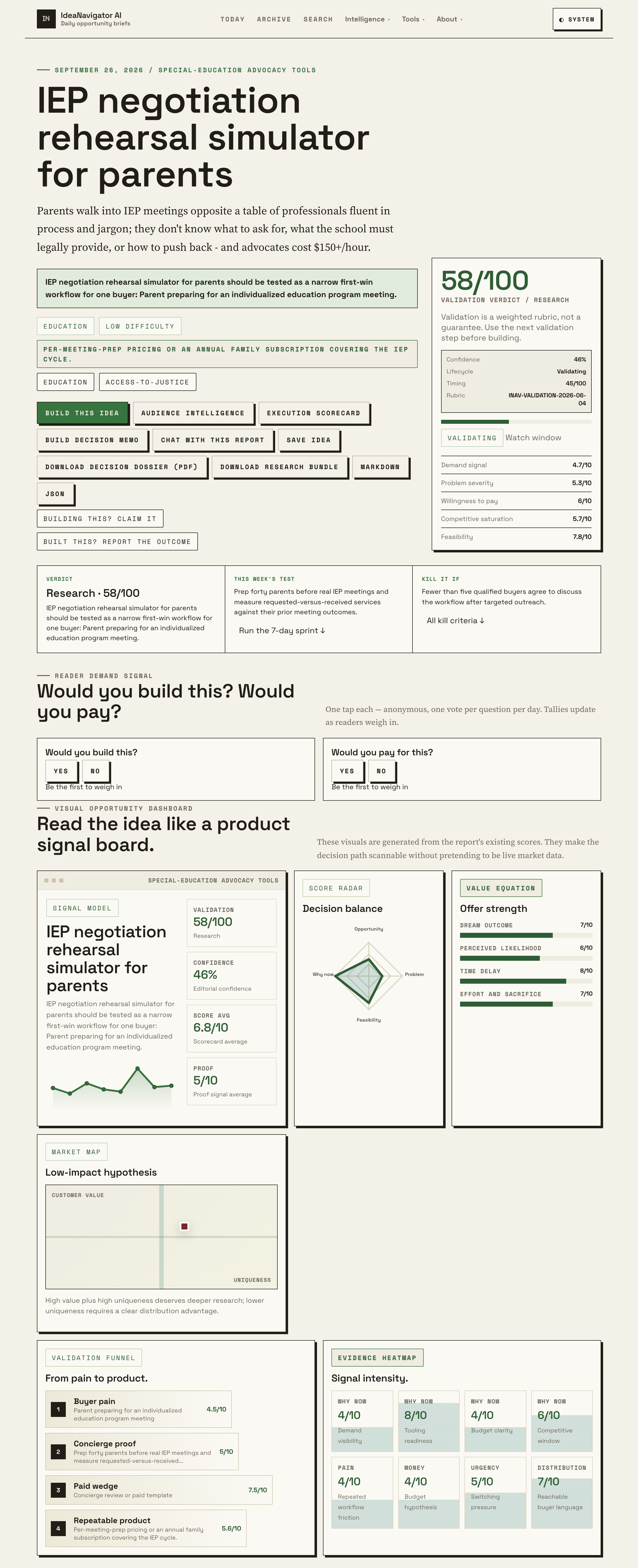
IdeaNavigator AI has outlined an IEP meeting preparation simulator for parents, with document review, plain-language explanations and role-play practice. The proposal is an early product concept: its effectiveness, legal accuracy, pricing and impact on services have not been established.
IdeaNavigator AI has proposed an IEP negotiation rehearsal simulator to help parents prepare for meetings about their child’s special education services. The concept would let families review existing education documents, develop requests and practice responding to school representatives, but no product launch, trial results or evidence of effectiveness has been reported.
The proposed tool is aimed at a specific moment: when a parent is preparing for an individualized education program (IEP) meeting. The concept would allow parents to upload a current IEP and evaluation reports. It would then explain relevant information in plain language, generate a list of possible requests with legal grounding and simulate a meeting that includes realistic pushback.
IdeaNavigator AI frames the problem as an imbalance between parents and school professionals who may be more familiar with meeting procedures and special education terminology. It also points to the cost of hiring an advocate, stating that advocacy can cost $150 or more per hour. That figure is presented as part of the proposal; no geographic range, pricing survey or supporting data is provided.
The proposed business models are per-meeting preparation fees or an annual family subscription covering an IEP cycle. To test demand and outcomes, IdeaNavigator AI suggests preparing 40 parents before real meetings and comparing services requested with services received against each family’s prior meeting outcomes. No parents have been reported as enrolled, and no findings from such a test are available.
Preparing Parents for IEP Meetings
If developed and shown to work, the simulator could give parents a lower-cost way to organize questions and rehearse difficult conversations before meeting with a school team. A written request list and practice responding to objections may help families enter discussions with a clearer understanding of their priorities.
The practical stakes are the services discussed for an individual child. Still, preparation does not guarantee that a school will agree to a request, and the proposal does not establish that using a simulator would change services or improve outcomes. Its value would depend on whether its explanations are accurate, whether parents can use it effectively and whether real meeting results improve.
A Concept in Special Education Advocacy
The proposal sits within the broader field of special education advocacy, where families seek to understand evaluations, educational plans and available supports. Its suggested workflow brings document review and meeting practice together in one tool, focused on preparation for a particular IEP meeting rather than general education advice.
IdeaNavigator AI says the timing may be favorable because large language models can now support role-play, while special education identification rates are rising and district resources are tightening. The proposal supplies no dates, statistics or independent evidence for those claims, so they remain the idea’s stated rationale rather than established findings in this report.
Accuracy and Results Remain Unknown
No working product or evaluation results are described. It is unclear how the simulator would determine which legal rules apply to a family, keep information current across jurisdictions or handle gaps and errors in uploaded records. The proposal also does not explain how sensitive student documents would be stored, protected or deleted.
The suggested comparison with families’ prior meetings would need to account for differences in children’s needs, school districts and meeting circumstances. Without a defined study design or reported results, it is not possible to tell whether any change in services would be caused by simulator preparation. Pricing, accessibility, and whether advocates or educators would review the tool’s guidance are also unspecified.
A Forty-Parent Trial Proposed
The next step outlined by IdeaNavigator AI is to prepare 40 parents ahead of actual IEP meetings and compare the services requested and received with each parent’s prior meeting outcomes. The proposal does not give a timeline, say who would run the trial or describe how outcomes would be verified.
Until a test is conducted and its methods and results are made public, the simulator remains a product concept rather than a proven advocacy service. Any future assessment would need to clarify the tool’s legal review, privacy protections, costs and effect on families’ meeting experiences.
Source: IdeaNavigator AI
Key Questions
Has the IEP rehearsal simulator launched?
No launch is reported. IdeaNavigator AI describes a proposed product and a possible way to test it.
What would the proposed simulator do?
It would let parents upload an IEP and evaluation reports, receive plain-language explanations and a request list, then practice a simulated meeting with school representatives.
Has it been shown to improve services for students?
No results are available. The proposal suggests a 40-parent trial but does not report that one has taken place.
How much would it cost?
Pricing has not been set. The proposal mentions per-meeting fees or an annual family subscription as possible business models.
Source: IdeaNavigator AI
Fall Picks
fall essentials
As an affiliate, we earn on qualifying purchases.