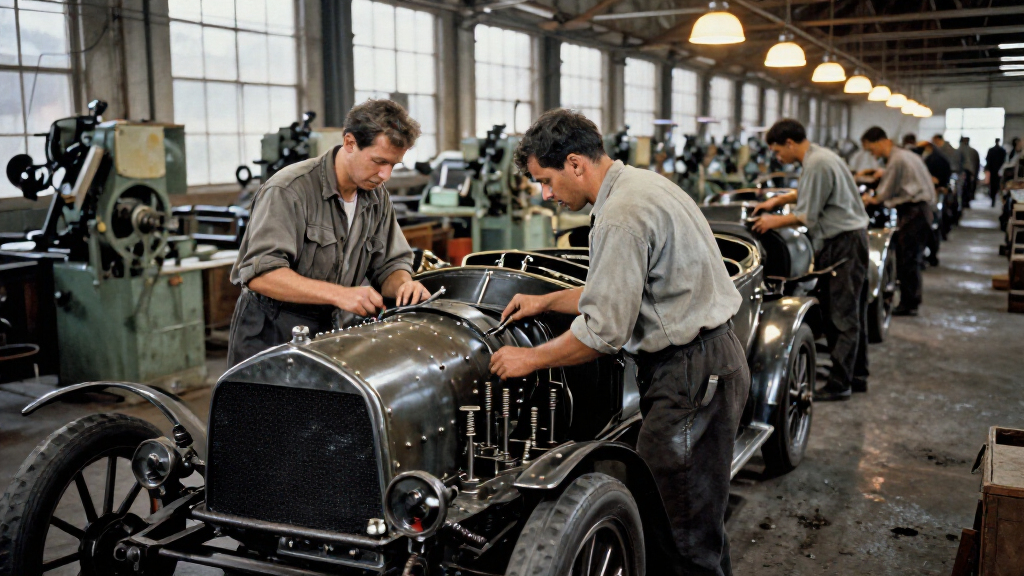

🔍 Read the full analysis: The Wage Policy Behind The Assembly Line’s Five-Dollar Day on ThorstenMeyerAI.com

Get the latest gadgets delivered free with Prime
- Fast, free delivery on millions of items
- Prime Video, Amazon Music and more included
- Member-only deals all year
TL;DR
Ford introduced a five-dollar minimum daily wage and an eight-hour day on Jan. 5, 1914, after high worker turnover disrupted production at its Detroit plant. The policy followed rapid assembly-line changes that cut labor time per Model T chassis, but the source account says the wage increase was aimed chiefly at retaining workers, not enabling them to buy Ford cars.
A historical account published Nov. 6, 2026, says Ford Motor Co.’s much-publicized five-dollar day was introduced in January 1914 largely to address workers leaving its Detroit factory at a rate that disrupted production. The policy paired a higher minimum daily wage with a shorter workday as the company adjusted to the demands of its moving assembly line.
Ford announced the policy on Jan. 5, 1914, cutting the workday from nine hours to eight and raising minimum daily pay from $2.34 to $5, according to the account. The payment was structured as profit sharing and came with strict conditions; the source material does not detail all of those requirements. The change followed a year in which Ford’s hiring figures pointed to substantial workforce instability.
In 1913, Ford hired 50,448 people to maintain an average workforce of 13,623, figures cited from a 1987 study by economists Daniel Raff and Lawrence Summers. The account describes this as 370% turnover. Ford’s own later recollection put hiring at about 53,000 annually to maintain a workforce of 14,000; the Henry Ford museum gives an estimate of about 380%. These are not identical figures, and the account attributes them to different records.
At the same time, production methods were changing quickly. Ford’s figures, published in his 1922 book My Life and Work, put the labor required to assemble a Model T chassis at 12 hours and 28 minutes before the moving line and one hour and 33 minutes by early 1914. That is a company account of production performance, not an independently established measurement in the material provided. The account says turnover fell to 54% in 1914, though it gives no detailed breakdown of how that rate was calculated.
Why Ford Changed the Pay Deal
The episode links a famous wage policy to a practical production problem: the assembly line required a stable workforce, but employees were leaving faster than Ford could comfortably replace them. Faster production did not automatically translate into a smoothly staffed factory. High absences and frequent departures meant the company had to recruit and train workers while trying to keep its manufacturing system running.
The change also matters because the five-dollar day is often explained as a way for Ford workers to afford the cars they built. The account challenges that familiar explanation, arguing that retaining workers was the immediate business concern. It reports that Ford had about 14,000 workers and produced about 250,000 cars a year around 1914, and frames the company’s problem as workforce turnover rather than a shortage of customers. That interpretation is grounded in the figures cited, but it does not establish that affordability played no role in Ford’s broader thinking.
Ford’s move illustrates a tension that persists in industrial work: productivity gains can intensify or reorganize jobs, while employers still depend on people willing to do them. The account also notes that U.S. factory employment grew by about a third between 1910 and 1920, suggesting that mechanized production did not immediately mean fewer factory jobs overall. The source gives no underlying dataset or detailed definition for that national comparison, so it should be read as a broad historical estimate.
Products Worth Considering

Kindle Paperwhite Signature Edition 32GB (2024) – Auto-adjusting front light, wireless charging, weeks of battery life – Metallic Black

Kindle Paperwhite 16GB (2024) – 7 Glare-Free Display, Weeks Battery Life – Black

Apple iPad mini (A17 Pro), 128GB, Wi-Fi 6E, Space Gray
As an affiliate, we earn on qualifying purchases.
From Stationary Cars to Moving Lines
Before Ford’s line experiments, workers assembled a car around a chassis that remained in one place, bringing components to it. The source says the company’s best average for this method was 12 hours and 28 minutes of labor per chassis. Ford had already made the Model T comparatively affordable for its era: the account lists a $950 price for the touring car in the 1909–10 model year, when the company built 18,664 cars.
Ford wrote that the company first tried an assembly line for the flywheel magneto around April 1, 1913. The small component moved past workers, with its assembly divided into separate operations. In Ford’s account, the task was split into 29 operations and the time fell from about 20 minutes per magneto to 13 minutes and 10 seconds, then to seven and later five minutes as the process was revised. Ford said the general inspiration came from overhead rails used in Chicago meatpacking plants.
The method was then applied to the chassis. In an early trial, a rope and windlass pulled a chassis along a 250-foot line while workers moved with it. Ford’s account put the labor time at five hours and 50 minutes in that experiment, before further changes brought it to one hour and 33 minutes by early 1914. Ford described the aim as reducing the worker’s required thought and movements. Those figures come from the company’s account, published in 1922 with journalist Samuel Crowther, and should be understood as Ford’s own description of the process.
Limits of the Historical Record
The account relies in part on Ford’s own 1922 description of production methods. While it presents detailed times for assembly work, the material provided does not include independent verification of each figure. The turnover estimates also vary: the account cites 370% from a study drawing on earlier records, about 380% from the Henry Ford museum, and Ford’s recollection of hiring roughly 53,000 people for a workforce of 14,000.
It is also unclear from the supplied material how the 54% turnover figure for 1914 was calculated or how much of the decline can be attributed specifically to higher pay, the shorter workday, or other changes. The five-dollar payment had conditions, but their full terms and how many workers qualified are not set out. The account argues that worker retention, rather than enabling car purchases, was the central motive; the evidence presented does not rule out other business or social motives.
What the Account Tracks Next
The source is part of “Work After Work,” Episode 5, a series about how the economy is built. It connects the 1914 policy to the longer history of industrial labor and says assembly lines remain in use, with more production tasks now handled by robots. It does not provide a specific next publication date or a new announcement about Ford.
For the historical question, further clarity would require examining the original company records and the methods behind the turnover estimates, alongside the conditions attached to the profit-sharing plan. The material here establishes the timing of Ford’s wage announcement and gives the reasons its author emphasizes; it does not settle every question about the policy’s effects or motives.
Key Questions
When did Ford introduce the five-dollar day?
Ford introduced the policy on Jan. 5, 1914, according to the source account. It raised minimum daily pay from $2.34 to $5 and cut the workday from nine hours to eight.
Why did Ford raise wages?
The account says Ford was responding chiefly to high worker turnover, which made it difficult to keep the factory staffed. It cites more than 50,000 hires in 1913 to maintain an average workforce of about 13,600.
Did Ford workers receive five dollars without conditions?
No. The source describes the payment as profit sharing with strict conditions, but the supplied material does not list all eligibility rules or explain how many workers received the full amount.
How much did the assembly line reduce chassis labor time?
Ford’s own figures, as reported in the account, put labor time at 12 hours and 28 minutes per chassis before the moving line and one hour and 33 minutes by early 1914. Those figures come from Ford’s account rather than independent verification provided here.
Was the wage increase meant to help workers buy Ford cars?
The account says that explanation is a popular legend and argues that Ford’s immediate concern was keeping workers from leaving. The material supports the retention explanation but does not establish that car affordability had no place in Ford’s broader motives.
Source: ThorstenMeyerAI.com