
TL;DR

Get the latest gadgets delivered free — and shop member deals
- Fast, free delivery on millions of items
- Access to Prime Big Deal Days deals on October 6–7
- Prime Video, Amazon Music and more included
A hobbyist has developed a DIY optical motion capture rig with 16 custom IR cameras, capable of processing 4 billion pixels per second. This setup aims to achieve Hollywood-level precision for V-tubing and motion tracking. The project is documented and available on GitHub.
A hobbyist has developed a DIY optical motion capture system that processes four billion pixels per second using 16 custom IR cameras, aiming to achieve Hollywood-level tracking precision for V-tubing applications.
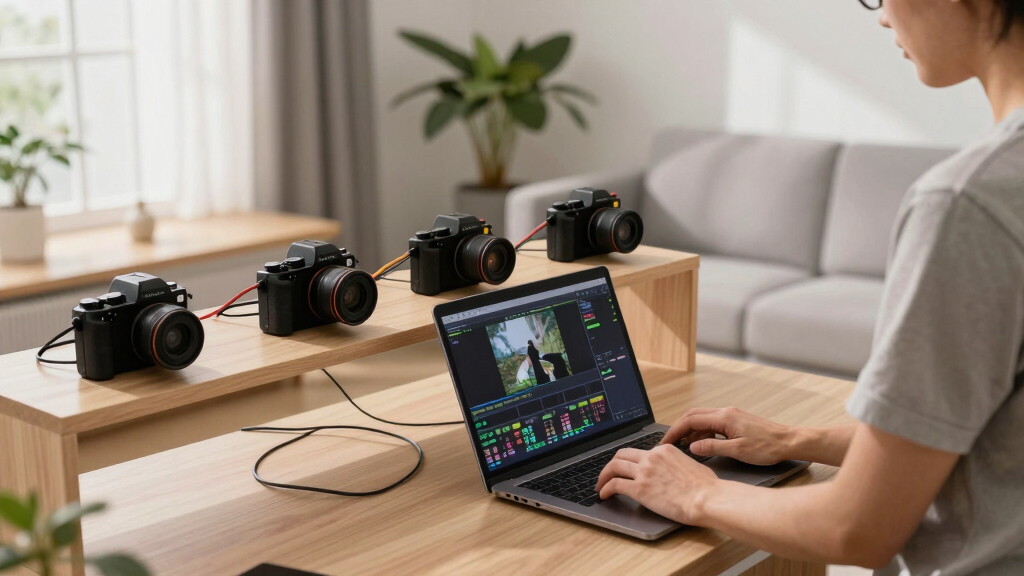
The project involves 16 infrared cameras built around AR0234 MIPI sensors, each equipped with M12 lenses and IR filters, connected to Raspberry Pi compute modules. These cameras are synchronized via a pulse-per-second signal to capture high-speed motion with sub-millimeter accuracy. Each camera is paired with a high-power near-IR LED ring light, pulsed at 160 W, to maximize signal quality while managing power consumption.
The maker, known on YouTube as “Made By Dennis,” used custom hardware and software solutions to process the massive data throughput, achieving a 300-fold speed increase over standard OpenCV methods. The entire setup is designed to track markers with extreme precision, suitable for professional motion capture in V-tubing and animation. The project files, including the software, are publicly available on GitHub, emphasizing its open-source nature.
Implications for High-Precision V-Tubing and MoCap
This development demonstrates that DIY solutions can approach professional-grade optical motion capture, potentially lowering costs and increasing accessibility for creators and researchers. Processing four billion pixels per second allows for highly detailed motion tracking, which can improve the realism and responsiveness of virtual avatars. The project also showcases advances in custom hardware integration and software optimization, highlighting the potential for hobbyists to contribute to high-end motion capture technology.
As an affiliate, we earn on qualifying purchases.
Background of DIY Optical Motion Capture Projects
Optical motion capture has traditionally been confined to Hollywood studios and professional labs due to its high cost and complexity. Recent years have seen efforts to democratize the technology, often through cheaper IMU sensors or simplified camera rigs. However, achieving Hollywood-level precision remains challenging outside professional environments. This project builds on previous DIY MoCap efforts, pushing the boundary by processing unprecedented amounts of pixel data with custom hardware and software, inspired by the needs of V-tubers and digital content creators.
“Processing four billion pixels per second is a significant milestone for DIY optical MoCap systems, bringing professional-grade accuracy within reach of hobbyists.”
— an anonymous researcher
As an affiliate, we earn on qualifying purchases.
Uncertainties in System Scalability and Practical Use
It remains unclear how scalable or practical this system is for everyday use, including setup complexity, cost, and real-time performance in different environments. The project is still in the experimental stage, and integration into commercial or live V-tubing workflows has not yet been demonstrated.
high-speed IR camera Raspberry Pi
As an affiliate, we earn on qualifying purchases.
As an affiliate, we earn on qualifying purchases.
Next Steps for Validation and Broader Adoption
The creator plans to refine the system for easier setup and real-time operation, potentially collaborating with other developers to improve software and hardware integration. Field testing in actual V-tubing scenarios is expected to be the next milestone, along with exploring cost reductions and further automation for broader accessibility.
infrared LED ring light for cameras
As an affiliate, we earn on qualifying purchases.
As an affiliate, we earn on qualifying purchases.
Key Questions
Can this system be used for real-time V-tubing?
While the project demonstrates high-speed data processing, real-time V-tubing applications require further optimization for latency and robustness, which are still in development stages.
How much does the hardware setup cost?
The project uses custom-built IR cameras, Raspberry Pi compute modules, and high-power IR LEDs, which can be assembled for a few thousand dollars, depending on parts sourcing and scale.
Is this system suitable for amateur or small-scale creators?
Currently, the setup requires technical expertise and custom hardware, making it more suitable for experienced hobbyists or researchers rather than casual users. Future simplifications could change this.
Will this technology be available commercially?
There is no indication of commercial plans; the project remains open-source, serving as a proof of concept and a resource for the community.
What are the safety considerations with high-power IR LEDs?
High-power IR LEDs pose safety risks; users should wear appropriate eye protection and ensure proper handling to avoid exposure to intense near-IR light.
Source: Hackaday
Evergreen bestsellers Picks
bestsellers
As an affiliate, we earn on qualifying purchases.