
TL;DR

Get the latest gadgets delivered free — and shop member deals
- Fast, free delivery on millions of items
- Access to Prime Big Deal Days deals on October 6–7
- Prime Video, Amazon Music and more included
UCSD is building a 2,000-phone computing cluster from retired smartphones to create a low-carbon cloud platform. This initiative aims to reduce hardware manufacturing emissions and support research and education.
Researchers at the University of California San Diego, with support from Google, are planning to deploy a 2,000-phone computing cluster built from recycled smartphones to provide low-carbon cloud computing resources for research and education.
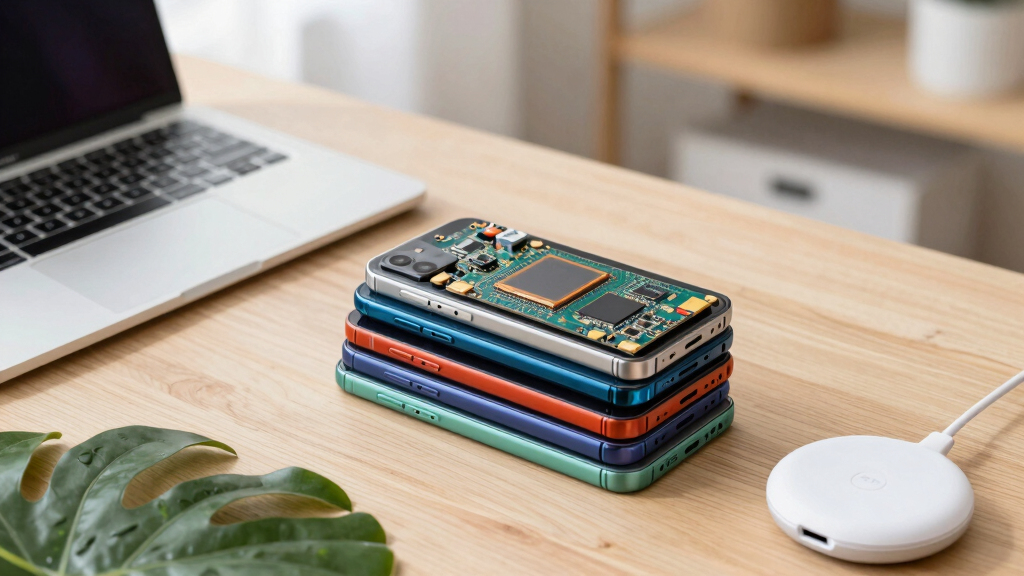
The project involves extracting motherboards from retired smartphones, primarily Pixel devices, and reconfiguring them into a cluster managed by Kubernetes to support various cloud applications. Early experiments with smaller clusters indicate that 20 phones can handle typical academic workloads, with a full 2,000-phone deployment expected to support hundreds of classes simultaneously. This approach aims to significantly lower the environmental footprint of computing by reusing existing hardware and avoiding new manufacturing emissions.
The initiative focuses on repurposing the core computing components of phones, removing non-essential parts like batteries and displays, and replacing the Android OS with a Linux distribution suitable for cloud workloads. The project also aims to evaluate the reliability of consumer-grade hardware under sustained use, providing insights into the feasibility of large-scale smartphone clustering for low-carbon computing.
Potential Impact on Sustainable Computing
This project could revolutionize how data centers are built and operated by demonstrating that retired consumer devices can be repurposed effectively, reducing the environmental impact of hardware manufacturing. It offers a scalable, low-cost alternative for academic institutions and research organizations seeking sustainable cloud solutions. If successful, it may influence broader industry practices towards circular hardware use and lower carbon emissions in data infrastructure.
recycled smartphones for cloud computing
As an affiliate, we earn on qualifying purchases.
As an affiliate, we earn on qualifying purchases.
Background on Smartphone Recycling and Cloud Computing
The environmental impact of data centers is driven by both operational energy use and embodied carbon from hardware manufacturing. While efforts have focused on energy efficiency, the carbon footprint of producing new servers remains significant. Smartphones, which are replaced roughly every four years, retain substantial computing power even after their initial use, making them candidates for secondary applications. Prior research has shown that modern smartphones’ single-thread performance can rival that of some servers, but integrating them into a data center requires significant hardware and software adaptation.
Previous initiatives have explored repurposing consumer electronics for various uses, but deploying large-scale clusters from retired phones remains a novel approach. This project builds on these ideas, aiming to demonstrate practical deployment at scale and assess the longevity and reliability of consumer-grade hardware in continuous operation.
“Repurposing retired smartphones into a large-scale computing cluster could significantly reduce the environmental footprint of cloud infrastructure.”
— UCSD researcher involved in the project
smartphone motherboard repair tools
As an affiliate, we earn on qualifying purchases.
As an affiliate, we earn on qualifying purchases.
Uncertainties About Hardware Reliability and Scalability
It remains unclear how consumer-grade smartphones will perform over extended periods under continuous load, and whether large-scale deployment will face unforeseen technical challenges. The project’s success depends on the durability of the hardware and the efficiency of managing clusters of devices with variable conditions.
As an affiliate, we earn on qualifying purchases.
Next Steps Toward Full Deployment and Evaluation
The project aims to complete the full deployment of the 2,000-phone cluster by Fall 2026. Following deployment, researchers will monitor system reliability, energy consumption, and performance metrics. Results will inform potential scaling and broader adoption of smartphone-based data centers, as well as further research into low-carbon computing solutions.
Kubernetes cluster management tools
As an affiliate, we earn on qualifying purchases.
As an affiliate, we earn on qualifying purchases.
Key Questions
How will the phones be repurposed for cloud computing?
The phones’ motherboards will be extracted, cleaned, and configured with Linux, replacing the original Android OS. They will then be organized into clusters managed by Kubernetes for distributed computing tasks.
What are the environmental benefits of this approach?
The main benefit is reducing the need for manufacturing new hardware, which accounts for a significant portion of the carbon footprint in data centers. Reusing existing smartphones also extends their lifespan and minimizes electronic waste.
Are there limitations to using retired phones for cloud computing?
Yes, concerns include hardware durability, potential performance degradation over time, and managing hardware heterogeneity. These factors are being evaluated through ongoing experiments.
Will this approach be scalable beyond research and education?
While promising, scalability depends on hardware reliability and software management. If successful, it could inform broader applications for sustainable cloud infrastructure.
Source: Hacker News
Fall Picks
fall essentials
As an affiliate, we earn on qualifying purchases.