
🔍 Read the full analysis: Which Of These 9 External GPUs Could Work For AI In 2027? on ThorstenMeyerAI.com

Get the latest gadgets delivered free with Prime
- Fast, free delivery on millions of items
- Prime Video, Amazon Music and more included
- Member-only deals all year
TL;DR
ThorstenMeyerAI.com compares nine external GPU options by connection bandwidth, portability, power and cooling, naming the Razer Core X V2 and Plugable Thunderbolt 5 enclosure as leading choices. The material provides no independent benchmark results or evidence that all nine models will be available or suitable for AI workloads in 2027.
ThorstenMeyerAI.com has compared nine external GPU (eGPU) options as potential tools for AI workloads in 2027, highlighting the Razer Core X V2 for broad compatibility and a Plugable Thunderbolt 5 enclosure for higher connection bandwidth. The article frames the choices as a tradeoff among speed, portability and upgradeability, but its supplied material does not include test results proving how the products perform on AI tasks or confirming their 2027 availability.
The comparison groups eGPUs into empty enclosures, which users pair with a separate graphics card, and integrated units with a fixed GPU. The source favors empty enclosures for the ability to replace or upgrade the card, while describing integrated designs such as the NIMO and BOSGAME units as simpler and more compact but less flexible. It does not provide a complete specification sheet or individual AI benchmark for each of the nine options.
Connection type is a central part of the article’s assessment. It says Thunderbolt 3 and 4 offer 40 Gbps, while Thunderbolt 5 and USB4 Version 2 are presented as supporting up to 80 Gbps. OCuLink is described as a direct PCIe 4.0 x4 connection, with a theoretical 64 Gbps, but it requires a compatible port. These are interface figures, not measured AI-processing speeds; actual performance also depends on the computer, GPU, workload and implementation.
The source also weighs power supply, cooling and laptop charging. It says some empty docks need a separate, bulky power supply, while other designs use smaller power arrangements. Its selection criteria include airflow and sustained operation, but no temperatures, noise readings or controlled comparisons are supplied. The article’s recommendation of the Core X V2 as a choice for most users and Plugable’s Thunderbolt 5 option for throughput should therefore be read as the source’s editorial judgments, not independent test findings.
The 9 picks
- 1
 BOSGAME eGPU Graphic Card Dock Expansion Card with Radeon RX 7600M XT 8GB GDD…View on Amazon →
 - 2
 NIMO External GPU Docking Station with AMD Radeon RX 7600M XT 8GB GDDR6View on Amazon →
 - 3
 Plugable Thunderbolt 5 AI eGPU Enclosure & Dock: 80Gbps, TAA CompliantView on Amazon →
 - 4
 Razer Core X V2 External Graphics Enclosure (eGPU)View on Amazon →
 - 5
 MINISFORUM DEG2 USB4 V2 (TBT5 Compatible) & OCuLink eGPU Dock, 80Gbps Dual-Li…View on Amazon →
 - 6
 MINISFORUM DEG1 eGPU Dock – External GPU Docking Station for RTX 4090 & AMD R…View on Amazon →
 - 7
 OwlTree Graphics Card eGPU Dock for Thunderbolt 3/4 USB 4, with 60cm CableView on Amazon →
 - 8
 OCuLink eGPU Dock – PCIe 4.0 x4 (64 Gbps) ATX External GPU EnclosureView on Amazon →
 - 9
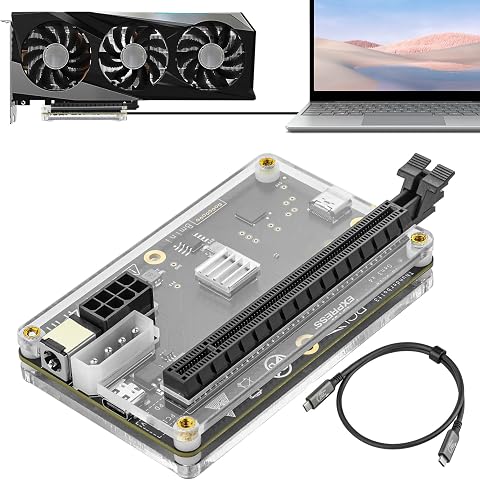 PCIe 3.0 x16 22Gbps eGPU Dock with Thunderbolt 4 Cable (compatible NVIDIA/AMD…View on Amazon →
Bandwidth Shapes AI Workloads
For readers considering local AI work on a laptop, an eGPU may offer access to a more powerful desktop-class graphics card without replacing the whole computer. The practical benefit depends on more than the GPU’s advertised specifications: connection bandwidth, system compatibility and power delivery can limit the setup, while cooling affects sustained operation. An enclosure that can accept a new card may also spread the cost of upgrades over time.
However, the source does not establish that faster interface ratings translate into a particular improvement in AI model speed, memory capacity or supported workload size. Buyers should distinguish theoretical connection bandwidth from measured application performance and check whether their AI software supports the selected GPU and operating system.
How the Nine Options Differ
The source says it assessed the products by bandwidth potential, compatibility and thermal design, while also considering whether a unit is integrated or accepts a separate GPU. It presents Thunderbolt as convenient because it is widely used, and OCuLink as a higher-performance route where a compatible laptop port exists. These are general selection criteria rather than a full, independently documented product-testing method.
That distinction matters because an eGPU is not a standalone AI computer. It connects to a host system, and the setup still relies on the host’s operating system, drivers, ports and software. The article describes possible gains from newer interfaces compared with older ones, but it supplies no reproducible test data establishing results for specific AI models or workloads.
“The Razer Core X V2 is its “top recommendation for most users.””
— ThorstenMeyerAI.com
Availability and AI Results
The supplied source material does not name all nine products or provide a complete table of their specifications, prices or test conditions. It is also unclear which models will remain available in 2027, what they will cost, and whether the listed connection standards and power features will apply to every configuration.
No AI benchmarks, GPU memory measurements, software compatibility tests or sustained-load thermal readings are included. The source’s bandwidth figures describe connection standards, not guaranteed end-to-end throughput. Its claim that newer connections reduce bottlenecks for high-end cards is not paired with measurements, so the size of any improvement for AI use remains unverified.
Verify Models Before Buying
Readers should check the full product list and current manufacturer specifications before treating any option as a 2027 purchase recommendation. The key checks are host-port compatibility, GPU support, power requirements, cooling and return policies, along with the software and operating system required for the intended AI workload.
A useful follow-up would be a set of controlled tests using the same host computer, graphics card and AI tasks across the enclosures. Until such data and current availability are documented, the comparison is best used as a shortlist of factors and product leads rather than a verified ranking of AI performance.
Key Questions
Which eGPU does the source recommend for most users?
ThorstenMeyerAI.com names the Razer Core X V2 as its top recommendation for most users, citing reliability and compatibility. The supplied material does not include independent test results supporting that judgment.
Which option is presented as the high-bandwidth choice?
The source highlights the Plugable Thunderbolt 5 AI eGPU Enclosure for users seeking higher throughput. Its material does not provide measured AI performance for the enclosure.
Are integrated eGPUs upgradeable?
The source says integrated units, including the named NIMO and BOSGAME examples, have a fixed GPU and are less upgradeable than empty enclosures. Product-specific upgrade options should be confirmed with the manufacturer.
Does a higher bandwidth rating guarantee faster AI results?
No. Interface bandwidth is only one factor. GPU capability, memory, host compatibility, drivers and the AI workload also affect results, and the source provides no comparable AI benchmarks.
Are all nine options confirmed for purchase in 2027?
No such confirmation appears in the supplied material. Availability, pricing and final specifications for 2027 remain unclear and should be checked against current manufacturer information.
Source: ThorstenMeyerAI.com
Halloween Picks
halloween
As an affiliate, we earn on qualifying purchases.