📊 Full opportunity report: AI compliance brief generator for small clinics on IdeaNavigator AI — validation score, market gap, and execution plan.

Get the latest gadgets delivered free — and shop member deals
- Fast, free delivery on millions of items
- Access to Prime Big Deal Days deals on October 6–7
- Prime Video, Amazon Music and more included
TL;DR
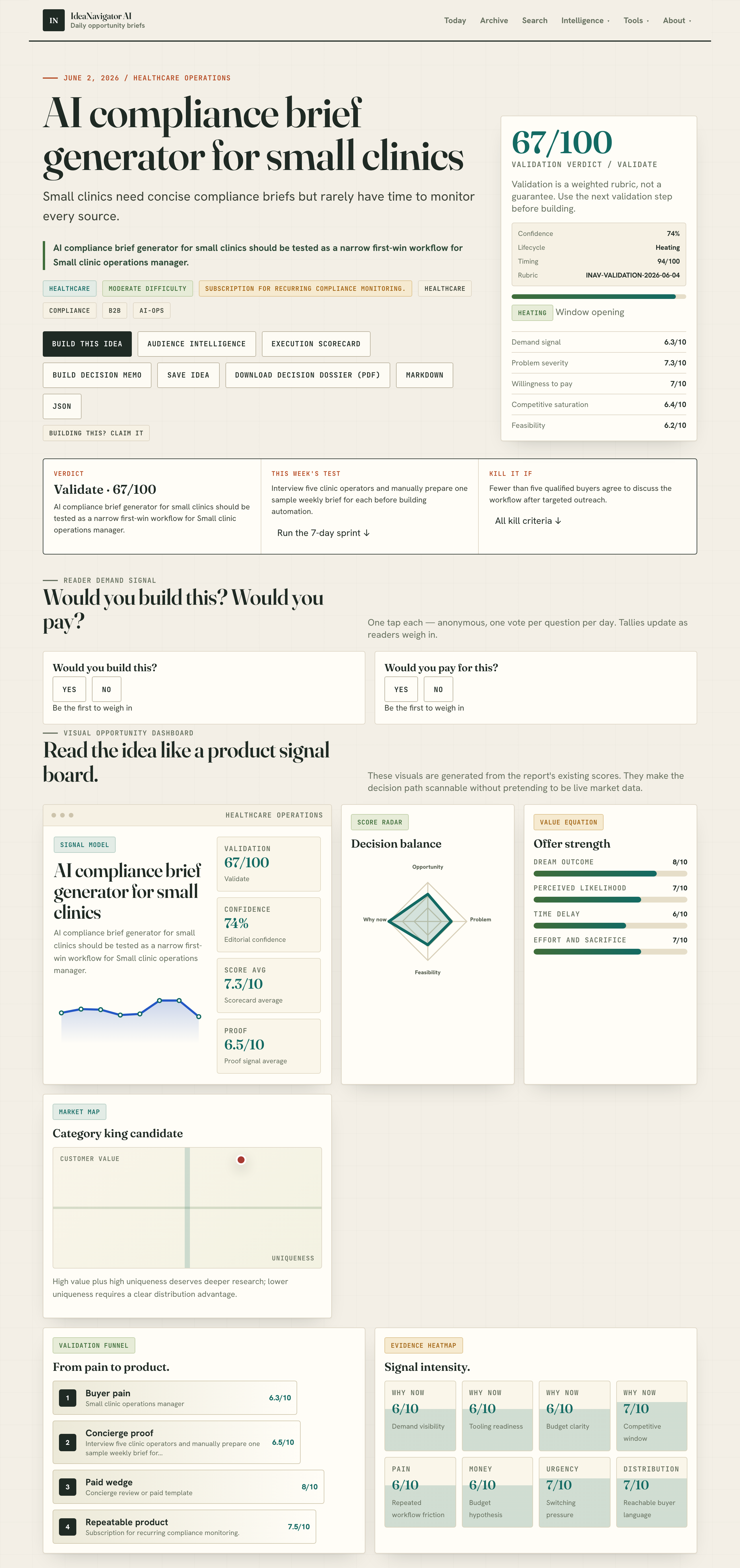
A new AI tool for small clinics is entering testing, aiming to automate weekly compliance briefs. This could simplify regulatory monitoring for busy healthcare providers. The project is in early validation stages with plans for subscription-based deployment.
IdeaNavigator AI is preparing to pilot an AI compliance brief generator tailored for small clinics, aiming to automate weekly regulatory summaries. The tool is designed to help clinic operations managers stay updated on compliance requirements without extensive manual effort, representing a targeted solution to a common operational challenge.
The AI compliance brief generator is intended as a narrow workflow tool for small clinics, focusing on delivering concise weekly summaries of regulatory updates with source links and action checklists. The initial phase involves validating the concept by interviewing five clinic operators and manually preparing sample briefs for each before automating the process. The project aims to offer a subscription-based service, providing recurring compliance monitoring tailored to the needs of small healthcare providers. This approach responds to the difficulty small clinics face in monitoring multiple sources and staying compliant amid frequent regulatory updates, leveraging advances in AI summarization technology.According to an anonymous researcher involved in the project, the goal is to create a simple, effective tool that integrates into existing clinic workflows. The MVP will feature a weekly brief, source links, and a review step for clinic owners, with plans to expand based on user feedback. The project is still in early validation, with no final product yet available for broader deployment.
Potential Impact on Small Clinic Compliance Management
This initiative could significantly ease the compliance burden for small clinics, which often lack dedicated regulatory staff. Automating weekly summaries may improve adherence to regulations, reduce legal risks, and save time. If successful, this targeted AI tool could become a standard part of small clinic operations, demonstrating how AI can streamline niche healthcare workflows and support regulatory compliance at a lower cost.
medical compliance management software
As an affiliate, we earn on qualifying purchases.
As an affiliate, we earn on qualifying purchases.
Growing Need for Automated Compliance Support in Healthcare
Small clinics face increasing regulatory demands but typically lack the resources for comprehensive monitoring. While larger healthcare organizations employ dedicated compliance teams, smaller providers often rely on manual research or generic tools. Recent advances in AI summarization and automation have opened possibilities for targeted operational tools. The idea of an AI-driven compliance brief generator aligns with broader trends toward automation in healthcare management, driven by the need for efficiency and accuracy amid rapidly changing regulations.
Previous efforts to automate compliance have focused on large institutions, leaving a gap for small clinics. The current project by IdeaNavigator AI aims to address this gap through a focused, easy-to-integrate solution, starting with validation through direct interviews and manual brief creation.
“The goal is to create a simple, effective weekly compliance summary that fits into small clinic workflows.”
— an anonymous researcher
clinic regulatory update subscription
As an affiliate, we earn on qualifying purchases.
As an affiliate, we earn on qualifying purchases.
Unconfirmed Aspects of the AI Brief Generator’s Deployment
It remains unclear how well the AI summarization will perform across diverse regulatory sources or how clinics will adopt and integrate the tool into their existing workflows. The success of the validation phase depends on user feedback, which is still being gathered. Additionally, the timeline for broader deployment and potential scalability has not yet been established.
healthcare compliance brief generator
As an affiliate, we earn on qualifying purchases.
As an affiliate, we earn on qualifying purchases.
Next Steps for Validation and Product Development
The project will proceed with interviews of clinic operators and manual brief creation to validate the concept. Following this, the development team plans to automate the process and conduct pilot testing with a small group of clinics. Success in these stages could lead to a broader rollout, with subscription plans and feature expansions based on user feedback. Further milestones include refining AI summarization accuracy and integrating feedback from early users.
AI compliance tool for small clinics
As an affiliate, we earn on qualifying purchases.
As an affiliate, we earn on qualifying purchases.
Key Questions
How will the AI compliance brief generator be tested?
It will be tested through interviews with five clinic operators, who will receive manually prepared weekly briefs to evaluate the AI’s effectiveness and usability.
What features will the initial MVP include?
The initial version will generate weekly compliance summaries with source links and a concise action checklist, reviewed by clinic owners before deployment.
When could the tool be available for broader use?
After successful validation and pilot testing, broader deployment could occur within the next several months, depending on feedback and development progress.
How will clinics pay for this service?
The project plans a subscription model for recurring compliance monitoring, tailored to small clinic budgets.
What regulatory sources will the AI summarize?
Specific sources are still being determined, but the tool aims to include relevant updates from healthcare regulators and industry standards.
Source: IdeaNavigator AI
Fall Picks
fall essentials
As an affiliate, we earn on qualifying purchases.