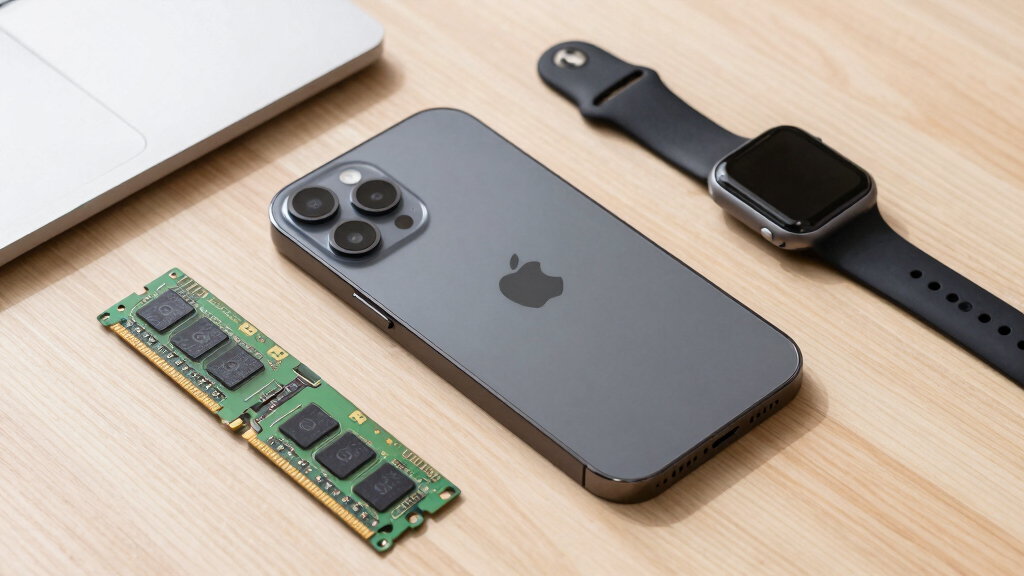

📊 Full opportunity report: Apple Is Reaching For Chinese Memory. Europe Doesn’t Even Have That Option. on ThorstenMeyerAI.com — validation score, market gap, and execution plan.

Get the latest gadgets delivered free — and shop member deals
- Fast, free delivery on millions of items
- Access to Prime Big Deal Days deals on October 6–7
- Prime Video, Amazon Music and more included
TL;DR
Apple is lobbying the U.S. government to purchase memory chips from China’s CXMT, highlighting its dependence on Chinese manufacturing. Europe has no similar options, revealing its vulnerability in the global chip supply chain.
Apple is lobbying Washington for permission to purchase memory chips from Chinese manufacturer CXMT, a move that underscores its dependence on Chinese supply amid ongoing shortages. This development is significant because it highlights the contrast with Europe, which has no comparable options or leverage in the global memory chip market. The move comes shortly after Apple raised prices on Macs and iPads, citing a global memory shortage, and signals a potential shift in supply chain strategies driven by geopolitical and market pressures.
According to sources, Apple’s lobbying efforts aim to secure access to memory chips from CXMT, a Chinese company on the Pentagon’s blacklist. This comes two days after Apple announced price hikes for its products, citing shortages in memory components as a key factor. The company’s ability to consider Chinese suppliers is facilitated by its lobbying influence and existing relationships in Washington, as well as its ability to turn to domestic suppliers like Micron.
In contrast, Europe faces a starkly different situation. The EU manufactures less than 10 percent of the world’s semiconductors by value and is almost entirely dependent on U.S. and Asian producers for memory chips, including DRAM and high-bandwidth memory (HBM). European companies have largely exited the memory market, leaving a gap that cannot be filled domestically or through existing policy tools. The EU’s chip manufacturing capacity remains limited, with flagship projects stalling and no immediate prospects for significant domestic production of advanced memory chips.
Apple is reaching for Chinese memory. Europe doesn’t even have that option.
The shortage exposes America’s dependence — and Europe’s far more brutally. Apple has a domestic supplier, political weight, and the China option. Europe has no memory of its own, no seat at the table, no leverage on what counts.
- EU makes < 10% of the world’s semiconductors
- Effectively no DRAM, no HBM from Europe
- 3–4 memory makers worldwide — none European
- Pure price-taker: memory ~4× in 3 quarters
- ASML: EUV monopoly — no leading-edge chip without it
- Zeiss: precision optics, unrivalled worldwide
- imec · CEA-Leti · Fraunhofer: world-class research
- Infineon, NXP, STMicro: automotive · power · SiC
The shortage is a sovereignty test — Europe fails on supply but still holds the leverage in its hand. If even Apple can’t buy its way out, Europe’s answer isn’t to buy its way in, but to run two tracks: press the unique chokepoints as real leverage — and cut dependence wherever it can without Brussels: local-first, open weights, quantization, right-sized hardware. Bury the 20% dream, defend what’s yours, need less.
Implications of Apple’s China Strategy for Europe’s Chip Independence
This development underscores Europe’s vulnerability in the global semiconductor supply chain. While Apple can leverage political influence and existing relationships to access Chinese memory chips, Europe lacks the capacity and strategic options to do the same. The reliance on external supply sources exposes European industries to geopolitical risks and market fluctuations, especially as global shortages and export controls intensify. The situation reveals the urgent need for Europe to build its own critical supply chain chokepoints, such as EUV lithography and other key manufacturing stages, to reduce dependence and enhance resilience.
As an affiliate, we earn on qualifying purchases.
Europe’s Semiconductor Industry and Supply Chain Challenges
Europe’s semiconductor manufacturing sector is significantly underdeveloped, producing less than 12 percent of the world’s chips by value, with even lower shares in memory. The number of European memory chip makers has dwindled from over twenty in the 1990s to just a handful today, with none involved in high-end DRAM or HBM production. The continent’s reliance on U.S. and Asian firms for memory components means prices have soared—quadrupling over recent quarters—without European influence over supply or costs.
Efforts like the EU Chips Act aim to increase Europe’s market share and build domestic capacity, but these initiatives face major hurdles. Flagship projects have stalled or collapsed, and the dense, complex supply ecosystems required for leading-edge fabrication are not easily subsidized into existence. Meanwhile, global demand for high-performance memory, especially for AI and hyperscale data centers, continues to outstrip supply, with much of the limited capacity already booked by U.S. and Chinese players.
“Europe remains heavily dependent on external suppliers for critical semiconductor components, especially memory.”
— European Commission official
High bandwidth memory (HBM) modules
As an affiliate, we earn on qualifying purchases.
As an affiliate, we earn on qualifying purchases.
Unclear Future of Europe’s Memory Manufacturing Plans
It remains uncertain whether Europe will accelerate its efforts to develop domestic memory manufacturing or secure alternative supply agreements. The scale of investment needed and the technical challenges involved suggest that significant progress may not be achievable within the next few years. Additionally, the impact of U.S.-China tensions and export controls on global supply chains adds further unpredictability to Europe’s strategic options.
As an affiliate, we earn on qualifying purchases.
Next Steps for Europe’s Semiconductor Strategy
Europe is likely to prioritize strengthening its existing chokepoints, such as ASML’s EUV lithography machines, and expanding capacities in related sectors. Policy initiatives like the Chips Act 2.0 will continue to push for faster permitting, increased funding, and public-private partnerships, but tangible breakthroughs in domestic memory production are not expected before 2030. Meanwhile, Apple’s move signals that companies may increasingly seek geopolitical flexibility, which could influence future European policy and industry strategies.
As an affiliate, we earn on qualifying purchases.
Key Questions
Why is Apple lobbying for Chinese memory chips?
Apple seeks access to Chinese memory chips to mitigate supply shortages and reduce costs, leveraging its influence in Washington to bypass restrictions on Chinese suppliers.
What does this mean for Europe’s chip industry?
Europe’s lack of domestic memory manufacturing capacity leaves it vulnerable to supply chain disruptions and geopolitical risks, highlighting the need for strategic investments and chokepoints.
Can Europe develop its own memory chip industry soon?
Current estimates suggest that building a competitive memory industry within Europe would require decades and hundreds of billions of euros, making it unlikely in the near term.
How do U.S. export controls affect Europe’s chip supply?
U.S. export controls, especially against China, restrict access to advanced manufacturing equipment and chips, complicating Europe’s efforts to develop independent supply chains.
What is Europe doing to improve its chip sovereignty?
Europe is investing in key infrastructure like EUV lithography, supporting research, and pushing policy initiatives such as the Chips Act, but significant progress remains challenging.
Source: ThorstenMeyerAI.com
Halloween Picks
halloween
As an affiliate, we earn on qualifying purchases.