
📊 Full opportunity report: Tracking Accuracy Improved: CORVUS ISR AI Cuts Switches By 42% on ThorstenMeyerAI.com — validation score, market gap, and execution plan.
TL;DR
CORVUS ISR has announced a new AI model that reduces identity switches by over 42% in synthetic benchmarks. The update improves tracking accuracy and maintains real-time performance, marking a significant advancement in wide-area motion imagery technology.
CORVUS ISR has introduced a new AI model that reduces object identity switches by approximately 42% in synthetic benchmarks, according to published results from its latest performance matrix. This improvement represents a significant step forward in the accuracy of wide-area motion imagery (WAMI) tracking technology, with potential implications for defense and surveillance applications.
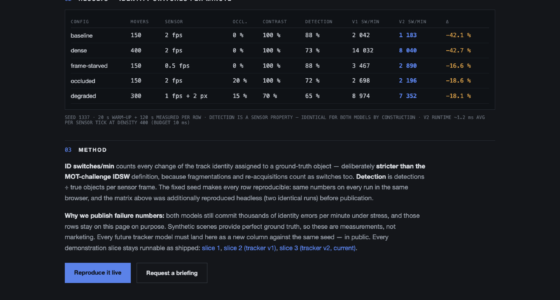
The benchmark, conducted using a synthetic scene with perfect ground truth, compares the performance of the existing ‘greedy nearest-neighbour’ model (v1) with the new ‘confirmed-track auction’ model (v2). The results show that, in a configuration with 150 moving objects tracked at 2 frames per second, the number of identity switches per minute dropped from 2,042 to 1,183, a 42.1% reduction. In a denser scenario with 400 objects, switches decreased from 14,032 to 8,040, a 42.7% decline.
Thorsten Meyer, who published the benchmark on his platform, emphasized that these gains were consistent across different stress conditions, including lower frame rates, occlusion, and degraded image contrast. For more details, see the original analysis. The benchmark’s strict metrics count every change in object identity, fragmentation, and re-acquisition, making the results a reliable indicator of tracking improvements. Both models maintained detection rates that are determined by sensor properties, which remained identical by design.
The new AI tracker, designed to operate in real time, averaged around 1.2 milliseconds per sensor tick, with some worst-case scenarios reaching 5 milliseconds, well within typical operational budgets. The model was independently reviewed and built under a formal acceptance contract, with the publication principle emphasizing transparency and measurement over marketing claims.
Implications of Reduced Identity Switches in WAMI Tracking
The 42% reduction in identity switches demonstrates a meaningful enhancement in tracking reliability, especially in dense, cluttered environments. This improvement can lead to more accurate object tracking in defense, surveillance, and intelligence operations, where maintaining correct object identities over time is critical. The open benchmarking approach also sets a new standard for transparency and reproducibility in tracking technology development, encouraging other vendors to publish comparable results.

OBSBOT Tiny SE 1080P 100FPS Webcam for PC, AI Tracking PTZ Streaming Camera with 1/2.8" Sensor, Gesture Control, Dual ISO, Staggered HDR, Web Camera for Desktop Computer, Laptop, Meeting, Video Calls.
【OBSBOT × EWC 2025 Official Partnership】 OBSBOT is proud to be an official camera & webcam partner of…
As an affiliate, we earn on qualifying purchases.
As an affiliate, we earn on qualifying purchases.
Advances in Synthetic Benchmarking for Tracking Accuracy
The benchmark uses a synthetic scene with perfect ground truth, allowing precise measurement of tracking performance without real-world noise or occlusion. The first version of CORVUS ISR’s tracker, based on simple greedy association, served as a baseline. The new v2 model introduces advanced features such as track confirmation, auction-based association, and velocity gating, which collectively improve tracking stability. The benchmark results build on prior efforts to quantify tracking accuracy and have been publicly available for validation since the initial release.
Previous iterations of CORVUS ISR focused on establishing a performance floor, with the latest update marking a significant step toward operational deployment in complex scenarios. The synthetic scene’s reproducibility and strict metrics help ensure that these improvements are measurable and comparable across future versions.
“The new AI model achieves over 42% fewer identity switches in synthetic benchmarks, representing a major advance in tracking accuracy.”
— Thorsten Meyer

ANNKE 3K Lite Wired Security Camera System Outdoor with AI Human/Vehicle Detection, 8CH H.265+ DVR and 8 x 1920TVL 2MP IP67 Home CCTV Cameras with Smart Dual Light, Color Night Vision, 1TB Hard Drive
AI Motion Detection 2.0 – Driving AI to the next level, human&vehicle detection and flexible detection area are…
As an affiliate, we earn on qualifying purchases.
As an affiliate, we earn on qualifying purchases.
Uncertainties About Real-World Performance and Deployment
While the benchmark results demonstrate clear improvements in synthetic environments, it remains uncertain how these gains will translate to real-world scenarios with unpredictable noise, occlusion, and sensor limitations. The synthetic scene’s perfect ground truth does not account for real operational challenges, and further testing in live environments is needed to confirm the model’s robustness and reliability.
wide-area motion imagery technology
As an affiliate, we earn on qualifying purchases.
As an affiliate, we earn on qualifying purchases.
Next Steps for Validation and Broader Adoption
The next phase involves deploying the v2 model in operational settings and conducting real-world testing to evaluate its performance under diverse conditions. Open benchmarking tools will continue to be available for independent validation, and future updates may incorporate additional features to further reduce identity errors. Industry stakeholders will likely monitor these developments closely, considering integration into existing surveillance systems.

GPS Tracker for Vehicles, No Monthly Fee, No Subscription, Real-Time Location, Long Battery Life, Hidden Magnetic Tracking Device for Cars, Trip History, GeoFence, Driving Alerts, Global Coverage
[No Subscriptions] No Monthly Fees! We are the only company that offers a car GPS tracker with no…
As an affiliate, we earn on qualifying purchases.
As an affiliate, we earn on qualifying purchases.
Key Questions
What is the significance of reducing identity switches in tracking?
Reducing identity switches improves the accuracy and reliability of object tracking, which is crucial for surveillance, defense, and intelligence operations where maintaining correct object identities over time is essential.
Are these benchmark results applicable to real-world scenarios?
The results are based on synthetic data with perfect ground truth, so real-world performance may vary. Further testing in operational environments is necessary to confirm applicability.
What features does the new AI model include?
The new model incorporates track confirmation, auction-based association, velocity-consistency gating, and confidence-decayed coasting, which collectively enhance tracking stability.
Will the improvements affect processing speed?
The model maintains real-time performance, averaging around 1.2 milliseconds per sensor tick, suitable for deployment in live systems.
How can I verify the benchmark results myself?
The benchmark is publicly accessible; users can open the demo, press ‘Run benchmark,’ and reproduce the results independently without signup or NDA.
Source: ThorstenMeyerAI.com