
📊 Full opportunity report: The Hidden Tech Behind 'SINGULARITY': Particle Geometry Mapping In AI on ThorstenMeyerAI.com — validation score, market gap, and execution plan.
Listen free for 30 days with Audible
Thousands of audiobooks and originals — cancel anytime.
Start your free trialAs an affiliate, we earn on qualifying purchases.
TL;DR
Researchers have revealed that particle geometry mapping is the key technology enabling the creation of the ‘SINGULARITY’ AI environment. This innovative approach transforms abstract data into immersive, visually dynamic spaces, advancing AI visualization techniques.
The core technological breakthrough behind the ‘SINGULARITY’ AI environment is the implementation of particle geometry mapping, a novel technique that translates complex data structures into immersive visual forms. This development is confirmed by the creators of the project, who state it is central to achieving the space’s dynamic, data-driven aesthetics. The breakthrough matters because it pushes the boundaries of how AI can visualize data in spatial environments, opening new avenues for design, art, and AI interface development.
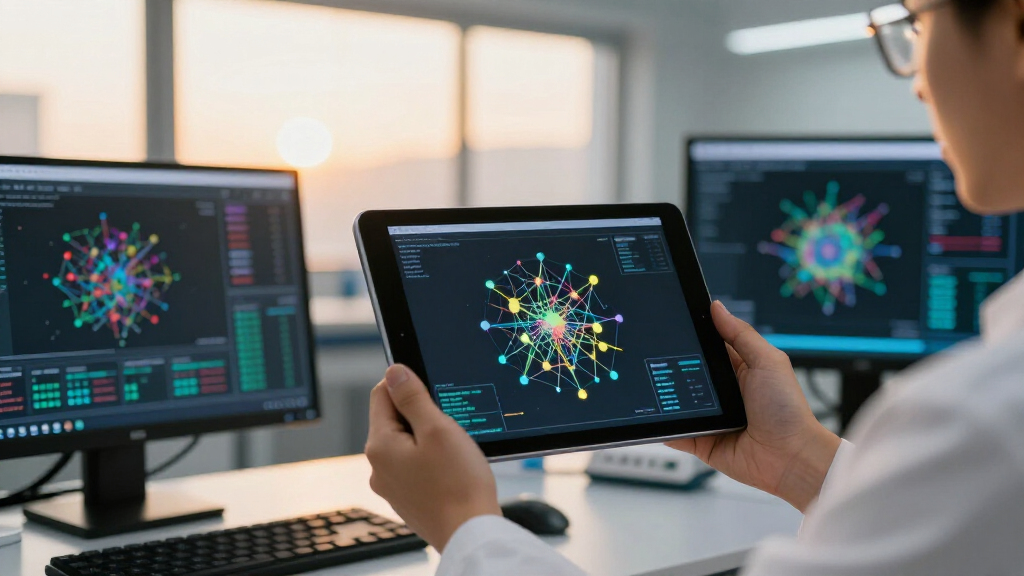
According to the project team, particle geometry mapping involves representing data points as particles that can be manipulated in space to form intricate, evolving geometries. This technique allows the environment to respond in real time to data inputs, creating a visual symphony of data and form. The ‘SINGULARITY’ space, which transforms a stark black room into a flowing, data-driven visual environment, exemplifies this technology’s potential.
Thorsten Meyer, the lead designer behind the project, explained that this method enables the seamless integration of complex data with aesthetic design, resulting in immersive experiences that challenge traditional notions of form and function. The project aims to serve as a blueprint for future AI environments, where data is not just displayed but experienced as art.
The Hidden Tech Behind ‘SINGULARITY’
Particle geometry mapping converts abstract data into particles, spatial relationships and evolving forms—turning a stark black room into a responsive visual environment where information is experienced as art.
How data becomes an environment
Instead of placing information on a static screen, the technique assigns data to particles in space. Their position, density, motion and connections can change as new inputs arrive, producing a continuously evolving visual system.
Abstract data
Values, categories, relationships and live signals provide the raw material for the environment.
Particle attributes
Data properties are translated into position, velocity, scale, density and spatial relationships.
Living geometry
Particles organize into responsive structures that make patterns visible through movement and form.
Why the technique changes the interface
Particle geometry mapping merges algorithmic behavior with aesthetic composition. Its strongest contribution is not a single graphic style, but a framework for making complex information responsive, spatial and perceptible.
Reported capability profile
Qualitative interpretation of the project’s described strengths—not independently benchmarked performance data.
Design shift: data is no longer only displayed. It becomes the material that generates the space itself.
Beyond static visualization
Earlier approaches often relied on fixed charts or predefined animation. Particle geometry mapping introduces a more adaptive model in which visual structure can be recalculated as the underlying data changes.
| Capability | Static display | Prebuilt animation | Particle geometry mapping |
|---|---|---|---|
| Real-time adaptation | ✕ | ~ | ✓ |
| Spatial data encoding | ~ | ~ | ✓ |
| Evolving relationships | ✕ | ~ | ✓ |
| Immersive presentation | ✕ | ✓ | ✓ |
| Commercial maturity | ✓ | ✓ | ~ |
Where the concept could travel next
The project team plans to refine the method, test scalability and explore environments beyond the original installation. These applications remain prospective rather than confirmed deployments.
Virtual reality
Users could move through datasets, examine clusters and perceive changing relationships from inside the visualization.
Data art installations
Live information could become a continuously evolving artistic material for galleries, stages and public spaces.
Data education
Spatial and animated representations may help learners engage with patterns that are difficult to grasp in conventional charts.
AI-human interaction
Responsive geometry could communicate model activity, system state or complex outputs through an intuitive visual language.
From signal to human insight
The value chain connects five concepts: source data, particle attributes, computational behavior, environmental form and human perception. Each stage preserves a relationship to the information beneath it.
Values and relationships
Particle properties
Motion and interaction
Living spatial geometry
Patterns become experiential
The essential briefing
A concise guide to what the technique is, why it matters and what still needs to happen before widespread practical adoption.
What is particle geometry mapping?
A technique that represents data points as particles in space and manipulates them to form complex, dynamic geometries responsive to input.
How does it improve AI environment design?
It enables real-time, immersive visualization of complex data, potentially making spatial interfaces more engaging and intuitive.
Is it commercially ready?
Not yet. The work remains experimental, and further research is needed to establish scalability, resource requirements and deployment viability.
What is the larger significance?
It suggests a future in which AI does not merely generate charts—it creates adaptive environments that let people experience information as form.
Innovative Data Visualization in AI Spaces
This development signifies a major step forward in AI-driven environment design. By translating data into dynamic, visual forms through particle geometry mapping, the project demonstrates how AI can create more intuitive, engaging interfaces. It also suggests new possibilities for data analysis, education, and artistic expression within AI environments. The approach could influence future virtual spaces, immersive data art, and AI-human interaction models, making complex information more accessible and engaging for users.
immersive data visualization display
As an affiliate, we earn on qualifying purchases.
As an affiliate, we earn on qualifying purchases.
Advances in Visualizing Complex Data with AI
The ‘SINGULARITY’ project builds on recent trends in AI and data visualization, where the challenge has been to make abstract data comprehensible and engaging. Previous efforts focused on static displays or simple animations, but the use of particle geometry mapping introduces a new level of complexity and responsiveness. The technique was developed in response to the need for more immersive, real-time visualizations that can adapt to data changes seamlessly.
While the project is still in experimental stages, it reflects a broader movement toward integrating artistic principles with AI technology, aiming to produce environments that are both functional and aesthetically compelling. This approach aligns with ongoing research into how AI can enhance human perception and interaction within digital spaces.
“Particle geometry mapping allows us to convert data into immersive, visual experiences that respond dynamically to inputs.”
— an anonymous researcher
AI-driven spatial environment equipment
As an affiliate, we earn on qualifying purchases.
As an affiliate, we earn on qualifying purchases.
Unconfirmed Aspects of Particle Geometry Mapping
It is not yet clear how scalable or adaptable the particle geometry mapping technique is for different types of data or environments beyond the ‘SINGULARITY’ project. Details about its computational requirements and potential limitations remain undisclosed. Additionally, the extent to which this method will be integrated into commercial or practical applications is still under development.
particle geometry mapping software
As an affiliate, we earn on qualifying purchases.
As an affiliate, we earn on qualifying purchases.
Future Developments and Broader Applications
Researchers plan to refine the particle geometry mapping technique and explore its application in other AI-driven environments, including virtual reality, data education, and artistic installations. Further testing will determine its scalability and potential for widespread adoption. The team also intends to publish detailed technical papers to share insights and collaborate with the broader AI and design communities.
interactive digital art installation
As an affiliate, we earn on qualifying purchases.
As an affiliate, we earn on qualifying purchases.
Key Questions
What is particle geometry mapping?
Particle geometry mapping is a technique that represents data points as particles in space, which can be manipulated to form complex, dynamic geometries responsive to data inputs.
How does this technology improve AI environment design?
It enables real-time, immersive visualizations of complex data, making environments more engaging and intuitively understandable.
Is this technology ready for commercial use?
Currently, it is in experimental stages, with further research needed to assess scalability and practical deployment.
What are the potential applications of this technique?
Potential applications include virtual reality environments, data art installations, educational tools, and AI-human interaction interfaces.
Source: ThorstenMeyerAI.com
Fall yard work Picks
leaf blowers
As an affiliate, we earn on qualifying purchases.