
📊 Full opportunity report: The Future Of Public Benefits Access: Benefit Check Bot Breakthroughs on IdeaNavigator AI — validation score, market gap, and execution plan.
Listen free for 30 days with Audible
Thousands of audiobooks and originals — cancel anytime.
Start your free trialAs an affiliate, we earn on qualifying purchases.
TL;DR
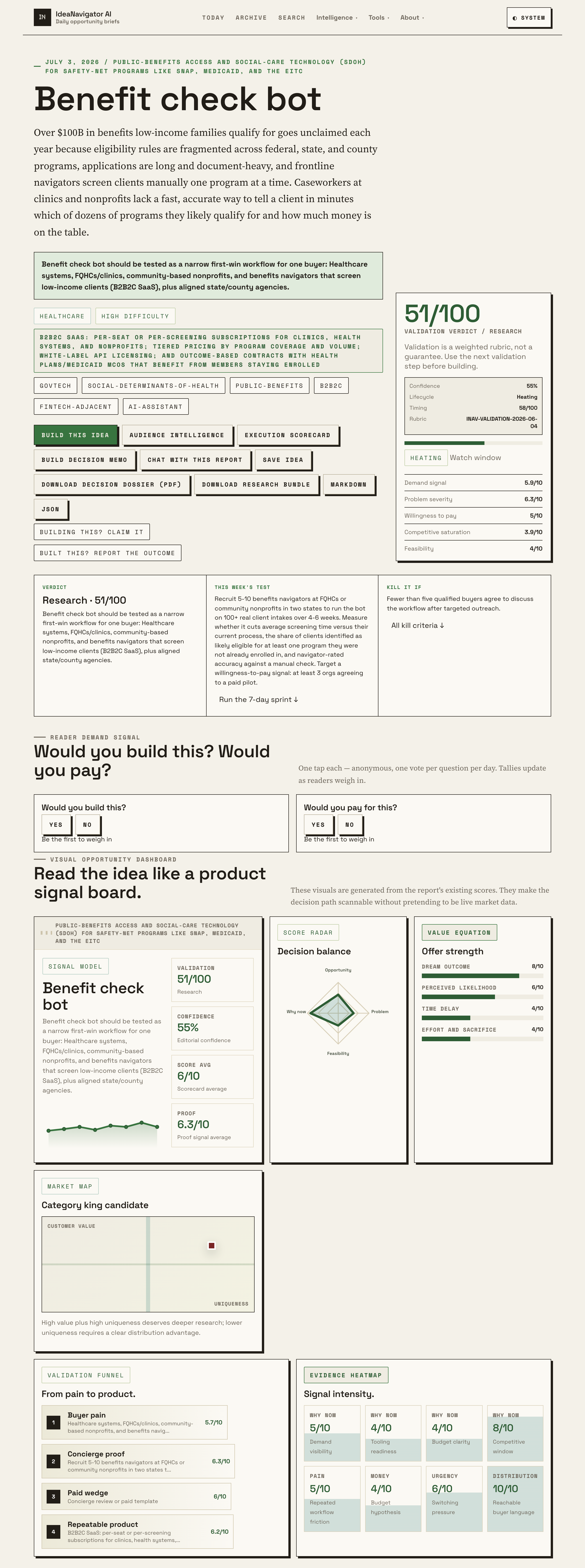
A new conversational AI benefit check bot is being tested to improve access to public benefits for low-income families. It addresses longstanding fragmentation and manual screening challenges, with pilot programs planned in two states.
A new AI-powered benefit check bot is entering pilot testing, offering a rapid, automated way for clinics and nonprofits to screen low-income clients for multiple benefits. Developed to address the longstanding gap in benefits access caused by fragmented eligibility rules and manual screening processes, this technology could significantly improve how millions access programs like SNAP, Medicaid, and energy assistance.
The benefit check bot is designed as a white-label conversational tool, embedded on health clinics’ or nonprofit websites or delivered via SMS, to streamline eligibility screening. It asks a short set of yes/no and multiple-choice questions, then provides a list of likely-eligible programs with estimated benefits and next steps. The initial rollout focuses on two states, targeting a pilot involving 5-10 benefits navigators who will test the system over 4-6 weeks.
This development comes after the shutdown of Benefits Data Trust in 2024, which previously provided benefits enrollment services across seven states, leaving a gap in outsourced capacity. Additionally, the post-pandemic Medicaid redetermination process has increased the workload for frontline staff, highlighting the need for faster, more accurate screening methods. The AI-driven bot leverages conversational AI to deliver multilingual, near-zero marginal cost assessments, promising to reduce manual effort and improve accuracy.
Early validation efforts will measure whether the bot reduces screening time, identifies eligible clients who were previously missed, and maintains high accuracy levels as rated by benefits navigators. Success in these pilots could lead to broader adoption across safety-net providers, health systems, and state agencies, with revenue models based on subscriptions, licensing, and outcome-based contracts.
Potential Impact on Benefits Access and Equity
This breakthrough could dramatically improve access to public benefits for low-income families by reducing barriers created by complex eligibility rules and lengthy application processes. Automating screening with AI can enable faster, more accurate identification of benefits, potentially increasing take-up rates and reducing unclaimed benefits, which currently exceed $100 billion annually. For health systems and social service providers, this technology offers a scalable, cost-effective solution to address longstanding gaps in social care and benefits navigation. If successful, it could set a new standard for digital social support tools, making benefits more equitable and accessible.
benefit eligibility screening software
As an affiliate, we earn on qualifying purchases.
As an affiliate, we earn on qualifying purchases.
Background on Benefits Access Challenges and Recent Developments
Over $100 billion in benefits go unclaimed each year by eligible low-income families, largely due to fragmented eligibility criteria across federal, state, and local programs. Manual screening processes are time-consuming and resource-intensive, often involving paper forms and multiple program-specific assessments. The shutdown of Benefits Data Trust in 2024 removed a key capacity provider for benefits enrollment, intensifying the need for automated solutions. Meanwhile, the post-pandemic Medicaid redetermination process has added millions to the workload of frontline staff, many of whom rely on manual, one-at-a-time screening methods. Advances in conversational AI and the urgency of redeterminations have created an opportunity to develop scalable, automated screening tools that can operate across multiple programs and languages, promising to fill this critical gap.
AI-powered social benefits check tool
As an affiliate, we earn on qualifying purchases.
As an affiliate, we earn on qualifying purchases.
Uncertainties and Challenges in Implementation
While pilot testing is underway, it remains unclear how well the benefit check bot will perform at scale, particularly in diverse language and literacy contexts. Questions about long-term accuracy, user engagement, and integration with existing state and federal systems are still unresolved. Additionally, the extent to which frontline staff will adopt and trust the AI tool remains to be seen, as does its ability to handle complex eligibility scenarios beyond initial screening. Further validation is required to confirm whether the system can reliably identify all eligible clients and reduce workload without introducing new errors or biases.
multilingual benefits eligibility chatbot
As an affiliate, we earn on qualifying purchases.
As an affiliate, we earn on qualifying purchases.
Next Steps for Broader Adoption and Validation
Following the initial pilot phase, organizers plan to evaluate system performance based on screening speed, accuracy, and user feedback. If results are positive, the system could be expanded to additional states and programs, with further testing in more diverse settings. Developers will also work to improve multilingual capabilities and integrate the tool with existing benefits management platforms. Stakeholders will monitor whether the system can sustainably reduce manual screening time and increase benefit uptake, ultimately aiming for wider deployment across safety-net providers and government agencies.
public benefits application assistance tools
As an affiliate, we earn on qualifying purchases.
As an affiliate, we earn on qualifying purchases.
Key Questions
How does the benefit check bot work?
The bot uses a conversational interface to ask clients a series of yes/no and multiple-choice questions, then estimates eligibility and benefits for programs like SNAP, Medicaid, and energy assistance. It provides next-step links and documentation checklists to streamline applications.
Which states are participating in the pilot?
The initial pilots are planned for two states, with specific locations still to be announced. The focus is on testing the system’s effectiveness in diverse eligibility environments.
Will this replace human benefits navigators?
The system is designed to augment, not replace, human navigators by reducing manual screening time and helping them focus on complex cases. It aims to improve efficiency and accuracy in benefits access.
What are the main challenges to wider adoption?
Key challenges include ensuring accuracy across diverse populations, integrating with existing government systems, and gaining trust from frontline staff and clients. Further validation will determine readiness for broader rollout.
When will the benefits of this technology be widely available?
If pilots are successful, broader deployment could occur within the next 1-2 years, depending on validation outcomes and stakeholder adoption.
Source: IdeaNavigator AI
Fall Picks
fall essentials
As an affiliate, we earn on qualifying purchases.