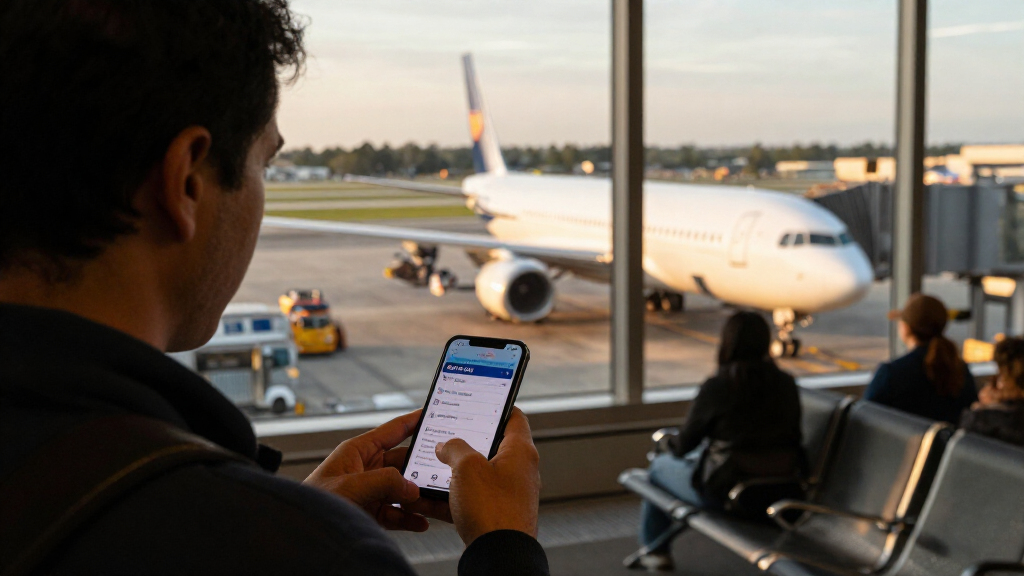

🔍 Read the full analysis: FAA Flight Pause Disrupts US Airports: What’s Known So Far on ThorstenMeyerAI.com

Get the latest gadgets delivered free with Prime
- Fast, free delivery on millions of items
- Prime Video, Amazon Music and more included
- Member-only deals all year
TL;DR
The FAA halted departures from U.S. airports for about four hours on Nov. 13 after communications and radar instability affected air traffic facilities. Transportation Secretary Sean Duffy blamed overloaded legacy telecom equipment, while officials said they had seen no evidence of a cyberattack; the FAA has not published a written root-cause report.
The Federal Aviation Administration halted departures from airports nationwide for about four hours on Friday, Nov. 13, after communications problems affected multiple air traffic control facilities. The disruption delayed and cancelled flights in the United States and affected international services; officials have described equipment instability but have not published a written root-cause report.
The FAA Command Center issued its nationwide ground-stop advisory at 3:54 p.m. Eastern time, citing “extraordinary circumstances and for reasons of safety.” Its records put the event start at 3:53 p.m. and the cancellation at 8:16 p.m. Transportation Secretary Sean Duffy said the airspace reopened at 8:15 p.m. The FAA’s advisories therefore indicate a stop of about four hours and 23 minutes.
The trouble appeared earlier in Chicago. At 3:21 p.m., an FAA advisory cited equipment issues as it warned of arrival delays and airborne holding at O’Hare. The agency restricted departures to O’Hare at 3:28 p.m. and to Chicago Midway at 3:31 p.m. Duffy said the wider problem began at 3:36 p.m., affecting radar and communications at en route centers and approach control facilities around the country.
Duffy said overloaded legacy analog telecom switches and routers supplied inconsistent data, but stressed that the system did not lose all radar or telecommunications. More than 3,500 aircraft were airborne when the national stop began, he said, falling to fewer than 400 by 8 p.m. Medevac flights, life-saving cargo and law-enforcement flights were allowed to continue. The FAA said technicians were investigating communication issues affecting multiple Air Route Traffic Control Centers.
FlightAware counted 9,159 cancellations within, into or out of the United States on Friday, and 3,515 more by 7:58 a.m. ET Saturday. Those figures cover all cancellations during those periods, not only flights attributed to the ground stop. FAA advisories also show the agency extended flight-plan validity and coordinated some departures as facilities recovered.
FAA ground stop · Nov 13, 2026 · times ET (UTC−5)
Unreliable data, a full stop, a slow restart
What the FAA Command Center’s advisories and Transportation Secretary Sean Duffy describe, step by step.
US airspace (schematic)
plane (schematic)airports
3,500+ planes in the airwhen the stop began, Duffy says Fewer than 400still airborne by 8 p.m. ET, Duffy says Restartground stop cancelled; flights resume slowly
What the FAA and Duffy said
- 3:21 p.m.Chicago O’Hare: arrival delays “due to equipment issues”FAA advisory 106
- 3:36 p.m.Radar and communications unstable at centers and TRACONs nationwideDuffy
- 3:54 p.m.“All airports are ground stopped”; departures heldFAA advisory 111
- 4:20 p.m.Airborne holding expected at “any and all airports”FAA advisory 116
- 8 p.m.Fewer than 400 planes still airborne, down from 3,500+Duffy
- 8:16 p.m.Nationwide ground stop cancelled; Duffy: airspace reopened at 8:15 p.m.FAA advisory 005
Sources: FAA Air Traffic Control System Command Center advisories 106, 111 and 116 (Nov 13) and 005 (Nov 14, 2026, UTC dates); Transportation Secretary Sean Duffy at the White House briefing, Nov 13 (transcript: Roll Call Factba.se) and on X (as quoted by Fox Business); BBC News, Nov 14. Durations: own calculation from advisory event times (2026: 20:53 to 01:16 UTC; 2023: 12:20 to 14:00 UTC). The radar picture is a schematic, not real traffic.
Graphic: Powered by Thorsten Meyer AI
How the Stop Disrupted Flight Networks
A nationwide departure halt affects more than planes waiting at U.S. gates. It can strand passengers, separate aircraft from their scheduled crews and leave airlines managing delays well after the restriction is lifted. The FAA’s advisories continued into the evening with airport- and airline-specific ground stops as carriers worked to restore schedules.
The disruption also reached international routes. The source material reports that, at the FAA’s request, Eurocontrol suspended U.S.-bound departures from its member states from 22:00 UTC on Nov. 13 to 05:00 UTC on Nov. 14. It also reports that Sydney Airport held U.S.-bound flights and Air Canada cancelled some U.S.-Canada services. For travelers, a reopened airspace did not mean every flight could resume on time.
The incident has broader implications because air traffic control depends on reliable communications among facilities coordinating aircraft on the ground and in the air. Duffy warned that similar events could recur without investment in system upgrades. That is his assessment, not a published finding that establishes how often such failures may happen.
Products Worth Considering

Samsung Odyssey OLED G5 27-Inch QHD Gaming Monitor

LG UltraGear 32GX850A-B 32-inch 4K UHD OLED Gaming Monitor

LG UltraGear evo 27-inch 5K Mini-LED Gaming Monitor
As an affiliate, we earn on qualifying purchases.
From Chicago Delays to a National Halt
The FAA Command Center’s advisories trace the developing disruption from Chicago to the national stop. Earlier notices that afternoon cited weather and traffic volume. The first cited equipment issues at 3:21 p.m. for O’Hare, followed by departure restrictions for O’Hare and Midway. At 3:30 p.m., the center activated a diversion recovery tool for all airports.
After the national stop, advisories instructed operators to expect airborne holding at any airport and extended flight-plan drop times at all en route centers to 240 minutes. At 5:46 p.m., the FAA said flights could depart as en route facilities recovered, subject to coordination with the Command Center. At 7:37 p.m., it reported that some coastal facilities had released some international departures. A notice issued at 8:19 p.m. recorded the nationwide stop’s cancellation time as 8:16 p.m.
The source material identifies 21 en route centers, citing an FAA-commissioned 2023 review. These facilities largely manage aircraft traveling between airports, while approach control facilities handle traffic closer to airports. The distinction helps explain why communications problems at multiple points could affect both en-route operations and arrivals.
““ALL AIRPORTS ARE GROUND STOPPED.””
— FAA Command Center advisory
What Investigators Have Not Established
The FAA has not released a written report identifying the failure’s precise root cause. Duffy attributed the instability to overloaded legacy telecom equipment, but the FAA’s public statement described communication issues and said technicians were investigating. The available information does not specify which components failed, how the problem spread between facilities, or what technical changes would prevent a recurrence.
Mullin said officials had found no evidence of a cyberattack and that the incident appeared mechanical, while cautioning that investigators were not ruling out a cyber cause. Duffy and the maker of the FAA’s SMART air-traffic tool said the system was not connected to the failed equipment. The source material does not provide independent technical documentation establishing the full chain of events.
Cancellation totals also need careful interpretation: FlightAware’s counts include all cancellations in the stated periods, not only those caused by the ground stop. The precise number of affected passengers and the share of cancellations directly attributable to the FAA’s action are not established in the supplied material.
FAA Review and Airline Recovery
The FAA’s technicians are investigating the communications problems, but no date for a final report or public technical findings is given in the source material. Until the agency explains the failure and its response, the exact cause and any permanent remedy remain open questions.
Airlines will continue adjusting schedules, aircraft and crew assignments after the halt. Travelers with flights affected by the disruption should check directly with their airline for current departure information; the cancellation totals reported for Friday and Saturday do not by themselves identify which individual flights were stopped because of the FAA action.
Duffy has called for $50 billion for a new system and warned of further disruptions without funding. The source material does not establish whether Congress will approve that amount or when any replacement system would be delivered. The next major development is likely to be the FAA’s findings on what failed and what steps it plans to take.
Key Questions
When did the FAA ground stop begin and end?
The FAA Command Center issued its nationwide advisory at 3:54 p.m. ET on Nov. 13, with an event start listed at 3:53 p.m. The cancellation notice gives 8:16 p.m. ET as the end; Duffy said airspace reopened at 8:15 p.m.
What caused the nationwide flight pause?
Duffy attributed the disruption to radar and communications instability and said legacy analog telecom equipment became overloaded and supplied inconsistent data. The FAA has not published a written root-cause report, so the precise technical cause remains unconfirmed in a public investigation report.
Was the ground stop caused by a cyberattack?
Homeland Security Secretary Markwayne Mullin said officials had seen “zero evidence” of a cyberattack and that the incident appeared mechanically driven, while saying investigators would not rule out cyber activity. No definitive public finding on that question is provided.
How many flights were cancelled?
FlightAware counted 9,159 cancellations within, into or out of the United States on Friday and 3,515 more by 7:58 a.m. ET Saturday. The figures include all cancellations in those periods, not just ones caused by the FAA ground stop.
Could another nationwide stop happen?
Duffy warned that there could be more disruptions without funding for a new system and called for $50 billion. That is his warning; the source material does not establish the likelihood or timing of another stop, or whether Congress will approve the proposed funding.
Source: ThorstenMeyerAI.com