
📊 Full opportunity report: Incident postmortem builder for managed service providers on IdeaNavigator AI — validation score, market gap, and execution plan.

Get the latest gadgets delivered free with Prime
- Fast, free delivery on millions of items
- Prime Video, Amazon Music and more included
- Member-only deals all year
TL;DR
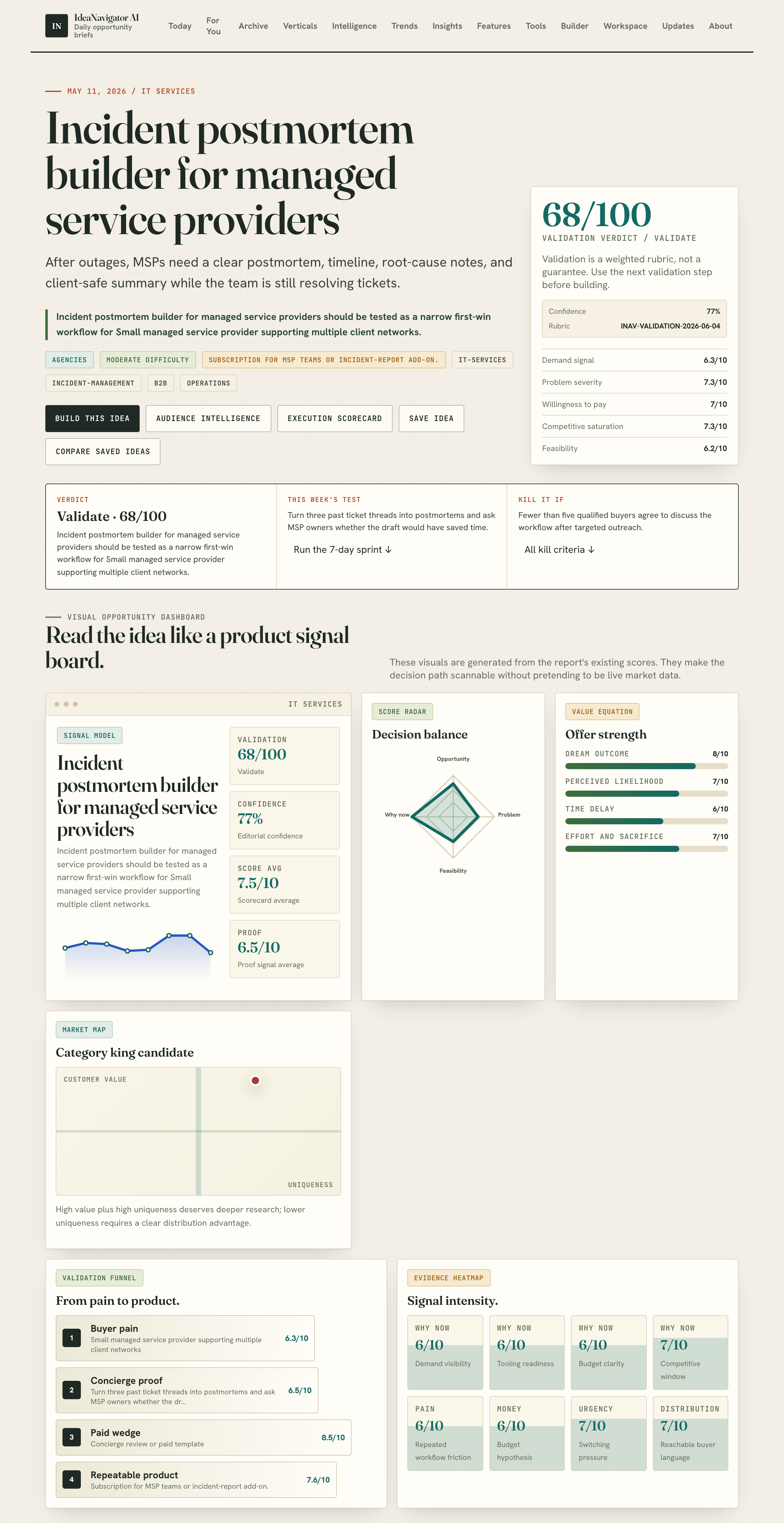
A new incident postmortem tool for small MSPs is in the testing stage, focusing on automating incident reports and improving client communication after outages. Its success depends on validation with real ticket data.
A new incident postmortem builder designed for small managed service providers (MSPs) is in the testing stage, aiming to streamline incident reporting and improve communication with clients after outages. The tool, if successful, could help MSPs deliver professional, timely incident summaries, addressing a key industry need.
The incident postmortem builder is targeted at small MSPs supporting multiple client networks. It is currently in a pilot phase, where the primary focus is on validating its effectiveness by converting past ticket threads into draft postmortem reports. The tool is designed to import ticket notes, timestamp events, and distinguish internal notes from client-facing summaries. It also aims to generate next steps, helping MSPs communicate clearly and efficiently during incident resolution.
According to sources familiar with the project, the MVP (minimum viable product) will offer a workspace that enables teams to draft incident reports quickly, with features to separate internal notes from client communication. The developers plan to monetize the tool through subscription plans for MSP teams or as an add-on feature for incident reports. The initiative is driven by market demand for more professional incident communication, even among smaller providers, as clients increasingly expect timely, transparent updates.
Validation involves testing the tool against three past ticket threads, asking MSP owners whether the drafts would have saved time or improved client communication. The project is still in early stages, with no official launch date announced, and further testing and refinement are expected before broader deployment.
Why Streamlined Postmortems Matter for Small MSPs
This development addresses a gap for small MSPs, who often lack dedicated resources for incident communication. Automating and standardizing post-incident reports could improve professionalism, reduce time spent on report drafting, and enhance client trust. As clients demand more transparency, MSPs that adopt such tools may gain a competitive advantage in the IT services market.
incident report management software for MSPs
As an affiliate, we earn on qualifying purchases.
As an affiliate, we earn on qualifying purchases.
Industry Need for Better Incident Communication Tools
Small managed service providers typically manage multiple client networks but often lack dedicated staff for incident reporting and client updates. Currently, many rely on manual note-taking and post-incident summaries, which can be inconsistent and time-consuming. The increasing expectation from clients for prompt, transparent communication has created a market opportunity for tools that facilitate professional incident reporting. Previous efforts in larger organizations have demonstrated the value of structured postmortems, but small MSPs have yet to widely adopt such solutions.
The project reflects a broader trend toward automation and standardization in IT service management, driven by client expectations and competitive pressures. Its success could lead to more integrated incident management workflows tailored for small providers.
“This tool could significantly reduce the time MSPs spend on incident reports while improving the quality of communication with clients.”
— an anonymous researcher
As an affiliate, we earn on qualifying purchases.
Unconfirmed Aspects of the Postmortem Builder’s Effectiveness
It remains uncertain how the tool will perform in real-world scenarios or whether MSPs will adopt it at scale. The quality of the draft reports and their impact on client satisfaction are yet to be validated through broader testing. Additionally, the final feature set and pricing model are still under development, and no official launch date has been announced.
client communication incident reports
As an affiliate, we earn on qualifying purchases.
As an affiliate, we earn on qualifying purchases.
Next Steps in Validation and Deployment
The project team plans to complete testing with three past ticket threads, gather feedback from MSP owners, and refine the tool accordingly. Pending positive validation, a broader pilot or phased rollout could begin within the next few months. Further developments will include finalizing features, establishing pricing, and marketing to small MSPs seeking to improve incident communication processes.
automated incident report generator
As an affiliate, we earn on qualifying purchases.
As an affiliate, we earn on qualifying purchases.
Key Questions
When will the incident postmortem builder be available to MSPs?
There is no confirmed launch date yet. The tool is currently in testing, with plans for further validation before a broader release.
How will the tool help MSPs improve incident reporting?
It will automate the creation of incident reports, timestamp events, separate internal and client-facing notes, and suggest next steps, saving time and enhancing professionalism.
Will this tool be suitable for larger MSPs or only small providers?
The current focus is on small MSPs supporting multiple clients, but if successful, similar principles could be adapted for larger organizations.
What is the cost model for this incident postmortem builder?
Developers plan to monetize via subscriptions for MSP teams or as an incident-reporting add-on, but specific pricing details are not yet available.
What challenges might MSPs face in adopting this tool?
Potential challenges include integration with existing ticketing systems, training staff to use the new workflow, and validating the quality of automated drafts.
Source: IdeaNavigator AI
Halloween Picks
halloween
As an affiliate, we earn on qualifying purchases.