

📊 Full opportunity report: The $9 Billion Signature Tax: How DocuSign’s Business Model Survives on One Assumption on ThorstenMeyerAI.com — validation score, market gap, and execution plan.
TL;DR
DocuSign remains a $9 billion company, but a new open source alternative called DocuSeal demonstrates that its core service—digital signatures—can be replicated cheaply and easily. This raises questions about the company’s long-term moat and business model.
In 2026, a developer introduced DocuSeal, an open source digital signature platform that can be self-hosted in 30 minutes for less than $5, directly challenging DocuSign’s $9 billion valuation and business model.
DocuSeal, an open source project built in 2023 using Ruby, is designed to replicate the core functionalities of DocuSign, including multi-signer support, API integration, and compliance with electronic signature laws such as ESIGN, UETA, and eIDAS. It is hosted on a minimal cost VPS, with annual expenses around €45 ($48), compared to DocuSign’s median contract of approximately $17,250 per year, according to Vendr’s 2026 benchmark.
The project has gained significant traction on GitHub, with over 11,800 stars and 50+ commits per month, supported by a sustainable funding model through premium cloud tiers. The developer claims that deploying DocuSeal involves five straightforward steps, totaling about 28 minutes, and costs less than $5 annually for hosting.
While DocuSeal does not currently support certain features like federal government contracts or some EU notarial processes, it offers a comprehensive set of features including drag-and-drop form building, multiple signers, conditional fields, and compliance with major legal frameworks. It is positioned as a fully functional alternative for most business documents, aside from specific high-security or government-specific use cases.
The $9 billion signature tax.
DocuSign’s business model survives on one assumption.
A 50-person team pays $24,000 to $39,000 per year to put names on PDFs. Not because the tech is hard. The cryptographic signature math has been solved for thirty years. The legal frameworks are a quarter-century old. There is no moat. There is one assumption holding it together: that you will not bother to look at the alternative.
You are rationing digital signatures in 2026.
Stop and look at that sentence again. You are rationing — keeping a count, watching the meter, deciding whether this contract is worth using one of your remaining envelopes — a function whose actual cost to perform is somewhere between zero and one cent per signature. You are doing this in 2026, on a function that has been a commodity since 1999.

The 2023 Report on Digital Signature Software: World Market Segmentation by City
As an affiliate, we earn on qualifying purchases.
As an affiliate, we earn on qualifying purchases.
Same job. Different bill. Four team sizes.
Pure SaaS-vs-VPS comparison. As your team grows, the absolute savings grow linearly while relative savings asymptote at ~99.9%. The DocuSign business model assumes per-seat pricing on a function that has no per-seat marginal cost.
self-hosted electronic signature platform
As an affiliate, we earn on qualifying purchases.
As an affiliate, we earn on qualifying purchases.
Five commands. Production-grade signature platform.
PostgreSQL 18 + DocuSeal app + Caddy reverse proxy with automatic Let’s Encrypt SSL. Verified against the official docusealco/docuseal repository at v2.2.9. 28 minutes if everything goes smoothly; 45 if DNS is slow.
Production deploy · $5/month VPS → live signature platform.
ssh root@IP
5 min
sign.you.com → IP · Cloudflare proxy OFF
5 min
curl -fsSL get.docker.com | sh · entire install
3 min
docker-compose.yml · set .env · docker compose up -d
10 min

Moleskine Smart Writing Set with Improved Battery – 2024 Edition | Smart Notebook & Smart Pen for Digital Note-Taking | Works Notes App Smart Notebooks Only
SMART WRITING SET: Seamlessly transfer handwritten notes from page to screen, instantly digitizing your ideas. Edit, search, share,…
As an affiliate, we earn on qualifying purchases.
As an affiliate, we earn on qualifying purchases.
DocuSign is not the only $9B company built on this assumption.
Same dynamic. Per-seat pricing on a function with near-zero marginal cost. Open-source alternative is mature, properly licensed, and runs on a $5 VPS. A typical 50-person company running 5–8 of these is paying $40K–$120K/year that’s structurally replaceable.
The first time you do this, you save $30,000. The savings are the surface. The actual outcome is that you stop trusting the SaaS price tag entirely.
How to Replace DocuSign in 30 Minutes for $5 a Month
The complete DocuSeal self-host guide for 2026. Every command tested. Every cost verified. Every workflow ready to run today.
- 30-min deploy walkthrough · v2.2.9
- 4 hosting options ranked by cost
- Production docker-compose.yml
- 13 field types · DocuSign mapping
- API patterns · CRM, billing, contracts
- Cost comparison · 1, 10, 50, 200 sizes
- Compliance · ESIGN, eIDAS, GDPR, HIPAA
- The 12-category replacement framework
- 5 questions before any SaaS swap
- Honest maintenance accounting
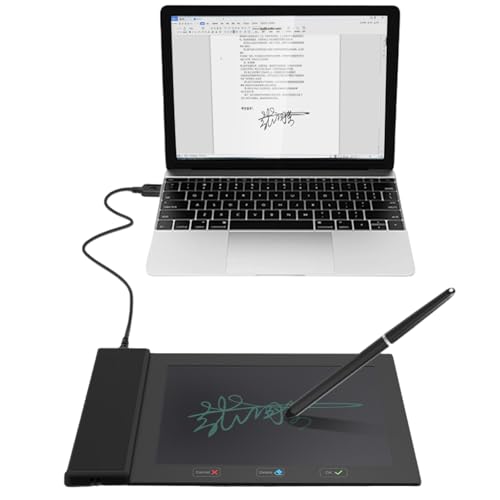
Visualible Signature Pad E-Signature on Word, Excel, PowerPoint and PDF with Timestamp 6×4 Inch Writing Area with Battery-Free Stylus Pen Suitable for Windows
Support English: The software download for this pad is not only in Chinese, you can change it into…
As an affiliate, we earn on qualifying purchases.
As an affiliate, we earn on qualifying purchases.
Implications for SaaS and Digital Signature Industry
The emergence of DocuSeal questions the long-held industry assumption that digital signature services like DocuSign have a durable moat due to proprietary technology or network effects. Since the cryptographic foundation is open and the legal frameworks are mature, the primary barrier is the cost and effort of deployment. This development could accelerate the move towards open source, self-hosted solutions, potentially disrupting the pricing and competitive dynamics of the digital signature market.
For businesses, this could mean significant cost savings and increased flexibility, especially for organizations willing to manage their own infrastructure. For industry incumbents, it presents a challenge to justify premium pricing when functional equivalents are accessible at a fraction of the cost.
Historical and Industry Background of Digital Signatures
Digital signatures have been a legal and technical standard since the late 1990s, with open standards and open cryptography making proprietary technology less critical. Companies like DocuSign emerged around 2003, capitalizing on network effects, brand trust, and integrations, to build a valuation exceeding $9 billion. Their business model relies heavily on subscription tiers, envelope limits, and add-on services, with median contracts around $17,250 annually.
Until now, the industry has operated under the assumption that switching costs, legal compliance, and network effects create a durable moat. The launch of DocuSeal demonstrates that the core technology can be replicated cheaply, challenging this assumption and raising questions about the future pricing and competitive landscape.
“The cryptographic foundation of digital signatures has been open and standardized for decades. The real barrier has been the perceived difficulty of deployment and legal compliance—barriers that open source solutions like DocuSeal now threaten to remove.”
— Thorsten Meyer
Unclear Impact on Industry Dominance and Adoption
It remains unclear how quickly organizations will adopt open source solutions like DocuSeal at scale, especially in regulated sectors or where contractual obligations specify use of certain providers. Additionally, legal, security, and compliance concerns may slow widespread acceptance, and incumbent providers may respond with new features or pricing strategies.
Next Steps for Open Source Digital Signature Adoption
Further development of DocuSeal’s features and integrations will determine its competitiveness. Monitoring enterprise adoption, legal acceptance, and potential industry responses will be key over the coming months. Meanwhile, organizations may start evaluating self-hosted options for cost savings and control, potentially accelerating a shift away from proprietary services.
Key Questions
Can DocuSeal fully replace DocuSign for all use cases?
While DocuSeal offers many features comparable to DocuSign, it currently lacks support for certain high-security or government-specific workflows, such as federal contracts and some EU notarial processes. For most business documents, it appears functionally equivalent.
Is deploying DocuSeal technically difficult?
No, the developer claims it can be deployed in about 30 minutes following a straightforward five-step process, with minimal technical expertise required.
Will legal frameworks accept self-hosted signatures as valid?
Legal frameworks like ESIGN, UETA, and eIDAS are designed to recognize electronic signatures, including self-hosted solutions, provided they meet certain criteria. Adoption in regulated sectors may vary and is still being tested in practice.
What does this mean for existing DocuSign customers?
Customers may have more cost-effective alternatives, especially for non-critical or internal use cases. However, contractual obligations and security requirements could limit immediate switching for some organizations.
Source: ThorstenMeyerAI.com