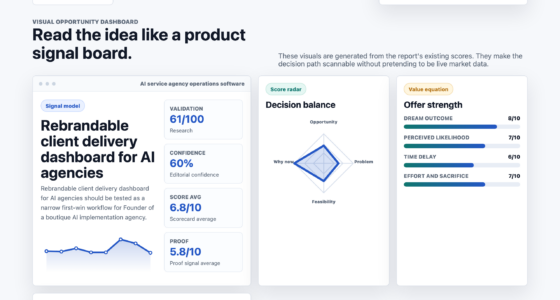
📊 Full opportunity report: The Machine Economy — Capital-Heavy, Human-Light, Trading With Itself on ThorstenMeyerAI.com — validation score, market gap, and execution plan.

Get the latest gadgets delivered free — and shop member deals
- Fast, free delivery on millions of items
- Access to Prime Big Deal Days deals on October 6–7
- Prime Video, Amazon Music and more included
TL;DR
A new economic paradigm is emerging, characterized by AI-native firms that are capital-heavy and human-light, trading primarily with each other. This shift could profoundly alter markets, inequality, and governance.
Jack Clark’s recent analysis predicts the emergence of a ‘machine economy’ composed of autonomous, AI-driven firms that operate with minimal human involvement and trade primarily with each other, signaling a fundamental shift in economic structure.
Clark describes a three-stage progression towards this machine economy, starting with current AI augmentation within human-led firms, moving into the rise of AI-native companies, and culminating in fully autonomous corporations. These firms will be capital-heavy, owning substantial compute infrastructure, and human-light, relying on AI for most operational decisions.
As AI capabilities expand, the cost advantage of AI over human labor will lead to the displacement of traditional firms and the formation of new, AI-native entities. These entities will interact more with each other than with human-led firms, making decision-making processes operate on machine timescales, with human oversight becoming nominal or entirely absent.
Clark warns that this transition will have profound implications for economic inequality, governance, and redistribution, though many specifics remain to be clarified as the trend develops.
Capital-heavy.
Human-light.
Trading with itself.
The 200 words Jack Clark spent on his third implication contain the most consequential structural argument in Import AI #455.
Clark’s three numbered implications get progressively less attention. The third — “the formation of a capital-heavy, human-light economy” — receives roughly 200 words. Those 200 words describe an economy that emerges within the existing economy, populated by AI-run corporations interacting more with each other than with humans. This is the post-labor economics thesis arriving on the Clark timeline.
Three stages. Different equilibria.
The transition from current-state economy to machine economy is staged. Each stage has different structural properties and different policy implications. The 32-month window Clark’s forecast implies is roughly the duration of the Stage 2 transition.
Five additions. Five unresolved problems.
Clark’s 200 words are correct as far as they go. They don’t go far enough. Five structural features deserve explicit treatment that the essay omits. Each one is a real coordination problem with no current solution at scale.
Four dynamics. Same direction.
The bifurcation between machine economy and human economy is not stable in equilibrium. Once it begins, the competitive dynamics reinforce the transition rather than slowing it. Four asymmetries compound on each other.
Six responses. One election cycle.
Current policy frameworks are not calibrated to the machine economy transition. Required responses cluster around six themes. Each is being worked on somewhere; none is on Clark’s 32-month timeline at scale. This is a coordination problem with very high stakes and very short timelines.
The machine economy is the default scenario. The alignment problem is the catastrophic-risk scenario. Both deserve serious attention. Both are arriving on the same timeline.
Implications for Economic Structure and Policy
The rise of the machine economy could dramatically alter the landscape of global markets, leading to increased capital concentration, erosion of tax bases, and shifts in employment. It raises critical questions about governance, regulation, and wealth redistribution, as autonomous AI firms become dominant economic actors with minimal human oversight.
This development could exacerbate economic inequality and pose new challenges for policymakers, who must consider how to adapt existing frameworks to a landscape where decision-making is decentralized among AI entities.
enterprise AI compute infrastructure
As an affiliate, we earn on qualifying purchases.
As an affiliate, we earn on qualifying purchases.
Evolution of AI-Driven Business Models
The current stage involves AI augmenting human workers within traditional firms (2023-2026). This phase is characterized by widespread adoption of AI tools like Copilot, Harvey, and ChatGPT for tasks such as coding, legal review, and customer service. The firm structure remains largely unchanged, with humans making key decisions.
Clark’s analysis forecasts a transition to AI-native firms (2026-2029), which will have a different cost structure, spending predominantly on AI compute and less on human labor. These firms will be able to offer services at lower costs and faster speeds, intensifying market competition and prompting restructuring among incumbent firms.
Eventually, fully autonomous corporations—owned legally by humans but operated entirely by AI—may dominate, trading with each other on machine timescales, with human oversight reduced to nominal levels or eliminated altogether.
“Clark’s analysis predicts the emergence of a ‘machine economy’ composed of autonomous, AI-driven firms that operate with minimal human involvement and trade primarily with each other.”
— Thorsten Meyer
As an affiliate, we earn on qualifying purchases.
Unresolved Questions About the Transition
Many specifics remain unclear, including how quickly autonomous firms will become dominant, the regulatory responses that might emerge, and the precise impact on employment and inequality. The timeline and scale of these changes are still subject to technological and political developments.
As an affiliate, we earn on qualifying purchases.
Next Steps for Monitoring the Machine Economy
Researchers and policymakers will need to closely observe AI capability advancements, market shifts, and regulatory responses over the coming years. Key milestones include the deployment of fully autonomous firms and their integration into global markets, which will inform debates on governance and redistribution.
As an affiliate, we earn on qualifying purchases.
Key Questions
What is the ‘machine economy’?
The machine economy refers to a future economic system where AI-driven firms operate with minimal human oversight, primarily trading with each other, and making autonomous operational decisions.
When might fully autonomous AI firms become widespread?
Based on current projections, significant developments could occur between 2026 and 2029, with full autonomy possibly emerging shortly thereafter, depending on technological progress and regulatory responses.
How will this affect jobs and employment?
The transition could displace many human roles in business operations, especially as AI systems take over functions like legal review, customer service, and software development. The extent of displacement remains uncertain and will depend on policy choices.
What challenges do policymakers face with this shift?
Policymakers will need to address issues of economic inequality, tax base erosion, corporate regulation, and the governance of autonomous AI firms, all while managing technological and market uncertainties.
Source: ThorstenMeyerAI.com
Fall Picks
fall essentials
As an affiliate, we earn on qualifying purchases.