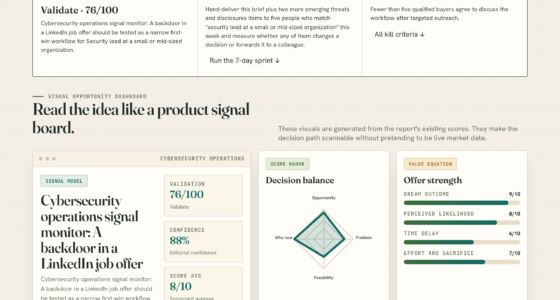

📊 Full opportunity report: Capital: The Lever Beneath the Levers on ThorstenMeyerAI.com — validation score, market gap, and execution plan.

Get the latest gadgets delivered free — and shop member deals
- Fast, free delivery on millions of items
- Access to Prime Big Deal Days deals on October 6–7
- Prime Video, Amazon Music and more included
TL;DR
In 2026, major AI firms like SpaceX, Anthropic, and OpenAI have gone public with multi-trillion valuations, highlighting how capital funding underpins AI development. This creates interconnected risks and vulnerabilities in the industry.
In June 2026, SpaceX, which now includes xAI, listed on the Nasdaq with a valuation near $1.77 trillion, briefly surpassing $2 trillion. Simultaneously, Anthropic and OpenAI are preparing for public offerings valued at hundreds of billions, marking a historic shift in AI funding and valuation. These moves confirm that capital is the primary chokepoint enabling AI infrastructure, and its flow now shapes the industry’s trajectory.
Over the past weeks, the three most valuable private AI firms—SpaceX/xAI, Anthropic, and OpenAI—have transitioned to public markets, collectively representing around $4 trillion in private value. SpaceX’s Nasdaq listing was oversubscribed several times, with a significant portion of shares allocated to retail investors, indicating high demand and investor confidence. Meanwhile, Anthropic and OpenAI are expected to follow with IPOs valued at hundreds of billions, driven by a cycle of risk transfer from early investors to the public, as noted by Bank of America.
This cycle is facilitated by a circular flow of capital: tech giants like Microsoft, Amazon, and Google funnel money into Nvidia, which supplies AI chips and infrastructure, while investments are often made via internal credits like Azure and AWS. This creates a self-reinforcing loop, where demand appears endless, but also risks mispricing and systemic fragility. Notably, Microsoft has recently reduced its commitment to AI compute supply, signaling caution amid the interconnected demand cycle.
Capital: The Lever Beneath the Levers
Every chokepoint costs money — so whoever can fund the buildout decides who builds at all. In 2026 the bill came due in public: a trillion-dollar IPO wave, financed by a circle of firms paying each other, now sold to everyone else.
The meta-chokepoint: it gates the other five, because you can’t build any of them without clearing the capital bar. A synchronized machine has no natural brake — no one can slow first — and the IPO wave moves the risk to the public as insiders take gains. The hedge is solvency that doesn’t depend on the music playing: sane burn, own what’s cheap, self-host where you can.
Implications of Capital Concentration in AI Industry
This concentration of capital at the top of the AI industry means that funding decisions drive infrastructure expansion and risk exposure. The interconnected demand creates a fragile system vulnerable to shocks—any slowdown in one node could cascade across the entire AI ecosystem. Furthermore, the shift of risk from private investors to the public markets at high valuations raises concerns about potential market corrections and economic stability, especially given the high levels of debt financing and limited paying customer base.
AI infrastructure development kits
As an affiliate, we earn on qualifying purchases.
As an affiliate, we earn on qualifying purchases.
Recent Public Listings and Industry Funding Patterns
In 2026, the AI industry experienced a surge of large-scale IPOs: SpaceX/xAI listed on June 12 at a valuation over $2 trillion, with oversubscription indicating strong investor interest. Similarly, Anthropic and OpenAI are preparing for public offerings valued at roughly $965 billion and $730–850 billion, respectively. These developments follow a pattern of private risk transfer, where early investors take gains before the broader market absorbs the risk, often at valuations disconnected from actual economic demand.
This cycle is underpinned by a circular flow of capital, where major firms invest into Nvidia, which supplies AI hardware, which in turn fuels further investment into AI development. This interconnected funding loop amplifies demand but also introduces systemic risks, especially as some key players, like Microsoft, show signs of restraint.
“There is more greed than fear right now, and liquidity remains abundant, but that could change quickly if optimism wanes.”
— Goldman Sachs CEO
As an affiliate, we earn on qualifying purchases.
Unclear Risks and Potential Market Corrections
It is still unclear how the high valuations at IPOs will hold up under market scrutiny, especially if demand wanes or if macroeconomic conditions shift. The extent to which the interconnected demand cycle can sustain itself without causing a systemic bust remains uncertain. Additionally, the long-term impact of high debt levels financed through private credit on the broader economy is still being evaluated by economists.
enterprise cloud computing hardware
As an affiliate, we earn on qualifying purchases.
As an affiliate, we earn on qualifying purchases.
Next Steps for AI Funding and Market Stability
Expect further public listings of AI firms, potentially at valuations that will be scrutinized as market conditions evolve. Monitoring how companies and investors respond to signs of demand slowdown or macroeconomic shifts will be critical. Regulators and industry leaders may also begin to address systemic risks associated with the concentrated capital flows and interconnected demand cycle.
As an affiliate, we earn on qualifying purchases.
Key Questions
Why are AI companies listing at such high valuations?
Because of the intense demand for exposure to AI growth, early private investors and companies are seeking to capitalize on high valuations through IPOs, transferring risk to the public market.
What is the main risk of the current capital cycle?
The cycle’s interconnected demand can lead to systemic fragility, where a slowdown or correction in one part could cascade across the entire AI ecosystem and broader economy.
How does the circular flow of capital impact AI development?
The flow of money from tech giants to hardware providers and back creates a self-reinforcing demand loop, which can inflate valuations and mask underlying demand weaknesses.
What role do private credits play in funding AI infrastructure?
Private credit is expected to fund about half of the estimated $3 trillion in global data-center spending between 2025 and 2028, increasing leverage and potential systemic risks.
Source: ThorstenMeyerAI.com
Fall Picks
fall essentials
As an affiliate, we earn on qualifying purchases.