
📊 Full opportunity report: Could Estate Administration Software Use A Trust Tracker? on IdeaNavigator AI — validation score, market gap, and execution plan.

Get the latest gadgets delivered free — and shop member deals
- Fast, free delivery on millions of items
- Access to Prime Big Deal Days deals on October 6–7
- Prime Video, Amazon Music and more included
TL;DR
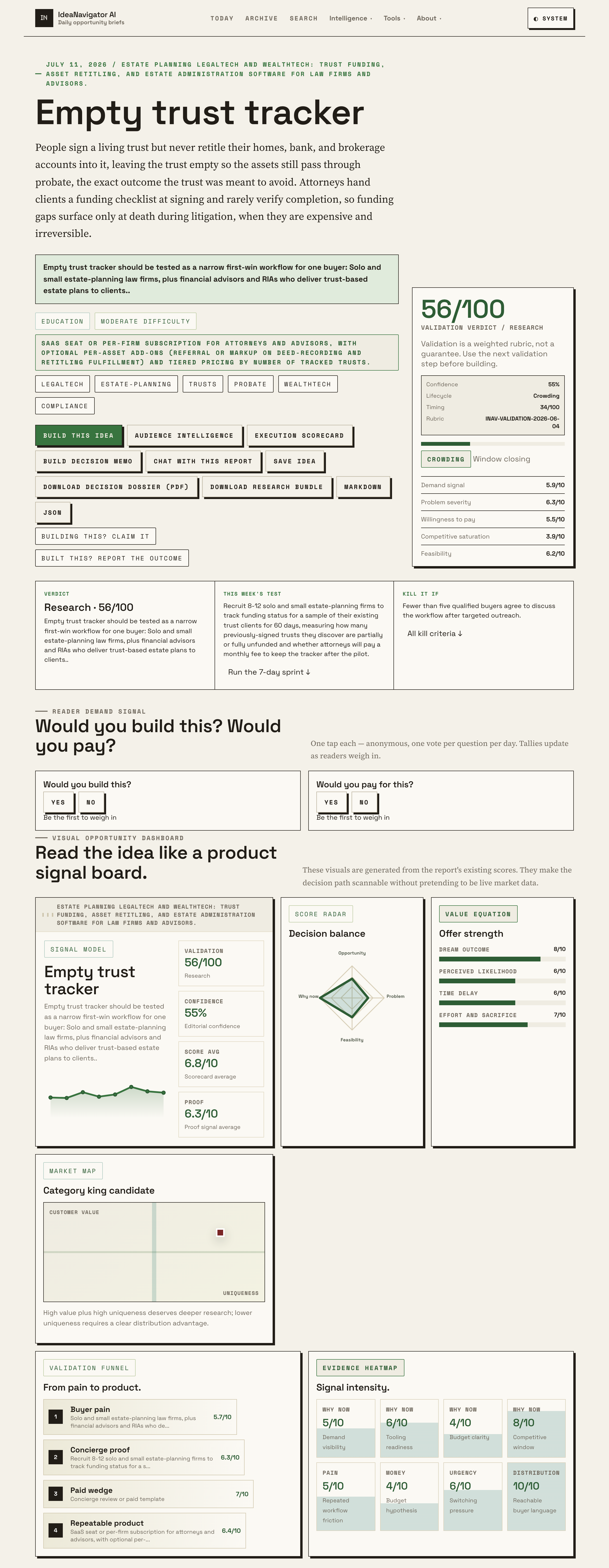
A new product analysis from IdeaNavigator AI argues for a ‘trust funding tracker’ — SaaS that lets solo law firms and financial advisors verify that signed living trusts are actually funded. The analysis says unfunded trusts routinely send assets through probate, and proposes a 60-day pilot with 8-12 firms to test demand.
A new product analysis from IdeaNavigator AI proposes that estate administration software vendors build a trust funding tracker, a tool that would let solo and small estate-planning law firms and financial advisors verify whether signed living trusts actually hold the assets they were designed to govern. The analysis, published in 2026, identifies unfunded trusts — where clients sign the documents but never retitle homes and accounts — as a persistent gap that existing document-drafting software does not address.
The core problem the analysis describes is straightforward: clients sign a living trust but never complete the follow-through of retitling their homes, bank accounts, and brokerage accounts into the trust’s name. The result is what practitioners call an empty trust — a legally valid document with nothing in it, leaving the assets to pass through probate, the very outcome the trust was meant to avoid. According to the analysis, attorneys typically hand clients a funding checklist at signing and rarely verify completion, so funding gaps surface only at death, often during litigation, when they are expensive or impossible to fix.
The proposed minimum viable product is a client-by-client funding tracker. Attorneys or advisors would create a funding checklist per trust covering real estate, bank and brokerage accounts, retirement assets, business interests, and beneficiary designations. Each asset would carry a status — pending, in-progress, or confirmed funded — with proof attached, such as a recorded deed or a retitled account statement. Automated reminders would go to clients, and a firm-level dashboard would show the book of trusts by percent funded so partners can flag dangerously empty trusts before a client dies.
On monetization, the analysis outlines a SaaS seat or per-firm subscription for attorneys and advisors, with optional per-asset add-ons such as referral fees or markups on deed-recording and retitling fulfillment, and tiered pricing based on the number of tracked trusts. The addressable market is described as the intersection of estate planning legaltech and wealthtech: trust funding, asset retitling, and estate administration software.
Why Unfunded Trusts Cost Firms and Heirs
The proposal targets a failure mode with direct financial consequences. When a trust goes unfunded, heirs bear the cost and delay of probate, and the attorney or advisor who delivered the plan faces reputational and potential liability exposure. A verification layer converts funding from a one-time handout at signing into an ongoing, auditable process with documented proof per asset.
The analysis also argues the timing is favorable. Estate planning adoption and digital tooling are described as surging in 2026, yet only about 11% of Americans hold a trust, and trust funding remains a manual, fragmented step. Advisors and registered investment advisors are said to be racing to bundle funded estate plans into client offerings, and paid per-deed funding services priced from $250 have already created a market that a tracking layer can sit on top of.
Where Drafting Software Stops Short
: “Existing estate planning software has historically focused on document generation — producing the trust instrument, wills, and ancillary documents. According to the IdeaNavigator AI analysis, funding the trust afterward — recording deeds, retitling accounts, updating beneficiary designations — remains a fragmented manual step that no mainstream tool closes the loop on. That gap is why the analysis frames a narrow tracker, rather than a full estate administration platform, as the right first product.
The proposed target customers are deliberately small: solo and small estate-planning law firms, plus financial advisors and RIAs who deliver trust-based estate plans. Larger firms and institutional trustees are not the initial focus.
Unproven Demand and Open Questions
This is a product concept, not a launched company. No firm has publicly committed to the pilot, and there is no evidence yet that attorneys will pay a monthly subscription for a funding tracker. The analysis itself flags this, proposing validation rather than asserting demand.
Other open questions include whether clients will respond to automated funding reminders at rates high enough to matter, whether proof-attachment workflows (recorded deeds, retitled statements) can be kept current as accounts change over years, and how liability for a dashboard that flags a trust as funded would be handled if the underlying verification is wrong. The 11% trust-adoption figure and the claim that advisors are racing to bundle funded estate plans are presented in the analysis without named underlying studies or sources.
The 60-Day Pilot Test
The proposed next step is a contained validation pilot: recruit 8-12 solo and small estate-planning firms to track funding status for a sample of their existing trust clients over 60 days. Two metrics would determine whether the idea has legs: how many previously signed trusts the firms discover are partially or fully unfunded, and whether attorneys are willing to pay a monthly fee to keep using the tracker once the pilot ends.
For software vendors and advisors watching the space, the signals to monitor are pilot recruitment, any published findings on unfunded-trust discovery rates, and whether established estate planning or wealthtech platforms add funding-verification features natively.
Source: IdeaNavigator AI
Key Questions
What is an empty trust?
A legally valid living trust that holds no assets because the client never retitled property or accounts into the trust’s name. Assets left outside the trust typically pass through probate, defeating the trust’s purpose.
Who would use a trust funding tracker?
Per the IdeaNavigator AI analysis, the initial users would be solo and small estate-planning law firms, plus financial advisors and RIAs who deliver trust-based estate plans to clients.
How would the product be priced?
The analysis proposes a SaaS seat or per-firm subscription, with optional per-asset add-ons such as markups on deed-recording and retitling fulfillment, and tiered pricing by number of tracked trusts.
Has anyone built or tested this yet?
No. It is a product concept. The proposed validation step is a 60-day pilot with 8-12 firms to measure how many existing trusts are unfunded and whether attorneys would pay to keep the tool.
Why can’t funding checklists alone solve this?
According to the analysis, attorneys typically hand clients a checklist at signing but rarely verify completion, so gaps go undetected until death — when they are costly or irreversible to fix. A tracker adds status, proof, and reminders per asset.
Source: IdeaNavigator AI
Fall Picks
fall essentials
As an affiliate, we earn on qualifying purchases.