
📊 Full opportunity report: Cross-platform buyer history for multi-marketplace resellers on IdeaNavigator AI — validation score, market gap, and execution plan.

Get the latest gadgets delivered free with Prime
- Fast, free delivery on millions of items
- Prime Video, Amazon Music and more included
- Member-only deals all year
TL;DR
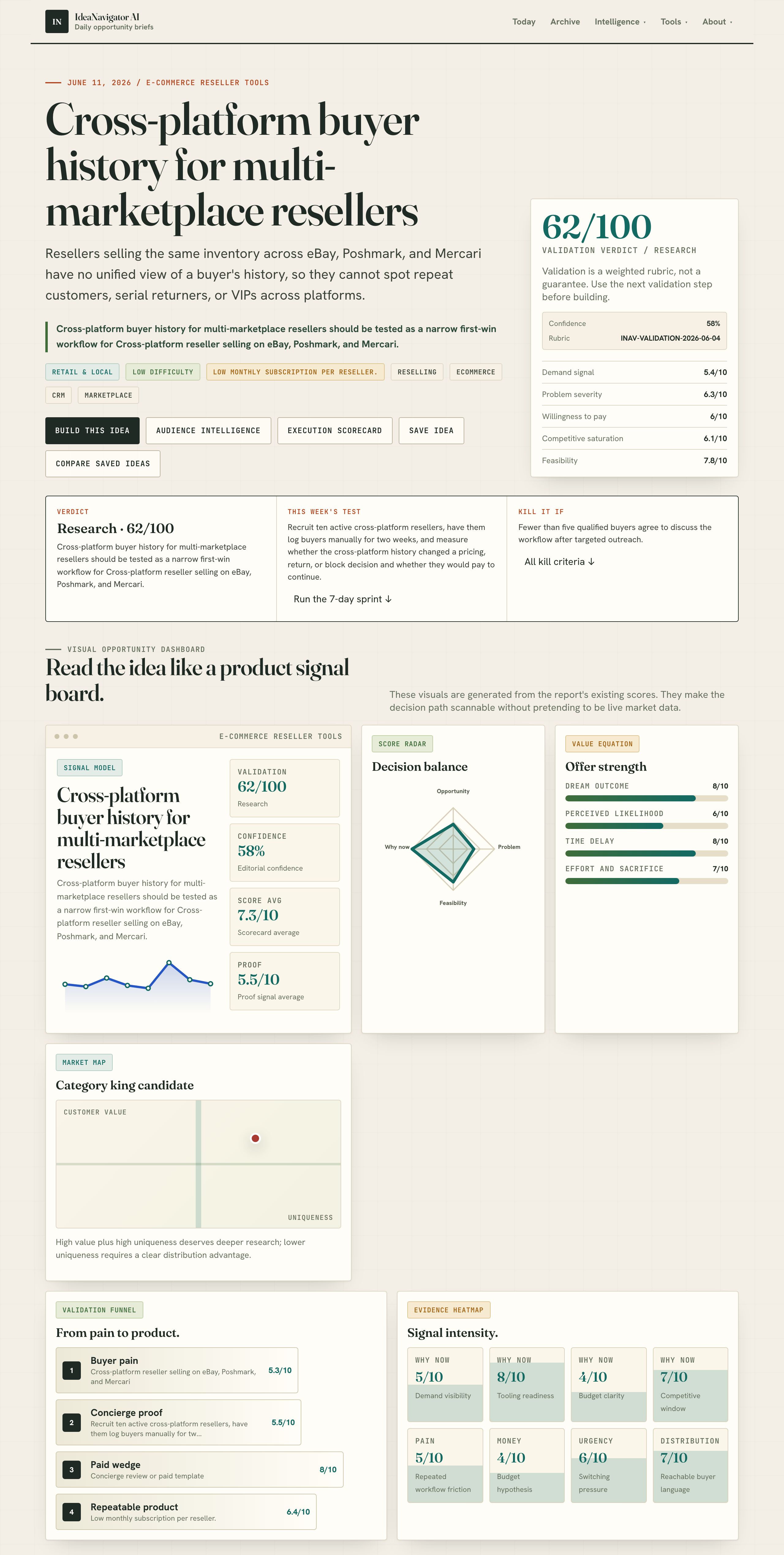
A new initiative is underway to create a manual cross-platform buyer history system for resellers operating on multiple marketplaces. Early testing aims to assess its impact on pricing, returns, and customer management.
Resellers operating simultaneously on eBay, Poshmark, and Mercari are beginning to test a manual buyer ledger designed to unify buyer data across platforms, aiming to improve decision-making and customer management.
The initiative involves resellers logging each sale manually, noting buyer handles, platform, items purchased, and relevant notes. This data is then searched to build a cross-platform buyer profile, enabling resellers to identify repeat customers, serial returners, or VIPs who operate across multiple marketplaces.
According to an anonymous researcher involved in the project, the goal is to validate whether access to cross-platform buyer history influences pricing strategies, return decisions, or blocking of problematic buyers. The test involves ten active resellers who will log buyer data over two weeks and report on any changes in their operational decisions.
This approach is seen as a low-cost, low-tech solution to a significant problem: each platform currently maintains siloed buyer data, making it difficult for resellers to recognize repeat or high-value customers across different marketplaces. The project aims to demonstrate whether a simple manual system can provide meaningful insights and justify further development.
Implications for Multi-Marketplace Reselling Efficiency
If successful, this manual buyer ledger could serve as a proof of concept for a cross-platform buyer history system, offering resellers a competitive edge through better customer insights. Recognizing repeat buyers or serial returners across platforms could lead to more tailored pricing, improved customer service, and reduced fraud or return rates.
While the current solution is manual, it highlights the need for integrated, automated tools that can handle cross-platform buyer data. The project may accelerate demand for such features in e-commerce reseller tools, potentially influencing future platform integrations or third-party solutions.
Products Worth Considering

Bose SoundLink Flex Bluetooth Speaker (2nd Gen), Waterproof, Dustproof, USB‑C, Up to 12 hr Battery, Black

Apple AirPods Pro 3 Wireless Earbuds with Active Noise Cancellation

Apple Watch SE (2nd Gen) GPS 40mm with Starlight Aluminum Case and Sport Band (S/M)
As an affiliate, we earn on qualifying purchases.
Growing Need for Cross-Platform Buyer Data Integration
Many individual resellers now list inventory across multiple marketplaces, including eBay, Poshmark, and Mercari. However, each platform operates in silos, with no shared buyer information, making it difficult to track customer behavior comprehensively. This fragmentation limits resellers’ ability to identify high-value customers or detect serial returners who operate across different sites.
Current tools primarily focus on platform-specific data, leaving a gap for cross-platform insights. Some resellers manually track buyers, but this approach is time-consuming and prone to errors. The recent testing initiative aims to explore whether a simple, manual system can provide initial proof of value.
“The goal is to see if a manual cross-platform buyer ledger can influence operational decisions like pricing and returns.”
— an anonymous researcher
Unclear Impact and Scalability of Manual Tracking
It is not yet confirmed whether the manual buyer ledger will significantly influence reseller decisions or lead to scalable automated solutions. The effectiveness of this approach remains to be validated after the two-week testing period, and broader adoption depends on its demonstrated value and ease of use.
Next Steps in Validating Cross-Platform Buyer Tracking
Following the current testing phase, resellers and developers will analyze the collected data to assess whether cross-platform buyer history impacts pricing, returns, or buyer management. If positive results emerge, the initiative could lead to the development of automated tools or integrated platform features, with plans to expand testing to a larger group of resellers.
Key Questions
How does the manual buyer ledger work?
Resellers log each sale with buyer handle, platform, item details, and notes in a simple record. They then search this log to view a buyer’s cross-platform activity.
Will this system replace automated solutions?
Currently, it is a manual proof-of-concept. If successful, it may inform the development of automated, integrated cross-platform buyer data tools in the future.
Who is testing this system?
Ten active resellers operating across eBay, Poshmark, and Mercari are participating in the two-week trial.
What are the potential benefits for resellers?
Better identification of repeat customers, improved pricing decisions, reduced fraud or serial returns, and enhanced customer management across multiple platforms.
Is this approach scalable?
Scalability remains uncertain; the manual process is labor-intensive, and success depends on whether it meaningfully influences reseller decisions.
Source: IdeaNavigator AI