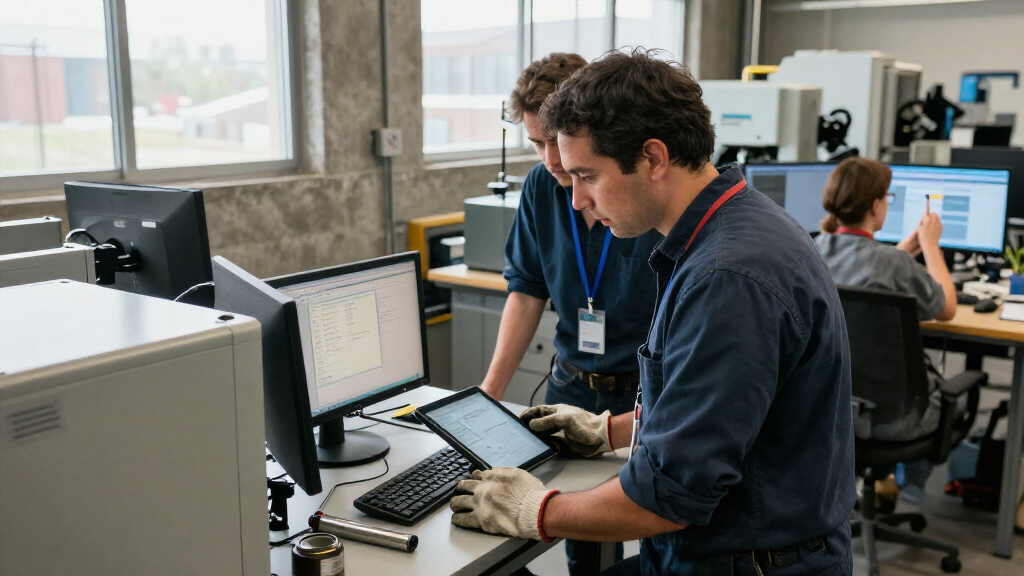

🔍 Read the full analysis: Field, Factory, And Office: Where Different Jobs Take Shape on ThorstenMeyerAI.com

Get the latest gadgets delivered free with Prime
- Fast, free delivery on millions of items
- Prime Video, Amazon Music and more included
- Member-only deals all year
TL;DR
ThorstenMeyerAI.com published the first episode of a 60-part series on how work and the economy change, introducing the primary, secondary and tertiary sectors. Its source material traces the long decline in agriculture’s share of employment and says services have employed more people worldwide than farming since 2001, based on ILO modelled estimates.
ThorstenMeyerAI.com published the first episode of Work After Work on November 2, introducing a 60-episode series about how economies and jobs change as technology develops. The opening installment uses the familiar division into primary, secondary and tertiary sectors to explain a long shift from farm work toward manufacturing and services, and says ILO modelled estimates put services ahead of farming in global employment from 2001.
The three-sector framework groups work by what it produces. The primary sector takes resources from nature, including farming, fishing and forestry; the secondary sector makes goods and builds infrastructure; and the tertiary sector covers services such as transport, trade, health care, education and government. The categories can vary: mining, for example, is placed differently in some statistical systems.
The article uses US and international figures to illustrate the shift. It cites economic historian Stanley Lebergott’s estimates that farming accounted for 73.7% of the US labor force in 1800, falling to 12.0% in 1950. It then gives an ILO modelled estimate of 1.5% for 2025. These figures have different sources and periods, so they describe a long-term change rather than one uniform series.
For other countries, the source reports that China’s primary-sector share of employment declined from 83.5% in 1952 to 22.2% in 2024, while Japan’s fell from 53.8% in 1920 to 3.2% in 2020. It also pushes back against the idea that the United States no longer makes goods: factory employment is about 35% below its June 1979 peak, but real manufacturing output in 2025 was about 1.9 times its 1979 level, according to the article.
How Jobs Move Across Sectors
The sector map matters because it describes more than the decline of one kind of work. It shows how employment can shift when productivity and technology change: fewer workers may be needed to produce food or manufactured goods, while more people earn a living in other activities. That distinction can help readers understand why falling factory employment does not automatically mean falling factory output.
The series also frames automation as a question about where workers go next. The episode presents historical arguments that service work absorbed people displaced from agriculture and industry, then signals that later installments will examine whether that pattern holds as machines take on more tasks. That is a question for the series to investigate, not a settled conclusion of the opening episode.
Products Worth Considering

Amazon Kindle Scribe (32GB) with Premium Pen, Tungsten

Jackery HomePower 3600 Plus Portable Power Station, 3584Wh, 3600W

LG UltraGear 32GX850A-B 32-inch 4K UHD Glossy OLED Gaming Monitor
As an affiliate, we earn on qualifying purchases.
A Model Built in the 1930s
The three-sector model took shape in economic writing during the 1930s and 1940s. The article credits New Zealand economist Allan G. B. Fisher with adding “tertiary” to the established terms “primary” and “secondary.” Fisher’s book, written in 1934 and published in 1935, set out the distinction; economist Colin Clark later compared sectoral employment across countries in his 1940 book, *The Conditions of Economic Progress*.
French economist Jean Fourastié argued in 1949 that services would absorb workers made less necessary by technological progress in farming and industry. The episode treats that proposition as a claim to examine across its wider series. Its own stated thesis—that automation could become a sector in its own right and perform up to 90% of work within a decade or a few decades—is explicitly a speculation, not a fact or forecast established by the employment figures.
““Within a decade or a few decades, automation could become a sector of its own, doing up to 90% of the work with no human hand.””
— Thorsten Meyer, in the episode’s stated thesis
Limits of the Sector Figures
The figures do not all use the same definitions, populations or methods. The source notes that mining’s classification varies by country and that a worker such as a software engineer at an automaker may be counted in manufacturing or services depending on the statistical system. Historical estimates, census counts and ILO modelled estimates should not be treated as a single perfectly comparable dataset.
The episode’s 90% automation figure is a personal thesis, and the source material does not provide a method, evidence base or precise definition of “work” for that estimate. It also does not establish how automation will affect employment in particular occupations, sectors or countries. Those questions remain open rather than answered by the historical trend alone.
The Series Turns to Automation
The first episode begins a planned daily run of 60 installments on how the economy is built, how work has moved and which tasks may remain human as machines take on more. According to the source, episode 48 will put Meyer’s automation thesis “on trial.” Until then, the series is expected to develop the argument through later examples, including the tractor and the chatbot.
The next useful test will be whether the series distinguishes automation’s technical ability to perform tasks from evidence that it has actually changed employment. The opening episode supplies historical employment comparisons; it does not yet quantify future job losses or gains. Those outcomes will depend on developments that remain uncertain.
Key Questions
What is the Work After Work series?
Work After Work is a daily series planned for 60 episodes by ThorstenMeyerAI.com. Its stated focus is how the economy is built, how work changes and which activities may remain human as machines take on more tasks.
What do the three sectors mean?
The primary sector extracts or grows resources from nature, the secondary sector manufactures or builds, and the tertiary sector provides services. Statistical definitions can differ, particularly for activities such as mining.
When did services overtake farming in global employment?
The source says ILO modelled estimates show services employing more people worldwide than farming from 2001. The statement refers to employment shares, not output or economic value.
Does the episode establish that automation will do 90% of work?
No. The figure is presented as Thorsten Meyer’s thesis about a possible future, not as a verified statistic or a finding established by the episode.
Source: ThorstenMeyerAI.com