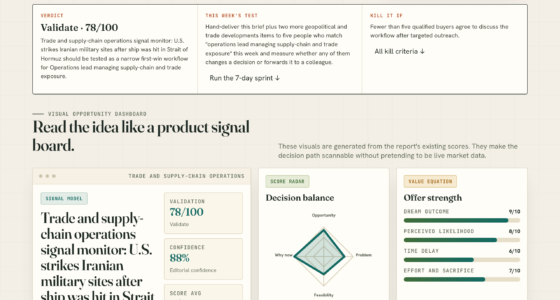

📊 Full opportunity report: The Compute Reckoning: Anthropic Finally Admits What Customers Suspected for Ten Months on ThorstenMeyerAI.com — validation score, market gap, and execution plan.
Open a free Amazon Business account
Business pricing, bulk buying and tax-exempt orders.
Create a free accountAs an affiliate, we earn on qualifying purchases.
TL;DR
Anthropic has officially acknowledged that its recent customer experience problems stem from insufficient compute capacity. The company announced a major deal with SpaceX to address this, marking a shift from a compute-constrained challenge to a resource-backed position.
Anthropic has officially admitted that its recent customer experience issues, including frequent rate limits and outages, were caused by a shortage of compute resources. The company announced a major deal with SpaceX to use the entire capacity of the Colossus 1 data center, marking a significant shift in its infrastructure strategy and addressing the root cause of its previous operational challenges.
On May 6, 2026, Anthropic announced an agreement with SpaceX to utilize over 300 megawatts of compute capacity at the Colossus 1 data center in Memphis, which includes more than 220,000 NVIDIA GPUs. This capacity is expected to be operational within the month. The move follows a ten-month period during which Anthropic gradually introduced throttling, rate limits, and outages, which users and observers had suspected were driven by compute shortages. The company’s own statement to Fortune in April confirmed that demand had outpaced infrastructure, leading to degraded user experiences. The deal with SpaceX, combined with existing commitments to Amazon, Google, Microsoft, and Fluidstack, elevates Anthropic from a compute-constrained challenger to a well-resourced frontier lab, significantly de-risking its infrastructure profile ahead of a potential IPO in late 2026.Ten months. One admission.
Anthropic finally got the compute. The customer-experience problem was scarcity all along.
May 6, 2026 — Anthropic announced SpaceX Colossus 1 deal · 300+ MW · 220,000+ NVIDIA GPUs · online within May. Effective immediately: Claude Code 5-hour rate limits doubled. Peak-hour throttling removed. API limits up 1,500% input / 900% output for Opus on Tier 1. Closes ten-month UX degradation arc. Compute risk in IPO disclosure framework materially de-risked.
multi-GW exploration
Nine moments. One constraint.
For ten months, Claude users experienced compute scarcity as broken product. Anthropic experienced it as the binding constraint on growth. May 6 closes the gap — at the announcement level. Verification follows.
Five partnerships. One arms race.
Anthropic now operates the second-largest publicly disclosed compute portfolio of any frontier lab — behind only Microsoft-OpenAI. Multi-vendor by design: Trainium + TPU + NVIDIA + custom · five major partners · multi-jurisdictional.
Three scenarios. Verification follows.
50/35/15 probability allocation. The May 6 announcement either delivers on customer experience improvements or doesn’t. Setup factors favor bullish: SpaceX execution capability, IPO incentive alignment.
- Online May 2026SpaceX capacity as announced.
- UX improvements stickDoubled limits, no peak throttle.
- Trust rebuilds Q3ARR growth continues.
- IPO Q4 2026 catalyzesPositive market response.
- Outcome: Compute reckoning is start of positive arc.
- Some delayCapacity partial through May.
- Mostly deliversSome peak-period gaps.
- Trust rebuild slowerThrough Q3-Q4.
- IPO early 2027Pushed if needed.
- Outcome: Continuation trajectory with friction.
- Capacity lateOr arrives in pieces.
- Partial improvementsIssues recur in different form.
- Competitive erosionOpenAI / Google gain share.
- IPO substantially delayedOr repriced.
- Outcome: Trust deficit compounds. Multi-quarter rebuild.
The era of “build your own compute” yields to “share compute across rival workloads when economics support it.” SpaceX/xAI’s flagship Memphis facility leases to a direct competitor — that’s how severe compute scarcity has become across the AI lab category.
Four assignments. By role.
Verify actual delivery vs announced.
Test the doubled rate limits in your workflow. Monitor performance through May-June. Consider whether to retain, upgrade, or cancel based on demonstrated improvement rather than announced improvement. The trust deficit from ten months of degradation requires sustained performance to repair. Anthropic has incentive to deliver — IPO timing depends on it.
Re-architect for new headroom.
1,500% input / 900% output Tier 1 increase is substantial. Scale rate-limit-bottlenecked applications. The structural implication: Anthropic now competitive with OpenAI on API capacity, narrowing what had been meaningful OpenAI advantage. Document delivered vs announced capacity in your monitoring.
Update models · compute risk de-risked.
The compute risk factor in the Anthropic IPO disclosure framework is materially de-risked. Q3-Q4 2026 IPO window becomes more credible. Valuation case strengthens — $30B ARR, $400-500B precedent from frontier-lab benchmarks, credible compute portfolio. Position based on demonstrated delivery through Q2-Q3 2026.
Direct demand validation for Q1 FY27 print.
220K+ GPUs from SpaceX deal alone. Aggregate NVIDIA-attributable demand from Anthropic’s compute portfolio plausibly $20-40B over 2026-2028. NVIDIA Q1 FY27 dispatch bull case gets concrete numbers. Hyperscaler capex thesis demand-pull validation gets specific evidence. Watch May 20 print for confirmation.
Implications of the Compute Capacity Expansion
This development marks a turning point for Anthropic, transforming its operational landscape. The acknowledgment of compute scarcity as the cause of customer issues clarifies the reasons behind the recent throttling and outages. Securing substantial compute resources from SpaceX not only addresses these immediate challenges but also positions Anthropic to scale its Claude models more reliably. This shift reduces the perceived risks associated with infrastructure limitations, potentially influencing investor confidence ahead of the company’s planned IPO. Furthermore, the partnership with SpaceX hints at future ambitions for orbital AI compute, indicating a strategic move into space-based AI infrastructure, which could redefine the competitive landscape for AI labs.
As an affiliate, we earn on qualifying purchases.
Background of the Compute Scarcity and Customer Impact
Throughout 2025, Anthropic faced increasing criticism from users over throttling, rate limits, and outages, especially during peak hours. Starting in July 2025, the company introduced weekly rate limits for its Pro and Max plans, which were gradually intensified through early 2026. By March 2026, peak-hour throttling was implemented, and subscribers with Max plans faced quotas as low as 19 minutes of continuous usage. Internal memos from OpenAI leaked to CNBC described Anthropic’s situation as a ‘strategic misstep’ resulting from insufficient compute capacity, which hindered product performance and user experience. Prior to the May 6 announcement, Anthropic publicly acknowledged that demand for Claude had grown at an unprecedented rate, stretching their infrastructure to its limits, especially during peak periods.
“Anthropic’s admission confirms that the recent customer issues were driven by a significant compute shortage, a problem they have now begun to address with a major new capacity deal.”
— Thorsten Meyer, author
“Demand for Claude has grown faster than our infrastructure could handle, leading to throttling and outages. The new capacity from SpaceX will fundamentally change this.”
— Anthropic spokesperson, Fortune interview
As an affiliate, we earn on qualifying purchases.
Remaining Questions About Future Capacity and Strategy
While the capacity from SpaceX is now secured, it remains unclear how quickly the infrastructure will scale to meet future demand beyond the initial deployment. The long-term implications of the orbital compute ambitions and how they will integrate with terrestrial infrastructure are still speculative. Additionally, the precise impact on Claude’s product development and competitive positioning in the AI market has yet to be fully realized or disclosed.
As an affiliate, we earn on qualifying purchases.
Upcoming Steps for Anthropic and Industry Impact
Anthropic is expected to fully deploy the SpaceX capacity within the coming weeks, which should lead to a stabilization of user experience and removal of throttling. The company will likely continue expanding compute commitments with existing partners like Amazon, Google, and Microsoft, further solidifying its infrastructure backbone. Monitoring will focus on how these capacity increases affect product performance, user growth, and the company’s IPO prospects. Additionally, industry observers will watch for developments in SpaceX’s orbital AI ambitions and how they might influence terrestrial AI infrastructure strategies.
As an affiliate, we earn on qualifying purchases.
Key Questions
What caused Anthropic’s recent customer experience issues?
The issues were primarily caused by a shortage of compute capacity, which led to throttling, rate limits, and outages during peak usage times.
How does the SpaceX deal change Anthropic’s infrastructure?
The deal provides over 300 MW of compute capacity from SpaceX’s Colossus 1 data center, significantly increasing Anthropic’s ability to support large-scale AI workloads.
Will this capacity be enough to meet future demand?
While the initial deployment addresses current shortages, it is still uncertain how quickly capacity will scale further or how it will handle future growth beyond this deployment.
What does this mean for Anthropic’s market position?
Securing substantial compute resources positions Anthropic as a better-resourced competitor, reducing infrastructure-related risks ahead of its IPO and enhancing its ability to scale models reliably.
Are there broader implications for the AI industry?
The partnership with SpaceX and the focus on orbital AI compute suggest a potential shift toward space-based AI infrastructure, which could influence the future landscape of AI development and deployment.
Source: ThorstenMeyerAI.com
Flea & tick season Picks
flea and tick prevention
As an affiliate, we earn on qualifying purchases.