
TL;DR

Get the latest gadgets delivered free with Prime
- Fast, free delivery on millions of items
- Prime Video, Amazon Music and more included
- Member-only deals all year
Building a DIY AI workstation used to save money, but rising component costs and shortages now often make prebuilt systems more cost-effective and reliable. Your choice depends on speed, control, and support needs more than just price.
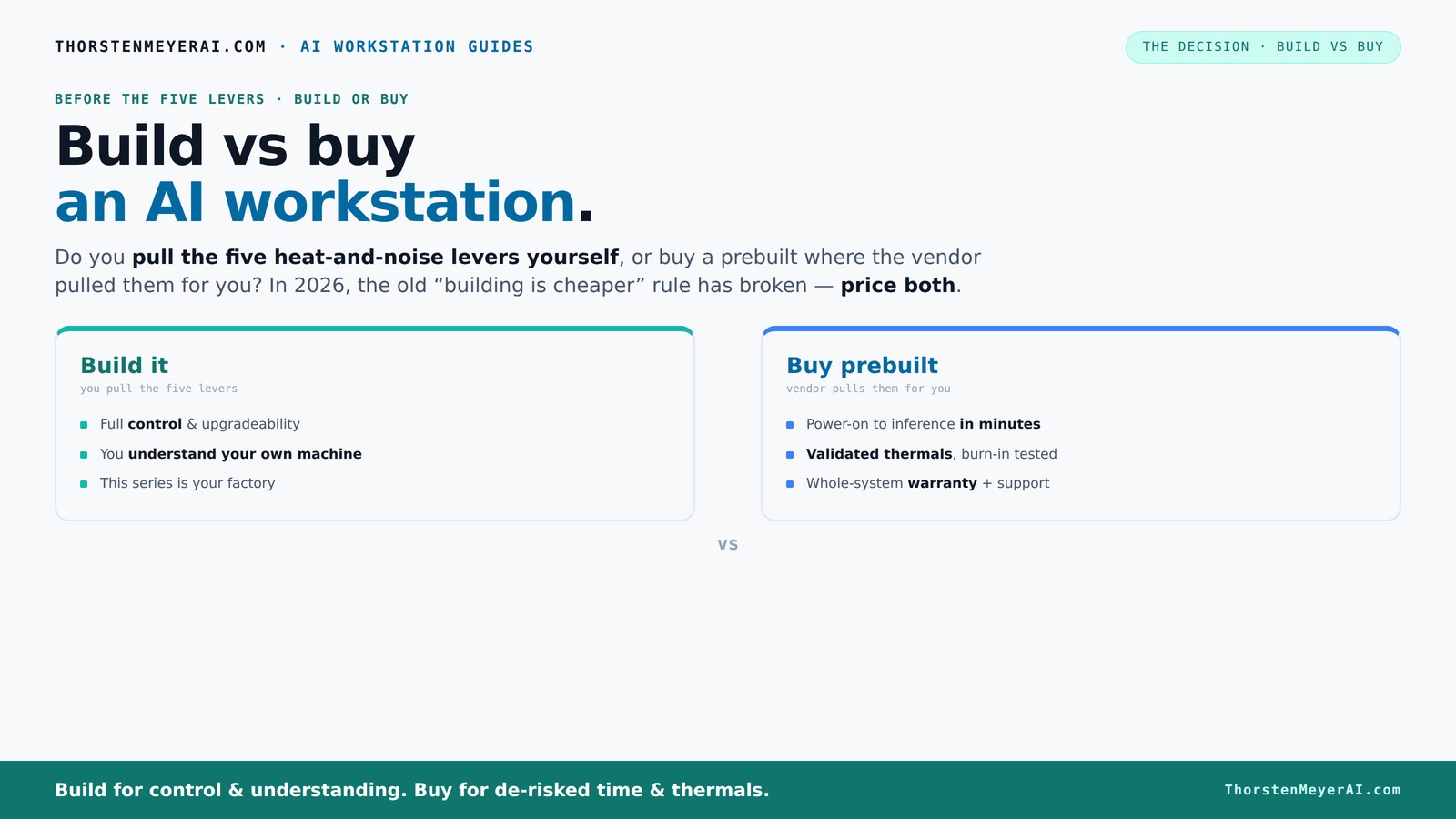
Build vs buy
an AI workstation.
The real question behind this whole series: do you pull the five heat-and-noise levers yourself, or buy a prebuilt where the vendor pulled them for you? And in 2026, the old “building is cheaper” rule has broken. Match your situation in Part 3.
Key Takeaways
- In 2026, bulk buying and component shortages make prebuilt AI workstations often cheaper or equal in price to DIY builds.
- Building offers maximum control and customization, but requires technical skill and time investment.
- Prebuilts come with validated thermals, support, and warranties, reducing setup risk.
- Upgrade paths depend heavily on whether the system uses standard or proprietary parts.
- Your choice hinges on speed, control, and support needs more than just initial cost.
high performance AI workstation prebuilt
As an affiliate, we earn on qualifying purchases.
As an affiliate, we earn on qualifying purchases.
Why Building Your Own AI Workstation Was Cheaper — Until 2026
Building your own AI rig used to cut costs significantly. You picked each component, avoided unnecessary features, and saved hundreds. But recent market shifts changed the game.
Component shortages drive prices up for GPUs, RAM, and SSDs, making DIY builds more expensive than before. For insights on building AI workstations, see Build vs Buy a Prebuilt AI Workstation. For example, a GPU that cost around $800 in 2024 can now hit $1,200 or more, just because supply dried up.
Meanwhile, prebuilt vendors bought in bulk, locking in lower prices and passing some savings to you. The result? A prebuilt system now often costs the same or less than a DIY, with less hassle.
Beyond cost, this shift influences the decision-making process. The tradeoff now leans more toward convenience and reliability than purely price. When DIY becomes more expensive, the incentive to build diminishes, especially for those who value time and stability over customization.
customizable AI GPU workstation build
As an affiliate, we earn on qualifying purchases.
As an affiliate, we earn on qualifying purchases.
Decoding the 'Build vs Buy' Decision: Control or Convenience?
Choosing between build and buy boils down to what matters most: control or convenience. Learn more about building AI workstations and the options available. Building gives you the freedom to pick each part—quiet GPUs, custom cooling, specific RAM sizes. You tune the machine for your exact workload.
Buying prebuilt means trusting experts to do the thermal engineering, testing, and validation for you. They run rigorous stress tests, tune fans, and often include water-cooling that’s whisper-quiet. It’s ready to fire up, saving you hours of setup time.
However, the core tradeoff extends beyond mere time savings. When you build, you gain control over every component, which is crucial for specialized AI workloads demanding specific configurations or future upgrades. For tips on upgrading and future-proofing, visit bestcadpapers.com. But this control comes with the responsibility of ensuring compatibility, effective cooling, and stability—areas where DIYers often have to learn through trial and error. Conversely, prebuilt systems are designed with optimized thermal performance and tested configurations, reducing the risk of bottlenecks or failures that could compromise your AI tasks. This means less downtime and more predictable performance, especially important in high-stakes environments where reliability is paramount.
quiet and cool AI workstation case
As an affiliate, we earn on qualifying purchases.
As an affiliate, we earn on qualifying purchases.
Performance and Cost: Which Gets You the Most Bang for Your Buck?
| Factor | Build Your Own | Prebuilt System |
|---|---|---|
| Cost in 2026 | Often higher due to shortages and markups, especially for high-end parts. | Typically competitive or lower, thanks to bulk purchasing and validation. |
| Performance | Fully customizable; can optimize for specific workloads, but requires effort to fine-tune and ensure compatibility. | Engineered for high performance, with validated configurations and thermal tuning, providing reliable results without extensive tinkering. |
| Upgradeability | Depends on standard parts; easier to upgrade with compatible components, allowing tailored future enhancements. | Varies; some systems use proprietary parts or integrated designs, which can hinder future upgrades or increase costs. |
professional AI workstation components
As an affiliate, we earn on qualifying purchases.
As an affiliate, we earn on qualifying purchases.
Time to Get Your AI System Running — Prebuilt Wins
If speed matters, prebuilt systems are the clear winners. They come with everything installed, tested, and ready to go.
Imagine you're a data scientist with a deadline. You order a prebuilt AI workstation, and within a day or two, it’s humming in your office, ready for training models. No fuss, no waiting for parts, no BIOS tweaks.
Building from scratch might take a week or more — sourcing parts, assembling, troubleshooting, and testing. For many, that delay isn’t worth the savings, especially when time equals money. The ability to deploy quickly can be critical in competitive or time-sensitive projects, making prebuilt systems the strategic choice for professionals who need immediate results.
Support, Warranty, and Peace of Mind — Why Prebuilt Wins. For more on reliable AI systems, see energylast.com.
When things go wrong, you want a partner, not a puzzle. Prebuilt vendors offer support, warranties, and troubleshooting that DIY can't match.
For example, if your GPU starts throttling under load, a prebuilt vendor will diagnose and fix it—often under a 3- or 5-year warranty. DIYers must identify the problem, order parts, and fix it themselves, which can introduce delays and uncertainty. This kind of support reduces downtime and mitigates the risks of costly errors, providing peace of mind especially when AI workloads are critical to your operations.
Additionally, prebuilt systems often undergo extensive burn-in testing and quality assurance, ensuring stability and performance from day one. For users who depend on consistent results, this comprehensive support and validation process can be the difference between success and costly troubleshooting.
Upgrade Path and Future-Proofing: Standardized Parts or Proprietary Hurdles?
Upgrading your AI workstation later depends on whether the system uses standard parts. For guidance on hardware compatibility, check bestcadpapers.com. Prebuilts with proprietary connectors or custom motherboards can turn future upgrades into headaches, forcing you to replace entire systems or pay premium prices for compatible components.
In contrast, a DIY build with standard ATX components makes swapping out GPUs, adding RAM, or upgrading storage straightforward—saving money and hassle down the line. This flexibility can extend the lifespan of your system and adapt to evolving AI workloads without major overhauls.
Think about it: you want to add a second GPU in two years. Will your prebuilt allow that? Sometimes, proprietary cases or power supplies block future expansion, forcing additional investments or limiting your growth. Recognizing these tradeoffs helps prioritize systems that balance current needs with future scalability.
Who Should Build, Who Should Buy?
If you love the process, have time, and want full control, building your own AI workstation offers unmatched customization and potential savings. Hobbyists, students, and researchers often fall into this camp because they value the learning experience and tailored configurations.
But if you prefer a quick, reliable setup with support, a prebuilt system minimizes hassle and risk. Business users, startups, or anyone needing immediate access should consider prebuilt options to ensure predictable results and faster deployment.
Remember, in 2026, the decision isn’t just about price — it’s about workflow, risk, and peace of mind. Your choice should align with your priorities, whether that’s control or convenience, long-term flexibility or immediate results.
Frequently Asked Questions
Is it cheaper to build or buy an AI workstation in 2026?
Thanks to market shifts and component shortages, prebuilt systems often cost the same or less than DIY builds today. Always compare specific configurations before deciding.Which option offers better performance for AI workloads?
Both can deliver top performance; prebuilts are tested under load and optimized for thermals. Building allows custom tuning, but requires effort to match that performance.How much time does a prebuilt system save compared to building from scratch?
Prebuilts are ready to run within a day or two. Building your own can take a week or more, including sourcing, assembly, and troubleshooting. For urgent needs, this time difference can be critical, influencing the overall project timeline and resource allocation.Are prebuilts reliable, or do they cut corners?
Reputable vendors rigorously test and validate their systems, often offering warranties. Cheaper or lesser-known prebuilts may cut corners, so research is key. Reliability impacts uptime, data integrity, and your confidence in AI deployment, making this a crucial consideration.Can I upgrade a prebuilt AI workstation later?
Depends on the system’s design. Standard parts are easier to upgrade, while proprietary components can limit future expansion. Check compatibility before purchasing. This impacts your ability to adapt to evolving AI demands without replacing the entire system, affecting long-term value.Conclusion
Choosing between build and buy for an AI workstation boils down to your priorities. Want instant deployment and support? Prebuilt is your friend. Crave control and customization? Building might still be your best move. In 2026, the smartest choice balances cost, workflow, and peace of mind—so pick what feels right for your AI journey.Fall Picks
fall essentials
As an affiliate, we earn on qualifying purchases.