
TL;DR
Open a free Amazon Business account
Business pricing, bulk buying and tax-exempt orders.
Create a free accountAs an affiliate, we earn on qualifying purchases.
AI mini PCs built around AMD Ryzen AI and Intel Core Ultra chips have become a mainstream desktop category in 2026, and a new 10-model roundup from Thorsten Meyer AI names the MINISFORUM AI X1 Pro the best overall pick. The guide compares 10 models across three brands on processor, storage, cooling and graphics, with the main tradeoffs being raw power, expandability and price. Vendor AI performance figures, such as TOPS ratings, remain manufacturer claims rather than independently verified results.
Mini PCs with dedicated AI hardware have moved from a niche to a mainstream desktop category in 2026, and a new 10-model roundup from Thorsten Meyer AI names the MINISFORUM AI X1 Pro — built on AMD’s Ryzen AI 9 HX370 with Radeon 890M graphics — as the best overall choice in its 2026 AI mini PC rankings. The guide matters for buyers because machines small enough to sit behind a monitor now ship with the NPUs, up to 128GB of memory and multi-terabyte SSD options needed to run AI workloads locally, a task that until recently demanded a full-size workstation or a cloud subscription.
The roundup compares 10 models across three brands — MINISFORUM, GEEKOM and GMKtec — on processor, storage, cooling and graphics, echoing the broader field covered in our own 15 best mini PCs in 2026 guide. The top pick, the MINISFORUM AI X1 Pro, pairs the 12-core, 24-thread Ryzen AI 9 HX370 (up to 5.1 GHz) with Radeon 890M graphics, support for up to 128GB of DDR5 RAM at 5600MHz, and three PCIe 4.0 SSD slots for as much as 12TB of total storage, according to the guide’s spec table.
For professional AI productivity, the guide points to the GEEKOM A9 Max, whose listing cites an XDNA 2 NPU rated at up to 55 TOPS and 86 TOPS of total AI performance — figures supplied by the vendor rather than independently tested. The GEEKOM IT15 is the leading Intel-based option, with a Core Ultra 9 285H (16 cores, up to 5.4 GHz), Arc 140T graphics and a 1TB NVMe Gen 4 SSD. At the high end, the GMKtec EVO-X2 runs AMD’s Ryzen AI Max+ 395 with a Radeon RX 8060S GPU (40 compute units) and 128GB of LPDDR5X memory, and is listed with support for up to four 8K displays.
Across the list, WiFi 7, USB4 and multi-display 8K output are standard on premium models, while storage ranges from 1TB to 2TB of PCIe 4.0 SSD in default configurations. Cooling designs vary, from independent CPU and SSD fans in the MINISFORUM unit to GEEKOM’s IceBlast 3.0 thermal system and GMKtec’s dual-fan copper-base setup, per the guide.
How AI Mini PCs Are Changing Tech in 2026
Machines small enough to hide behind a monitor now ship with dedicated NPUs, up to 128GB of memory and multi-terabyte SSDs — enough to run language models, image generation and video work locally. A new 10-model roundup names the MINISFORUM AI X1 Pro the best overall pick of the year.
How NPU Chips Built This Category
Two processor families — AMD’s Ryzen AI series and Intel’s Core Ultra line — put dedicated neural engines alongside CPU and GPU cores. Mini PC specialists now differentiate on memory ceilings, SSD expansion and display output rather than the chips themselves.
One package handles classic compute, graphics and AI throughput measured in TOPS.
HX370 and flagship Ryzen AI Max+ 395 from AMD; Ultra 9 285H and 185H from Intel.
MINISFORUM, GEEKOM and GMKtec build 2026 lineups around the same silicon.
On-device language models, image generation, video editing and 3D rendering — no cloud rent.
Top Picks at a Glance
Four machines define the 2026 field — from the balanced best-overall choice to a 128GB flagship that trades upgradability for raw power.
MINISFORUM AI X1 Pro
12 cores / 24 threads up to 5.1GHz, support for 128GB DDR5 at 5600MHz and three PCIe 4.0 SSD slots for up to 12TB. Independent CPU and SSD fans keep it cool.
GEEKOM A9 Max
Listing cites an XDNA 2 NPU at up to 55 TOPS and 86 TOPS total AI performance — figures supplied by the vendor, not independently tested.
GEEKOM IT15
The leading Intel-based pick: 16 cores up to 5.4GHz, Arc 140T graphics and a 1TB NVMe Gen 4 SSD in the default configuration.
GMKtec EVO-X2
40 compute units of Radeon graphics, 128GB of soldered LPDDR5X, dual-fan copper-base cooling and support for up to four 8K displays.
Head-to-Head: The Front Runners
Across premium models, WiFi 7, USB4 and multi-display 8K output are standard. The real separation comes from thermals, ports and upgrade headroom.
| Rank | Model | Processor | Graphics / NPU | Memory | Storage | Claims Check |
|---|---|---|---|---|---|---|
| #1 | MINISFORUM AI X1 ProBest Overall | Ryzen AI 9 HX370 12C/24T · 5.1GHz |
Radeon 890M | Up to 128GB DDR5 · 5600MHz | 3× PCIe 4.0 slots · 12TB max | ✓ Per guide spec table |
| #2 | GEEKOM A9 MaxPro AI Productivity | Ryzen AI 9 HX XDNA 2 NPU |
55 TOPS NPU · 86 TOPS total | DDR5 (config varies) | PCIe 4.0 SSD | ~ Vendor-supplied TOPS |
| #3 | GEEKOM IT15Best Intel | Core Ultra 9 285H 16C · 5.4GHz |
Arc 140T | DDR5 (config varies) | 1TB NVMe Gen 4 | ✓ Per guide listing |
| #4 | GMKtec EVO-X2High-End Flagship | Ryzen AI Max+ 395 | Radeon RX 8060S · 40 CU | 128GB LPDDR5X · soldered | PCIe 4.0 SSD | ~ RAM not upgradeable |
The Claims Behind the Marketing
TOPS — trillions of operations per second — is the industry’s shorthand for AI throughput. Treat headline figures as manufacturer claims, not benchmark results.
“The key tradeoffs often involve choosing between raw power, expandability, and price.”
— Thorsten Meyer AI Buying Guide“Expandability options such as RAM and SSD slots are critical for future-proofing, especially for demanding AI workloads.”
— Guide · Key Takeaways“AI Performance: 86 TOPS. NPU: XDNA 2 NPU up to 55 TOPS.”
— GEEKOM A9 Max Listing, as citedPower ↔ Price: Where the Field Splits
Premium models deliver more power and room to grow; cheaper options cover essential AI tasks. The same HX370 appears in several competing models — thermals and upgrade headroom set them apart.
Core AI Tasks
Cheaper options cover everyday NPU-accelerated work with 1TB–2TB PCIe 4.0 storage in default configs.
Power + Headroom
The X1 Pro formula: strong HX370 silicon, 128GB RAM ceiling and three SSD slots for future growth.
No-Compromise Rigs
EVO-X2 territory: Max+ 395, 40-CU graphics and four 8K displays — with soldered memory as the trade.
Where Listings and Claims Diverge
Several points in the source material remain unconfirmed or inconsistent. Check these before treating any spec sheet as settled fact.
UnverifiedTOPS Ratings
The 86 TOPS total and 55 TOPS NPU figures are manufacturer or listing claims — not independent benchmark results.
LabelingCopy Discrepancies
The A9 Max appears as both HX470 and HX 370; a 64GB EVO-X2 is tagged Ryzen 5 3950 — likely copy errors, not distinct hardware.
PricingNot Fixed
Prices vary by configuration and retailer, and the guide does not lock them in — expect movement through 2026.
LongevityShort Refresh Cycles
All three brands update lineups frequently; newer Ryzen AI and Core Ultra variants will reach mini PCs through 2026.
From NPU Silicon to Mainstream Desktop
What to Watch in 2026
The guide’s advice distilled into four checks — memory capacity, not headline processor numbers, is usually the binding constraint for local AI.
Prioritise Upgradeable RAM & SSD
Slots beat headline processor numbers — memory capacity limits which models you can run locally.
Beware Soldered Memory
High-end models like the 128GB EVO-X2 use LPDDR5X soldered to the board — no upgrades later.
Check Software Compatibility
NPU value depends on how fast desktop AI apps and OS features adopt these chips — verify for your workload.
Expect Frequent Refreshes
New Ryzen AI and Core Ultra variants arrive through 2026 — today’s flagship chip may be mid-range by winter.
The guide treats 32GB DDR5 as the practical baseline across most picks, with 64GB–128GB reserved for larger local models and heavier multitasking.
Quick Answers
What is an AI mini PC?
A compact desktop — small enough to mount behind a monitor — built around a processor with a dedicated NPU, such as AMD Ryzen AI or Intel Core Ultra, paired with up to 128GB RAM and multi-TB SSDs.
Which is the best overall pick?
Per the Thorsten Meyer AI roundup: the MINISFORUM AI X1 Pro — Ryzen AI 9 HX370, Radeon 890M, up to 128GB DDR5 and three PCIe 4.0 slots for up to 12TB.
How much memory do I need?
It depends on the models you run. 32GB is the practical baseline; 64–128GB covers larger local language models and heavy creative workloads.
Why Compact AI Desktops Matter Now
The roundup reflects a broader shift in 2026: AI inference is moving onto the desktop. Chips such as AMD’s Ryzen AI line and Intel’s Core Ultra series integrate NPUs alongside CPU and GPU cores, letting small-form-factor machines handle tasks like local language models, image generation, video editing and 3D rendering without renting cloud capacity.
For readers, the practical consequence is a changed buying calculation. A sub-litre desktop can now serve as an AI workstation, a multi-display content creation rig or a compact gaming machine, often with lower power draw and noise than a tower PC. The guide’s key takeaways frame the decision as a balance of processing needs, expandability, connectivity and budget — premium models deliver more power and room to grow, while cheaper options cover essential AI tasks. That framing gives buyers a concrete checklist in a market where spec sheets alone rarely settle the choice.
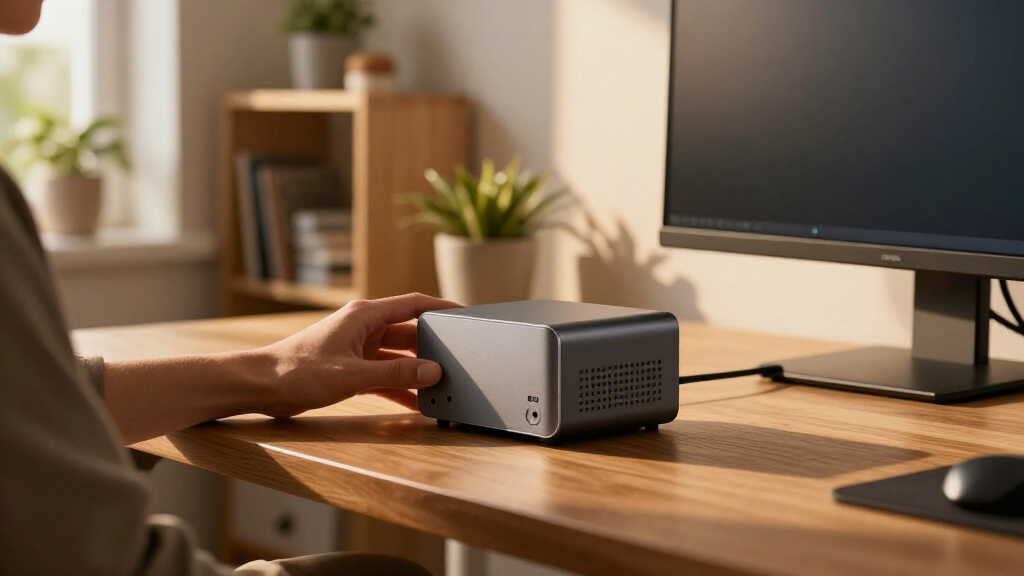
AI mini PC with AMD Ryzen AI 9 HX370
As an affiliate, we earn on qualifying purchases.
As an affiliate, we earn on qualifying purchases.
How NPU Chips Built This Category
The category rests on two processor families that brought dedicated AI engines to consumer desktops: AMD’s Ryzen AI series, led in this roundup by the HX370 and the flagship Ryzen AI Max+ 395, and Intel’s Core Ultra line, represented here by the Ultra 9 285H and Core Ultra 9 185H. Both pair conventional cores with NPUs marketed around TOPS (trillions of operations per second), the industry’s shorthand for AI throughput.
Mini PC specialists MINISFORUM, GEEKOM and GMKtec have built their 2026 lineups around those chips, differentiating on memory ceilings, SSD expansion and display output rather than on the processors themselves. The result, as the guide’s spec comparison shows, is a field where the same Ryzen AI 9 HX370 appears in several competing models and the real separation comes from thermals, ports and upgrade headroom.
“The key tradeoffs often involve choosing between raw power, expandability, and price.”
— Thorsten Meyer AI buying guide
Mini PC with 128GB RAM and PCIe 4.0 SSD slots
As an affiliate, we earn on qualifying purchases.
As an affiliate, we earn on qualifying purchases.
Where Listings and Claims Diverge
Several points remain unconfirmed or inconsistent. Vendor TOPS ratings — including the 86 TOPS total and 55 TOPS NPU figures attached to the GEEKOM A9 Max — are manufacturer or listing claims, not results from independent benchmark testing, and real-world AI performance depends heavily on software support for each NPU. The source listings also contain labeling discrepancies: the A9 Max is described with both a Ryzen AI 9 HX470 and an HX 370 in different entries, and a 64GB EVO-X2 variant is listed with a ‘Ryzen 5 3950’ designation that does not match the Ryzen AI Max+ 395 named elsewhere, suggesting copy errors rather than distinct hardware. Pricing is not fixed in the guide and varies by configuration and retailer, and it is not yet clear how long these specific chip generations will remain current as new models arrive through 2026.
AI mini PC for professional workloads
As an affiliate, we earn on qualifying purchases.
As an affiliate, we earn on qualifying purchases.
What to Watch Before Buying in 2026
Buyers weighing a purchase should expect frequent refreshes: all three brands update lineups on short cycles, and newer Ryzen AI and Core Ultra variants are likely to reach mini PCs through 2026. The guide’s advice is to prioritize upgradeable RAM and SSD slots over headline processor numbers, since memory capacity tends to be the binding constraint for local AI workloads — note that high-end models such as the 128GB EVO-X2 use soldered LPDDR5X, which cannot be upgraded later. On the software side, the value of NPU hardware will depend on how quickly desktop AI applications and operating-system features adopt these chips, so checking current software compatibility for a specific workload remains the sensible next step before committing.
Mini PC with WiFi 7 and multi-display support
As an affiliate, we earn on qualifying purchases.
As an affiliate, we earn on qualifying purchases.
Key Questions
What is an AI mini PC?
A compact desktop — typically small enough to mount behind a monitor — built around a processor with a dedicated NPU (neural processing unit), such as AMD’s Ryzen AI or Intel’s Core Ultra chips. In 2026 these machines pair that hardware with up to 128GB of RAM and multi-terabyte SSDs, letting them run AI tasks like local language models and image generation without cloud services.
Which AI mini PC is the best overall pick in 2026?
According to the Thorsten Meyer AI roundup, the MINISFORUM AI X1 Pro is the best overall choice, citing its AMD Ryzen AI 9 HX370, Radeon 890M graphics, support for up to 128GB of DDR5 RAM and three PCIe 4.0 SSD slots offering up to 12TB of storage.
How much memory do I need for local AI workloads?
It depends on the models you run, but the guide treats 32GB of DDR5 as the practical baseline across most of its picks, with 64GB to 128GB recommended for larger local models and heavy multitasking. Because some high-end machines use soldered LPDDR5X memory, buyers who expect their needs to grow should favor models with upgradeable RAM slots.
Are vendor TOPS ratings a reliable way to compare AI performance?
TOPS measures theoretical NPU throughput and is a manufacturer-supplied figure, not an independent benchmark. It is useful for rough comparisons within the same chip family, but actual performance depends on whether your software is optimized for that NPU, so it should not be the sole deciding factor.
What is the main tradeoff when choosing between these models?
As the guide puts it, the choice comes down to raw power, expandability and price. Premium models add faster chips, higher memory ceilings and more display outputs, while less expensive options cover essential AI tasks with fewer upgrade paths — so matching the machine to your actual workload matters more than chasing the top spec.
Source: Thorsten Meyer AI
NFL season / tailgating Picks
team gear
As an affiliate, we earn on qualifying purchases.