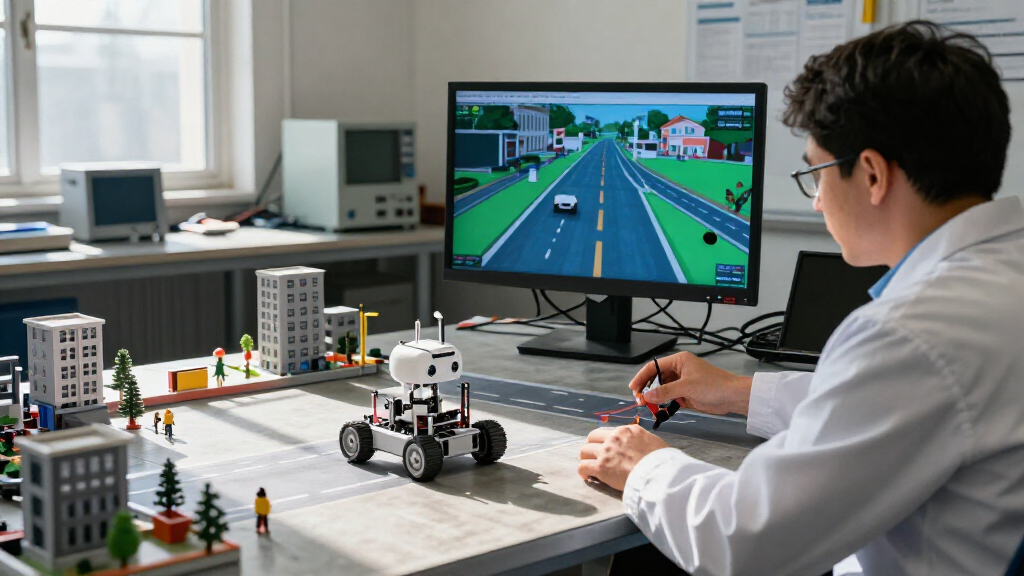

🔍 Read the full analysis: Can An AI That Simulates Worlds Understand The Real One? Genie 4 Explained on ThorstenMeyerAI.com

Get the latest gadgets delivered free with Prime
- Fast, free delivery on millions of items
- Prime Video, Amazon Music and more included
- Member-only deals all year
TL;DR
Google DeepMind describes Genie 4 as part of a path toward AGI because it can generate realistic environments for agents to explore. But the model has not been tested on the cited physics benchmark, and results for related video models show a gap between visual realism and physical understanding.
Google DeepMind presents Genie 4 as a step toward artificial general intelligence, arguing that realistic generated environments could let agents practice before operating in the physical world. But the model’s AGI relevance remains a research proposition, not a measured result: Genie 4 has not been evaluated on the physics benchmark cited in a November 1 analysis, and existing results for related video models show that visual realism does not by itself demonstrate understanding of physical rules.
On its Genie 4 model page, Google DeepMind says exploring “an unlimited range of realistic environments” is “a key stepping stone on the path to AGI.” The company’s stated case is practical: agents and robots need varied places to train, while real-world practice can be slow, expensive, risky or difficult to repeat. Generated worlds could supply scenarios that are rare or unsafe to stage outside a simulation.
The analysis by Thorsten Meyer points to two examples cited by DeepMind and Waymo. DeepMind reported in November 2025 that its game-playing agent SIMA 2 could follow instructions in worlds created by Genie 3 and improve itself in newly generated environments. In February 2026, Waymo said its driving simulator was built on Genie 3 and could generate unusual scenarios. These company reports suggest uses for generated environments; they do not establish that Genie 4 understands real-world physics.
A key qualification comes from Physics-IQ, a benchmark published by Google researchers in 2025. The researchers found video models’ physical understanding “severely limited, and unrelated to visual realism,” according to the source material. On Physics-IQ Verified, real videos score 100; the best image-to-video result among eight attempts was 55.1, while Gemini Omni 1.1 Flash scored 35.3. Genie 4 itself has not been tested on that benchmark, so those figures are not a direct score for Genie 4.
THE AGI CLAIM, VERSION BY VERSION
Three Genies, one promise
Google DeepMind has tied every recent Genie to the path to AGI. Here is what each version could do, what was claimed, and who said it.
- 4 Dec 2024Genie 23D worlds from one image, consistent for up to about a minute.“…the breadth and generality required to progress towards AGI.”Company claim
- 5 Aug 2025Genie 3First real-time Genie: 720p, 24 frames per second, a few minutes of consistency.“World models are also a key stepping stone on the path to AGI…”Company claim
- 13 Nov 2025SIMA 2 in Genie 3 worldsDeepMind's game agent orients itself and self-improves in newly generated worlds.“…a major milestone toward training general agents across diverse, generated worlds.”Company report
- 6 Feb 2026Waymo World ModelWaymo says its driving simulator is built on Genie 3 and can generate rare events.“…from a tornado to a casual encounter with an elephant.”Company report
- 27 Oct 2026Genie 4Photorealism, native sound, live text steering, Gemini in the loop. Trusted testers only.“…a key stepping stone on the path to AGI.”Company claim
- 31 Oct 2026TechRadar pushes backColumnist Eric Hal Schwartz: realism is not understanding.“Faking plausibility is easier than grasping the underlying rules…”Opinion
The Genie 2 and Genie 3 capability notes are DeepMind’s own descriptions. No Genie post measures progress toward AGI; DeepMind published no benchmark numbers for Genie 4.
Sources: Google DeepMind, Genie 2 (4 Dec 2024), Genie 3 (5 Aug 2025), SIMA 2 (13 Nov 2025), Genie 4 model page (read 1 Nov 2026); Waymo (6 Feb 2026); TechRadar (31 Oct 2026, opinion).
Powered by Thorsten Meyer AI
Why Realistic Practice Is Not Proof
The distinction matters for anyone deciding whether a system is ready to guide a robot, vehicle or business plan. A generated scene can be useful for rehearsing instructions or exploring possibilities, yet still depict events that do not obey the physical constraints of the real situation. A convincing clip is evidence of image generation quality, not by itself evidence that a system can predict what will happen when an object is pushed, a vehicle turns or a structure bears weight.
For companies, the near-term value may be in drafting and stress-testing scenarios, provided results are checked against real data and physical tests. The source analysis advises asking vendors for physics evaluations rather than relying on demonstration videos. For the public, “step toward AGI” should be read as Google’s description of a research direction, not as a benchmark finding that Genie 4 has achieved general intelligence.
There is also a broader research issue: agents may benefit from cheap, varied simulated practice, but only if skills learned there transfer to the real world. If a simulated environment omits important rules or behaves inconsistently, success inside it may not carry over. The available examples indicate that generated worlds are being explored as training tools; they do not settle how reliably that transfer works.
Products Worth Considering

Amazon Kindle Paperwhite (12th Generation, 2024), 16 GB, 7-inch Display, Jade

Amazon Kindle Scribe Colorsoft 64GB (1st Generation)

Logitech MX Brio Ultra HD 4K Webcam, Graphite
As an affiliate, we earn on qualifying purchases.
Three Meanings of World Model
The phrase “world model” covers different approaches. The source analysis distinguishes models that let an agent imagine and practice, systems that generate plausible video, and structured models built around data and rules. Genie 4 is described primarily as a video-generating model: it predicts subsequent frames based on earlier frames and user input, rather than relying on an underlying game engine or stored three-dimensional map. That can produce environments that look realistic without guaranteeing that their mechanics are correct.
The broader research idea predates Genie 4. In 2018, David Ha and Jürgen Schmidhuber described training an agent inside a learned model of a simple video game, then transferring the acquired skill back to the game. Google’s language about world models also predates Genie 4: DeepMind used similar “stepping stone” framing for Genie 3 in 2025 and described Genie 2 as pointing toward greater breadth and generality in 2024.
DeepMind’s approach is not presented as relying on generated pixels alone. According to the source, Genie 4 combines a Gemini model that plans a scene and checks frames with Genie, which generates them. DeepMind calls hybrid world models a promising direction. That design may help address weaknesses in purely visual simulation, but the source material provides no benchmark result showing how well Genie 4 performs on physical reasoning.
““The ability to explore an unlimited range of realistic environments is a key stepping stone on the path to AGI.””
— Google DeepMind, Genie 4 model page
What Genie 4 Has Not Shown
Genie 4 has no reported Physics-IQ score in the source material, and the benchmark results cited are for other models. It is not clear how well Genie 4 predicts physical outcomes, how consistently its environments follow real-world rules, or whether agents trained in them retain their skills outside simulation. The source also gives no benchmark numbers from Google that quantify Genie 4’s progress toward AGI.
The examples involving SIMA 2 and Waymo are reports from the organizations developing or using the systems. They show that generated worlds are being applied to agent training and driving simulation, but the source does not provide independent evaluations of real-world transfer or comparisons against other training methods. Those questions remain open.
Testing Transfer Beyond Simulations
The next meaningful evidence would include direct tests of Genie 4 on physical-reasoning benchmarks, with methodology and comparison results made public. Evaluations should also test whether agents trained in its generated environments perform better in unfamiliar simulations and, where safe, in real-world tasks. Until those results are available, Genie 4’s contribution to AGI remains an argument about the potential value of practice environments, rather than a demonstrated measure of general intelligence.
Key Questions
Has Google DeepMind shown that Genie 4 understands physics?
Not in the source material. Genie 4 has not been tested on the cited Physics-IQ benchmark, and DeepMind has not published benchmark numbers there demonstrating physical understanding.
What does Google mean by calling Genie 4 a step toward AGI?
DeepMind argues that agents may need many varied environments for training and testing, and that Genie 4 can generate such worlds. This is a research rationale, not a finding that Genie 4 is close to or has achieved AGI.
What did the Physics-IQ results show?
The source reports that real videos score 100 on Physics-IQ Verified, while the best image-to-video result among eight attempts scored 55.1. Gemini Omni 1.1 Flash scored 35.3. Neither score is a Genie 4 result.
Are generated worlds already being used?
DeepMind reported that SIMA 2 trained in Genie 3 worlds, and Waymo said its driving simulator was built on Genie 3. Those reports indicate practical use, but the source does not establish how reliably skills learned in simulation transfer to real-world performance.
Source: ThorstenMeyerAI.com