📊 Full opportunity report: How To Judge Financial Advice When You’ve Just Inherited on IdeaNavigator AI — validation score, market gap, and execution plan.

Get the latest gadgets delivered free — and shop member deals
- Fast, free delivery on millions of items
- Access to Prime Big Deal Days deals on October 6–7
- Prime Video, Amazon Music and more included
TL;DR
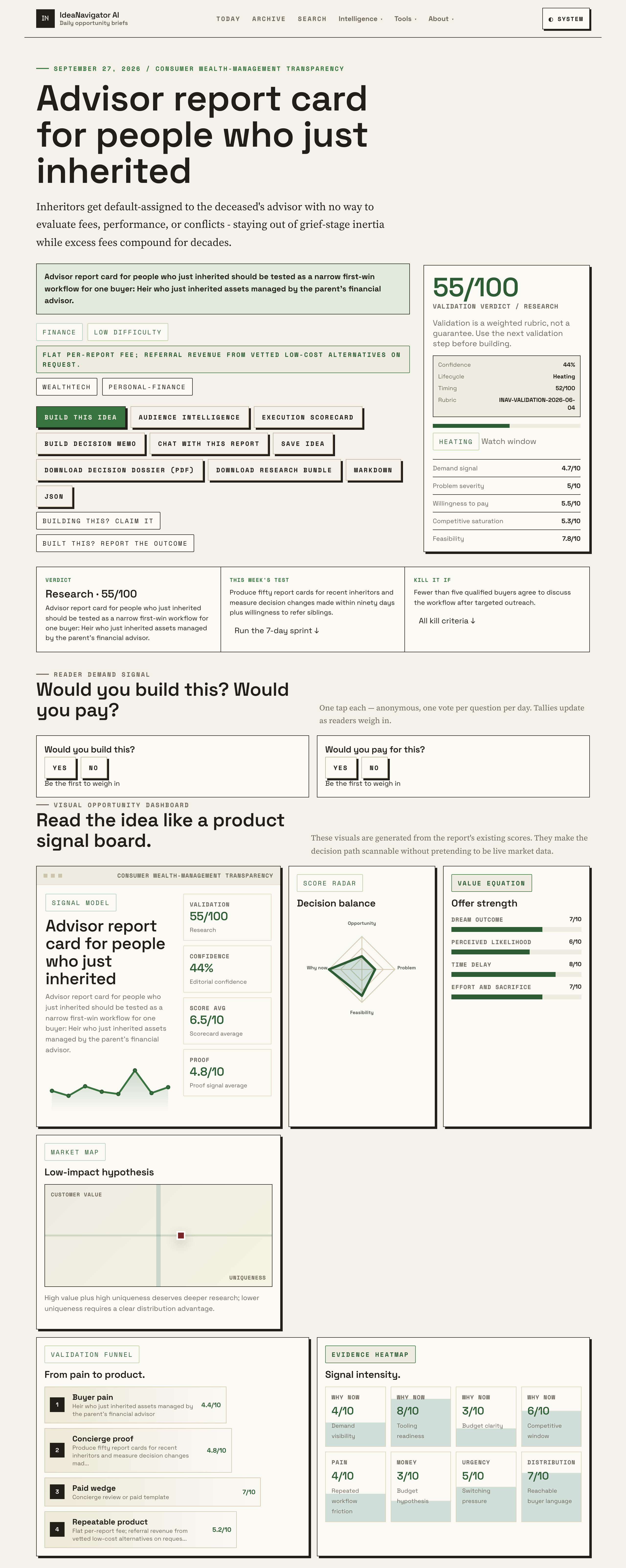
IdeaNavigator AI has outlined a proposed report card for people who inherit assets managed by a parent’s financial adviser. The concept would parse account statements and public disclosures to summarize fees, regulatory history and conflicts, but it has not been shown to be a launched product or a validated service.
IdeaNavigator AI has proposed a report card to help people who have just inherited assets assess the financial adviser who managed them for a deceased parent. The suggested service would analyze account statements and public disclosures to summarize fees, regulatory history and disclosed conflicts, then offer options to stay, negotiate or switch; no operating product or test results were provided.
The proposal targets a specific situation: an heir receives assets that remain with the parent’s financial adviser. IdeaNavigator AI says inheritors may continue with that adviser by default, particularly while dealing with a death, without having a clear way to compare costs, performance or conflicts. The proposal describes this as a problem to address, but supplies no research showing how often heirs face it or how much they pay.
The proposed minimum viable product would ask users to enter the adviser’s name and upload account statements. It would retrieve regulatory history and disclosed conflicts, estimate the account’s all-in fees from statements, and benchmark those costs against alternatives. Its report would include stay, negotiate or switch guidance and scripts for conversations with the adviser. The proposal does not explain which benchmarks would be used or how the service would verify its calculations.
The suggested business model combines a flat fee per report with referral revenue if a customer asks for vetted, lower-cost alternatives. IdeaNavigator AI recommends first producing 50 reports for recent inheritors, then measuring whether users change their decisions within 90 days and whether they would refer siblings. No reports have been described as completed, and no willingness-to-pay or customer outcome data was supplied.
A Check Before Inherited Assets Stay Put
The proposal focuses on a consequential decision that can arrive alongside bereavement: whether to keep financial assets with the adviser who served the deceased. A clear accounting of fees and disclosed conflicts could give heirs concrete questions to ask before allowing an existing arrangement to continue. The idea is especially relevant because the proposed customer is not every investor seeking financial advice, but an heir making a decision about an inherited account.
The possible benefit remains a proposition. Comparing costs does not by itself establish that a different adviser would produce better results, and a report’s usefulness would depend on accurate statement parsing, appropriate comparisons and clear treatment of uncertainty. Referral payments could also affect how alternatives are presented. The proposal says referrals would be made on request but provides no details on vetting standards, compensation disclosure or how recommendations would remain independent.
The Inheritance Advice Handoff
The concept is framed against a large transfer of wealth to heirs over the coming decade. IdeaNavigator AI describes that transfer as involving trillions of dollars, but the proposal gives no estimate, source or specific time period beyond “this decade.” The figure is therefore context asserted in the proposal, not a quantified finding established by the details provided here.
The suggested approach combines public regulatory information, including Form ADV and fee disclosures, with language-model tools that could extract information from documents. Those are the proposed inputs and methods; no technical evaluation, accuracy rate or regulatory review is reported. The development described is an idea for a narrowly targeted consumer service, rather than evidence that automated adviser comparisons are already reliable or widely available.
Accuracy, Fees and User Outcomes
Whether the service exists beyond the proposal is unclear. No launch date, price, completed analysis, customer interviews or test outcomes are stated. The proposal also does not specify how it would define and calculate all-in fees, select comparison advisers, account for differences in services, or handle incomplete and inconsistent statements.
It is also unclear what “performance” comparisons would mean in practice, since investment results can depend on asset mix, risk, time period and other factors. Regulatory history and disclosed conflicts would need context to avoid implying wrongdoing where a disclosure alone does not establish it. The proposal supplies no methodology for those judgments, and gives no details on privacy or retention for uploaded financial documents.
A 50-Report Validation Test
The next step proposed by IdeaNavigator AI is to prepare 50 reports for recent inheritors. The team would then track whether recipients changed a decision within 90 days and whether they would recommend the service to siblings. Those measures could offer an early indication of usefulness and referrals, but the proposal does not set out a schedule, recruitment method or standard for counting a decision change.
Until that test is reported, prospective users and advisers have no results to assess for accuracy, cost or impact. Any later account of the project would need to distinguish completed testing from the proposed plan and explain how the report handles fees, comparisons, conflicts and referral compensation.
Source: IdeaNavigator AI
Key Questions
What is the proposed advisor report card?
It is a proposed service for heirs whose inherited assets remain with a deceased parent’s adviser. The report would summarize fees, regulatory history and disclosed conflicts and offer stay, negotiate or switch guidance.
Has the report card launched?
The proposal provides no launch date and no evidence that the product is operating. It describes a minimum viable product and a planned validation test.
How would it make money?
The suggested model is a flat fee for each report, plus referral revenue when users request vetted lower-cost alternatives. Pricing and referral safeguards are not specified.
How would the idea be tested?
IdeaNavigator AI proposes producing 50 reports for recent inheritors and measuring decision changes within 90 days, along with willingness to refer siblings. No results from this test are available in the proposal.
Source: IdeaNavigator AI
Fall Picks
fall essentials
As an affiliate, we earn on qualifying purchases.