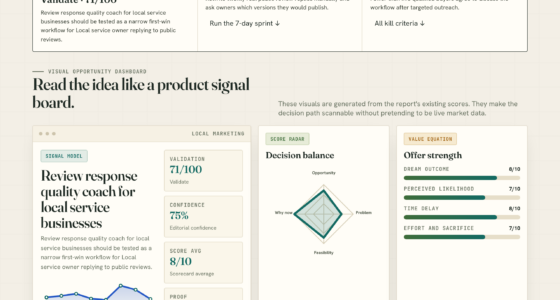
📊 Full opportunity report: The Bubble Is Not in Valuations: It’s in the Productivity Gap on ThorstenMeyerAI.com — validation score, market gap, and execution plan.

Get the latest gadgets delivered free — and shop member deals
- Fast, free delivery on millions of items
- Access to Prime Big Deal Days deals on October 6–7
- Prime Video, Amazon Music and more included
TL;DR
In 2026, the main AI bubble is not in stock valuations but in inflated expectations of productivity gains. Measured data shows minimal impact, yet corporate projections and market prices suggest otherwise, risking a structural disconnect.
New evidence in May 2026 shows that the core AI bubble is not in stock valuations but in corporate and market expectations of productivity gains that have not yet materialized, highlighting a potential misalignment between expectations and reality.
Recent data from the National Bureau of Economic Research (NBER) reveals that 90% of firms report no measurable AI impact on productivity, despite 76% citing AI in strategic plans and earnings calls. Meanwhile, the median forward revenue multiple for AI-exposed companies reached 22× in Q1 2026, compared to 7× for the S&P 500, with Palantir’s price-to-sales ratio at 86. These figures suggest a valuation bubble driven by inflated expectations.
However, the actual productivity gains from AI are limited and concentrated in narrow tasks such as code generation, customer support, and document processing, with measured improvements generally below 50%. The executive projection of a 1.4% median productivity increase indicates a significant gap between market expectations and measurable impact. This discrepancy points to a potential structural bubble rooted in expectation rather than asset prices alone.
Why the Expectation Bubble in AI Matters for Investors
This disconnect between expectations and reality could lead to a sharp correction in stock prices if measured productivity fails to meet projections, risking financial losses and strategic missteps. The structural nature of this expectation bubble means its correction could have long-term implications for corporate investment, labor markets, and innovation strategies.
AI productivity tools for business
As an affiliate, we earn on qualifying purchases.
As an affiliate, we earn on qualifying purchases.
The Evolution of AI Valuations and Productivity Claims in 2026
Throughout 2025 and into 2026, AI stocks surged amid hype about transformative productivity gains, with media coverage intensifying and valuation multiples soaring. The median forward revenue multiple for AI-related firms reached unprecedented levels, driven by optimistic projections of future growth. Simultaneously, corporate reports and academic studies, including a February 2026 NBER working paper, showed that 90% of firms saw no measurable impact on productivity, despite widespread claims and projections of gains.
Earlier in the decade, AI’s potential was viewed as a game-changer; however, recent data indicates that its actual impact remains narrowly confined to specific tasks, with broad enterprise-wide productivity increases still unmeasured. The discrepancy between expectations and reality is fueling the current debate about the true nature of the AI bubble.
“Our data shows that 90% of firms report no measurable AI impact on productivity, despite widespread strategic projections.”
— NBER researchers
As an affiliate, we earn on qualifying purchases.
Uncertainties Surrounding AI’s Long-Term Productivity Impact
It remains unclear how quickly and broadly AI will deliver measurable productivity gains at the enterprise level. The current data reflects narrow task improvements, but the potential for future breakthroughs or systemic impacts is still uncertain. Additionally, the timing and magnitude of any correction in valuations depend on how these productivity gaps evolve and are measured over the coming quarters.
As an affiliate, we earn on qualifying purchases.
Key Indicators to Track AI Productivity and Market Corrections
Investors and analysts should monitor quarterly revenue per employee, changes in forward P/S multiples, and academic updates on AI productivity metrics. A sustained decline in growth metrics or multiple compression could confirm the correction of the expectation bubble. Meanwhile, ongoing corporate capex plans and workforce adjustments will reveal how companies are responding to the reality gap.
As an affiliate, we earn on qualifying purchases.
Key Questions
Why is the AI productivity expectation considered a bubble?
The expectation bubble stems from inflated projections of AI-driven productivity gains that are not yet supported by measurable data, risking a correction if reality catches up with expectations.
What are the main areas where AI is delivering measurable gains?
AI is showing measurable improvements primarily in narrow tasks such as code generation, customer support, document extraction, and legal review, but these do not yet translate into broad enterprise productivity boosts.
How could this expectation gap impact markets and companies?
If the productivity gains remain unmeasured or smaller than projected, stock valuations could correct sharply, leading to financial losses and strategic adjustments across industries.
What should investors watch for to identify a correction?
Key indicators include declining revenue per employee, compression of valuation multiples, and academic or industry reports showing stagnating or minimal productivity improvements.
Source: ThorstenMeyerAI.com
Fall Picks
fall essentials
As an affiliate, we earn on qualifying purchases.