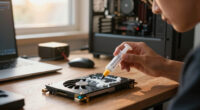
📊 Full opportunity report: Liquid vs Air Cooling for 24/7 Inference Rigs on ThorstenMeyerAI.com — validation score, market gap, and execution plan.

Get the latest gadgets delivered free — and shop member deals
- Fast, free delivery on millions of items
- Access to Prime Big Deal Days deals on October 6–7
- Prime Video, Amazon Music and more included
TL;DR
For 24/7 AI inference rigs, air cooling is generally more reliable, cheaper, and quieter over time. Liquid cooling offers higher thermal headroom but introduces potential failure points. The choice depends on workload and case constraints.
For continuous AI inference rigs operating 24/7, air cooling is generally the preferred choice over liquid cooling due to its superior reliability, lower cost, and quieter operation, according to recent expert analysis.
Most high-performance workstations running AI inference workloads prefer air cooling because it has fewer failure points. A top dual-tower air cooler can handle sustained loads comparable to mid-size liquid coolers at a fraction of the cost. Air coolers have only one moving part—the fan—which can be replaced easily and cheaply if needed. Their solid heatsinks last for years without degradation, making them ideal for unattended operation. In contrast, all-in-one (AIO) liquid coolers, despite their sleek design and higher thermal capacity, contain a pump that is a single point of failure. Pumps typically last 5–7 years and are non-repairable, meaning the entire cooler must be replaced once the pump fails. The coolant in AIOs gradually permeates through rubber tubing over time, reducing efficiency and risking leaks that could damage other components. While modern AIOs are reliable, their lifespan is limited, and running the pump continuously accelerates wear. Cost-wise, AIOs tend to be 2–3 times more expensive over their lifespan compared to air coolers. Noise levels also favor air cooling; high-quality air coolers often operate at lower decibel levels under load than AIOs, which include a constant hum from the pump. Maintenance is simpler for air coolers—dusting fins and reapplying thermal paste—whereas AIOs require careful handling to prevent leaks and pump failure.Liquid vs air
for a 24/7 inference rig.
For an always-on machine the question isn’t “which cools better” — it’s which one still works in three years without you thinking about it. That reframing makes air the default for most rigs. Answer three questions in Part 2 to find yours.
- Nothing to fail — fan swaps in minutes
- Lasts a decade+; lower total cost
- Quieter floor — no pump hum (~40–45 dBA)
- Trivial maintenance — wipe & repaste
- Tall — can block RAM, dumps heat in case
- Best headroom — ~360W TDP sustained
- Compact block — fits tight cases, clears RAM
- Exports heat out the radiator & room
- Pump fails at 5–7 yrs; replace whole unit
- Costs 2–3× more over its life; pump hum
- You run it 24/7 and want set-and-forget.
- Your CPU is mainstream-to-high-end (or power-capped).
- A big tower fits your case.
- You value lower cost and a quieter floor.
- Your CPU is too hot for air under sustained all-core load.
- A big tower won’t fit (compact / multi-GPU case).
- You need to export heat out of a warm room.
- RAM clearance is tight.
Reliability and Cost Are Key for Unattended AI Rigs
For AI inference systems that run continuously without supervision, reliability and long-term maintenance costs are critical. Air cooling's simplicity and durability make it the safer choice, reducing downtime and repair expenses. Although liquid cooling can handle higher sustained thermal loads, the potential for pump failure and leaks makes it less suitable for systems intended to operate for years without intervention. Cost savings over time further favor air cooling, especially in large deployments where total ownership costs matter.
As an affiliate, we earn on qualifying purchases.
Cooling Strategies in AI Workstations
Traditional gaming and high-performance workstations have often favored liquid cooling for its superior thermal capacity and aesthetic appeal. However, in the context of AI inference rigs, which typically run at steady loads for extended periods, the emphasis shifts from peak temperature performance to long-term reliability. Industry experts and testing data indicate that high-quality air coolers can dissipate comparable heat at a lower total cost of ownership. The trend towards larger, more efficient air coolers and the development of robust cases has further cemented air cooling as the default choice for server-grade, always-on AI systems.
"For unattended, 24/7 inference rigs, reliability and simplicity are paramount. Air cooling offers a proven, low-maintenance solution that lasts for years without intervention."
— Thorsten Meyer, AI cooling expert
As an affiliate, we earn on qualifying purchases.
Long-Term Performance and Failure Risks
While current data supports the reliability of air cooling, the long-term effects of continuous operation on high-end AIOs remain less documented. The actual lifespan of pumps and the potential for leaks under extended use are still being studied, and newer models may improve reliability. It is also unclear how future innovations in liquid cooling might alter these dynamics.
As an affiliate, we earn on qualifying purchases.
Monitoring and Future Cooling Innovations
System builders and operators are expected to prioritize air cooling for its proven reliability in AI inference rigs. Meanwhile, advancements in pump design, leak detection, and maintenance-free liquid coolers could shift the landscape. Ongoing testing and real-world deployments will clarify long-term performance, guiding best practices for continuous AI workloads.
As an affiliate, we earn on qualifying purchases.
Key Questions
Is liquid cooling worth it for 24/7 AI inference systems?
Generally, no. Unless your CPU runs extremely hot or space constraints prevent large air coolers, air cooling provides sufficient thermal performance with higher reliability and lower long-term costs.
How often do AIO pumps fail in continuous use?
Manufacturers typically warranty pumps for 5–6 years, but pumps can fail earlier due to wear, especially when run constantly. Failure rates are still relatively low but increase with age.
Can liquid cooling be more reliable than air for long-term operation?
Current designs suggest that air cooling is more reliable for unattended, long-term use due to fewer moving parts and no risk of leaks or fluid degradation.
What maintenance is involved with air cooling?
Cleaning dust from fins and reapplying thermal paste periodically is usually sufficient. No fluid management or leak prevention is needed.
Will future advancements change this cooling preference?
Potential improvements in pump durability and leak detection could make liquid cooling more attractive, but current evidence favors air cooling for reliability in AI inference rigs.
Source: ThorstenMeyerAI.com
Fall Picks
fall essentials
As an affiliate, we earn on qualifying purchases.