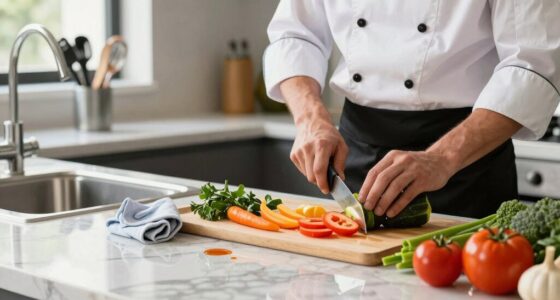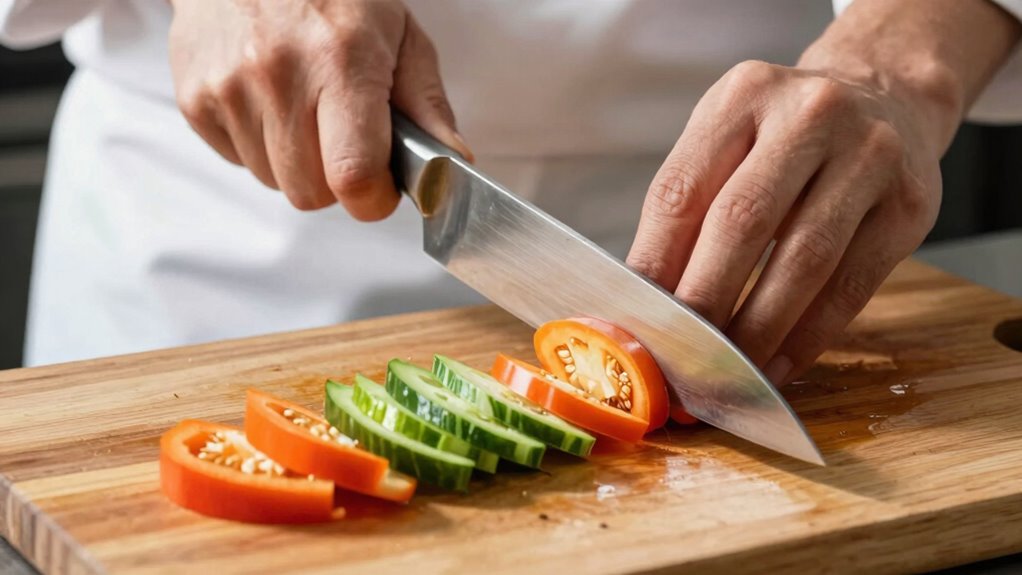

To double your prep speed safely, focus on mastering the claw grip and controlled chopping motions. Keep your fingers curled inward and maintain a steady, deliberate rhythm. Proper hand positioning and consistent technique build muscle memory, making quick cuts safe and effortless. Avoid rushing or applying too much pressure. By practicing these skills regularly, you’ll chop faster and more confidently. If you want to learn the exact steps, keep going to discover the full method.
Key Takeaways
- Use the pinch grip and curled fingers to control the knife and keep fingers safe during rapid chopping.
- Focus on short, deliberate cutting motions rather than large swings to increase speed safely.
- Maintain a steady rhythm and proper hand positioning to build muscle memory and improve confidence.
- Practice daily with a variety of vegetables to develop versatility and reinforce safe, efficient technique.
- Gradually increase chopping speed while prioritizing control and safety to achieve faster prep without risking injuries.

ARD Culinary Knife Cuts 3D Visual Model Set II, an educational precision knife skills with 3D templates and guides
Knife Cut 3D Model and Template-a handy kitchen tool for learning and teaching of classic knife cuts. These…
As an affiliate, we earn on qualifying purchases.
As an affiliate, we earn on qualifying purchases.
Why Faster, Safer Chopping Matters
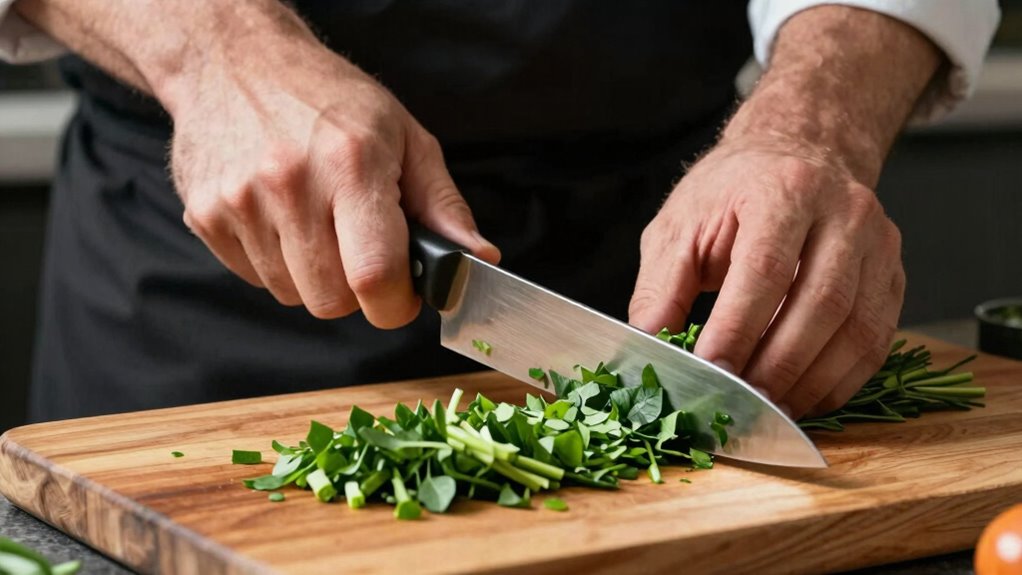
Have you ever noticed how slow and awkward chopping can increase the risk of accidents? When you rush, you tend to lose control, making knife safety a concern. But chopping too slowly can also lead to fatigue and frustration, slowing down your prep. Improving your cutting speed—without sacrificing safety—helps you work more efficiently and reduces the chance of slips or cuts. Faster chopping means you’re more confident with your knife, which encourages better technique. By striking a balance between speed and safety, you minimize errors and create a safer kitchen environment. Remember, mastering quick, precise cuts isn’t just about saving time; it’s about making your prep safer and more enjoyable. Speed, when controlled, becomes a powerful tool in your culinary skills. Understanding safe chopping techniques is essential to achieving this balance. Additionally, practicing proper knife grip and posture can significantly enhance your control and safety during cutting. Developing a steady rhythm and consistent motion can also help improve your cutting efficiency, making the process smoother and more predictable. Incorporating techniques from professional chefs can further refine your skills and boost your confidence at the cutting board. Recognizing how proper knife handling can improve safety and speed is an important step toward mastering your prep skills.

Plastic Training Knife Open Folder Style Combat Self Defense Practice Fixed Blade Martial Arts Weapon 8.25''
QUALITY MATERIAL: Solid training knife, well designed with nice rounded edges for light and medium contact training, molded…
As an affiliate, we earn on qualifying purchases.
As an affiliate, we earn on qualifying purchases.
Learn the Claw Grip for Quick, Safe Knife Skills
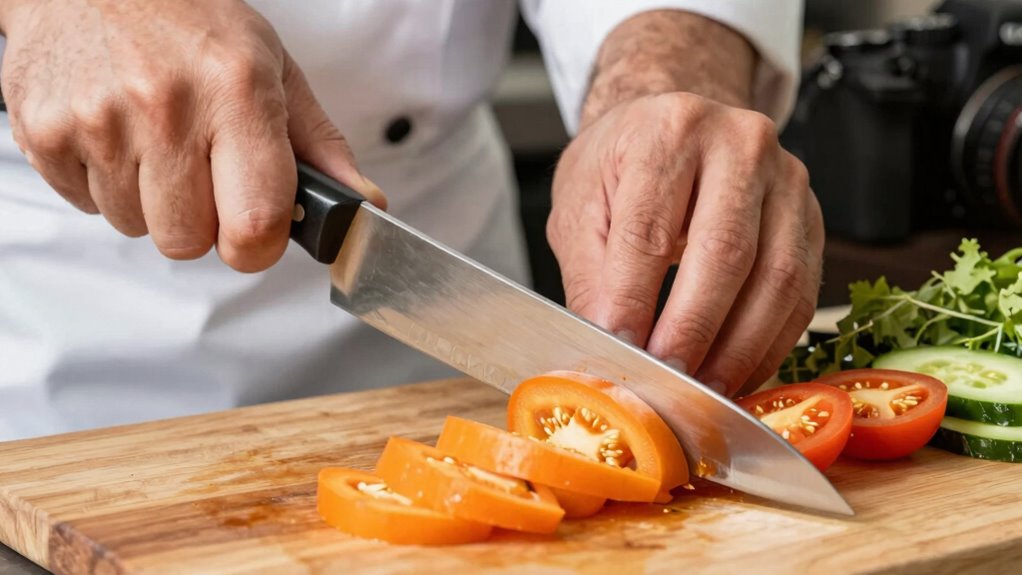
Mastering the claw grip guarantees your fingers stay safe while maintaining control of the knife. Proper hand positioning helps you cut quickly and confidently without slipping. With practice, you’ll build trust in your technique and chop more efficiently. Developing knife control is essential for increasing both speed and safety in your prep work. Additionally, practicing with electric knives can further enhance your precision and reduce fatigue during extended chopping sessions. Focusing on muscle memory can also improve your overall speed and consistency in knife skills. Incorporating consistent practice routines and emphasizing technique reinforcement can accelerate your learning curve and reinforce safe handling habits.
Proper Hand Positioning
Wondering how to keep your fingers safe while chopping? Proper hand positioning is key. The best way is to use the claw grip, which keeps your fingers tucked under and away from the knife’s blade. Your knife grip should be firm but relaxed, with your hand controlling the handle comfortably. Focus on where your fingers are placed; they should form a claw shape, guiding the knife while protecting your fingertips. Additionally, understanding the principles of talent retention strategies can help you develop skills that improve your efficiency and confidence in the kitchen. Proper hand positioning not only enhances safety but also reduces the risk of injury, making your prep faster and more confident. Developing muscle memory for proper technique is essential to maintaining safety during repetitive cutting tasks. Consistent practice ensures that good habits become automatic, further minimizing the chance of mishaps. Building proper technique through repetition is crucial for safety and speed. Here’s a quick comparison:
| Correct Hand Positioning | Incorrect Hand Positioning |
|---|---|
| Fingers curled inward | Fingers extended out |
| Knuckles aligned with blade | Knuckles bent or out of the way |
| Claw grip keeps fingers safe | Fingers exposed to cuts |
| Light grip on knife | Tight or shaky grip |
| Proper hand positioning | Variable, unsafe grip |
Maintaining Knife Control
Maintaining control of your knife is essential for safe and efficient chopping, and learning the claw grip is the quickest way to achieve this. The claw grip keeps your fingers tucked safely under your knuckles, reducing the risk of cuts and improving knife safety. By gripping the handle firmly and guiding the blade with your knuckles, you gain better control over each cut. This technique enhances your cutting precision, allowing you to slice uniformly and confidently. Consistently practicing the claw grip helps you develop muscle memory, making quick work of prep without sacrificing safety. Remember, steady control is key—always focus on maintaining the correct hand position to keep your cuts accurate and safe. Developing proper knife skills is a crucial step toward becoming a skilled, confident cook. Incorporating a focus on water safety can also help prevent accidents in the kitchen environment. Additionally, understanding proper knife maintenance ensures your blades stay sharp and effective, making your prep safer and more efficient. Practicing these skills regularly will also help you build trust in your tools, which is essential for confident, speedy prep work. To further enhance your safety, being aware of kitchen safety protocols can help prevent common accidents during meal prep.
Building Cutting Confidence
Are you ready to boost your confidence with the knife? Mastering the claw grip is a game-changer for knife safety and chopping efficiency. This technique keeps your fingers tucked, preventing cuts and allowing quicker, more controlled cuts. To help you visualize, here’s a simple table:
| Technique | Purpose | Tip |
|---|---|---|
| Claw Grip | Protect fingers | Curl fingertips inward, hold the food with knuckles forward |
| Rock Chopping | Increase speed | Use the full blade, pivot at the knuckles |
| Finger Position | Improve control | Keep fingers close to the blade edge |
| Hand Stability | Maintain balance | Keep your hand steady, avoid wobbling |
| Consistent Pressure | Ensure uniform cuts | Press down evenly, not too hard |
Building cutting confidence starts with mastering this grip, making every chop safer and faster. Developing proper technique not only enhances safety but also improves overall efficiency in the kitchen. Practicing this proper grip technique regularly can help ingrain good habits and boost your chopping speed over time.

Utopia Kitchen Knife Sharpener Rod 12 Inch, Professional Honing Rod for Knife Sharpening with Hanging Hook, Black
Premium Steel Construction – The steel rod is made of carbon steel and plated with nickel-chrome; the fine…
As an affiliate, we earn on qualifying purchases.
As an affiliate, we earn on qualifying purchases.
Step-by-Step: Mastering the Fast, Safe Chopping Technique
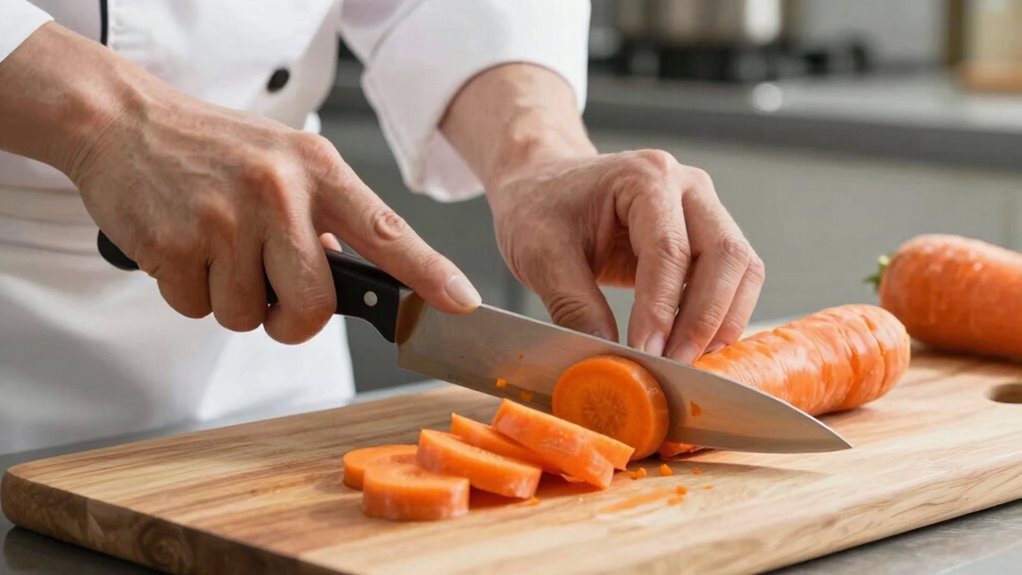
To chop quickly and safely, you need to focus on proper hand placement to keep your fingers out of harm’s way. Use a controlled, steady motion to avoid slipping, and keep your knife at a consistent angle for even cuts. Mastering these key points will help you chop faster without sacrificing safety.
Proper Hand Placement
Mastering proper hand placement is essential for both safety and efficiency when chopping. Your knife grip should be firm but relaxed, with your dominant hand comfortably wrapped around the handle. Keep your thumb and index finger gripping the blade just above the handle, creating better control and precision. Your other hand, the guiding hand, should hold the food with fingers curled inward, forming a claw shape to protect your fingertips. Proper hand positioning ensures your fingers stay clear of the blade’s path, reducing the risk of cuts. Maintain a stable, balanced stance, and avoid gripping the knife too tightly. With these techniques, your chopping becomes faster and safer, letting you work confidently and efficiently in the kitchen.
Controlled Chopping Motion
Controlling your chopping motion is key to working quickly and safely. To do this, maintain a proper precision grip on your knife, holding it firmly but comfortably. Keep your wrist aligned with your forearm to ensure smooth, controlled movements. Focus on making deliberate, short chopping motions rather than large, uncontrolled swings. This helps you stay accurate and prevents slips. As you chop, keep your knuckles slightly forward, guiding the blade with your finger pads. Consistent wrist alignment minimizes fatigue and enhances precision. With practice, your chopping becomes more fluid and efficient, allowing you to work faster without sacrificing safety. Remember, controlling your motion isn’t about speed alone; it’s about mastering a steady, deliberate rhythm that keeps you safe and efficient.
Consistent Knife Angle
Have you noticed how keeping your knife at the right angle makes chopping safer and faster? Maintaining a consistent knife angle enhances both safety and cutting precision. When your knife stays steady, you reduce slips and uneven cuts, making prep more efficient. Focus on holding the knife at about 20-30 degrees, depending on the task. Use this table to refine your technique:
| Knife Angle | Effect on Cutting | Tips for Consistency |
|---|---|---|
| 15-20° | Fine slicing | Keep your wrist steady, practice small movements |
| 20-30° | General chopping | Visualize your angle, use a guide hand |
| 30-40° | Rough cuts | Avoid excessive tilt to prevent slips |
| Over 40° | Dangerous, uneven | Keep angle low for safety and precision |
Mastering this guarantees precise cuts with less effort.
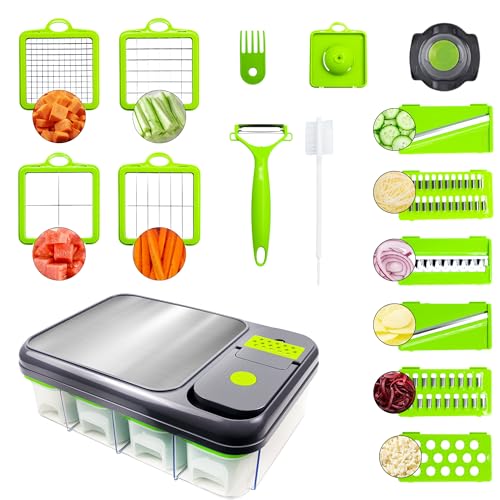
15-in-1 Vegetable Chopper & Slicer Set – Multifunctional Food Chopper with Container, Mandoline Slicer, Dicer, Grater, Peeler & Cleaning Tools – Kitchen Gadget for Onions, Carrots, Potatoes, Fruits
All in One Kitchen Organizer and Prep Station:This innovative cutting box integrates a durable chopping board with a…
As an affiliate, we earn on qualifying purchases.
As an affiliate, we earn on qualifying purchases.
Practice Tips to Make the Shortcut a Natural Part of Your Prep

To make your knife skills feel automatic, consistent practice is essential. Incorporate technique drills and speed exercises into your routine to build muscle memory. Start with slow, deliberate cuts to develop precision, then gradually increase speed without sacrificing safety. Focus on maintaining your knife angle and proper grip as you practice. Here are some tips to embed the shortcut into your prep:
- Dedicate a few minutes daily to technique drills, emphasizing form over speed.
- Use speed exercises to challenge yourself while keeping control.
- Record your progress to identify areas needing improvement.
- Vary your practice by cutting different vegetables to build versatility and confidence.
Regular, focused practice guarantees the shortcut becomes second nature, boosting both speed and safety in your prep.
Avoid These Common Mistakes When Using the Technique
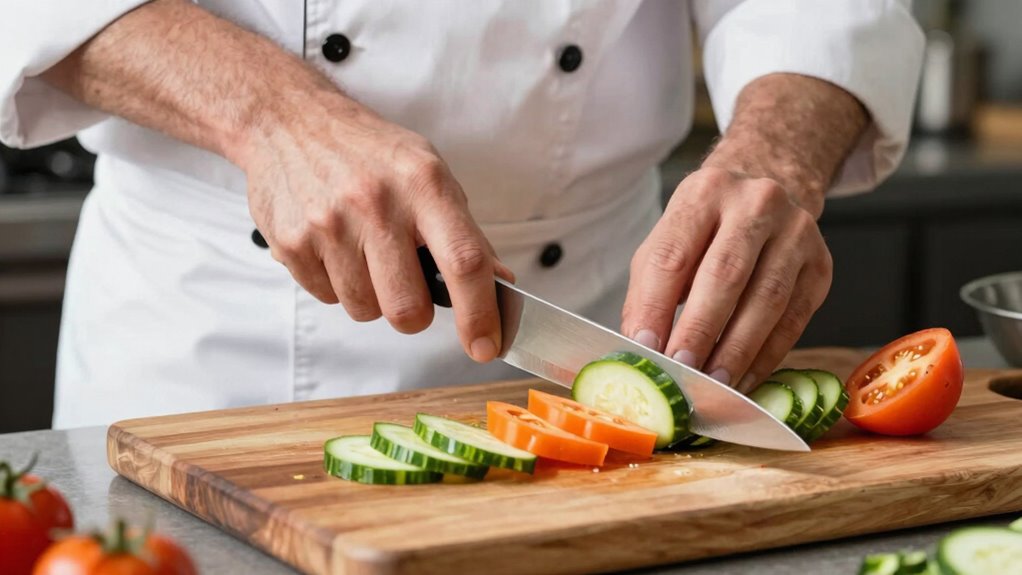
Even when you’ve practiced your knife skills extensively, it’s easy to make common mistakes that can compromise safety and efficiency. One mistake is using an improper knife grip, which reduces control and increases the risk of slips. Keep a firm but relaxed grip, avoiding a death grip that tires your hand. Another mistake is cutting on an unstable or inappropriate surface; always use a stable cutting surface like a quality cutting board to prevent slips. Also, pressing too hard on the knife can lead to accidents and uneven cuts. Focus on maintaining a steady, controlled motion and ensuring your cutting surface is secure. Avoid rushing or forcing cuts, as these habits compromise safety and slow you down. Proper technique minimizes risks and speeds up your prep.
How This Shortcut Will Help You Prep Meals Faster and Safer
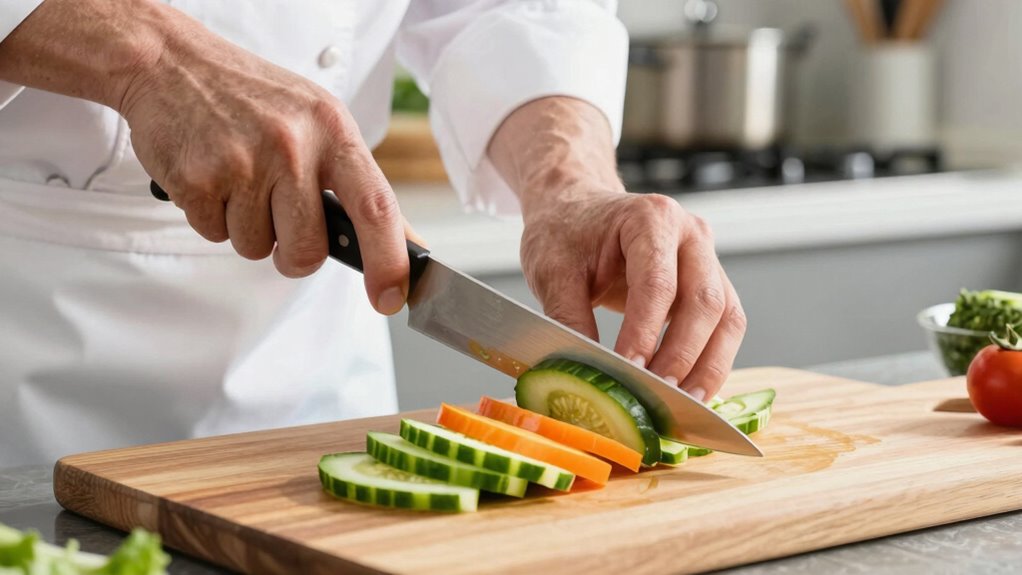
Mastering efficient knife skills can considerably speed up your meal prep while maintaining it safe. When you use this shortcut, you reduce the risk of accidents and improve your ingredient prep. Here’s how it helps:
Mastering quick, safe knife skills speeds up prep and ensures professional-looking results.
- Streamlines ingredient prep, saving time on chopping and slicing.
- Enhances knife safety by promoting controlled, confident cuts.
- Minimizes fatigue, allowing you to work longer without strain.
- Ensures uniform pieces, which cook evenly and look professional.
Frequently Asked Questions
Can This Technique Be Used With All Types of Knives?
This technique can be used with most types of knives, but you should always consider knife maintenance and safety precautions. For example, using a sharp knife is safer and more effective, so make certain your blades are properly honed. Be cautious with delicate or specialty knives, as they may require different handling. Always practice safety measures to prevent injuries, and regularly maintain your knives for maximum performance and safety during prep.
How Often Should I Practice to Become Proficient?
You should practice consistently, aiming for at least 15-20 minutes daily, to become proficient with knife skills. Regular practice helps reinforce muscle memory and improves your technique, boosting your confidence and safety in the kitchen. Focus on skill development steadily, and over time, you’ll notice faster, more precise cuts. Staying dedicated and practicing often guarantees continuous progress and mastery of knife handling, making prep quicker and safer.
Is This Method Suitable for Beginners With Limited Knife Experience?
Yes, this method is suitable for beginners with limited knife experience. It emphasizes essential beginner techniques and promotes knife safety, helping you build confidence and skill safely. By focusing on proper grip, controlled cuts, and mindful handling, you reduce the risk of accidents. Practice regularly, and you’ll improve quickly, making prep faster and safer. Just remember to stay attentive and follow safety guidelines as you develop your knife skills.
What Are Signs I Might Be Doing It Incorrectly?
If you’re slipping up, it’s a sign you might be doing it wrong. Watch for uneven cuts, which indicate poor cutting accuracy, or if you’re feeling unsafe, perhaps neglecting safety precautions. Keep your fingers tucked in, maintain a firm grip, and focus on control rather than speed. When you start rushing, safety’s the first to go—so slow down and double-check your technique to stay sharp and secure.
Does This Technique Work With All Cutting Board Materials?
This technique works with most cutting board materials, but its compatibility varies. You’ll find it works well on plastic and composite boards because they’re sturdy and smooth. However, with softer wood or bamboo boards, you might need to be more cautious, as they can chip or slide. Always test the technique on your specific cutting board material to guarantee safety and efficiency without damaging your surface.
Conclusion
So, who knew that a simple claw grip could make you faster—and safer—yet still turn you into a culinary ninja? It’s funny how a tiny tweak can save you time and avoid accidents, proving that the best shortcuts aren’t always about skipping steps. Now, you get to impress everyone with your speed and safety, all while thinking, “Who needs traditional chopping when you’ve got this?” Happy, faster, safer prepping!