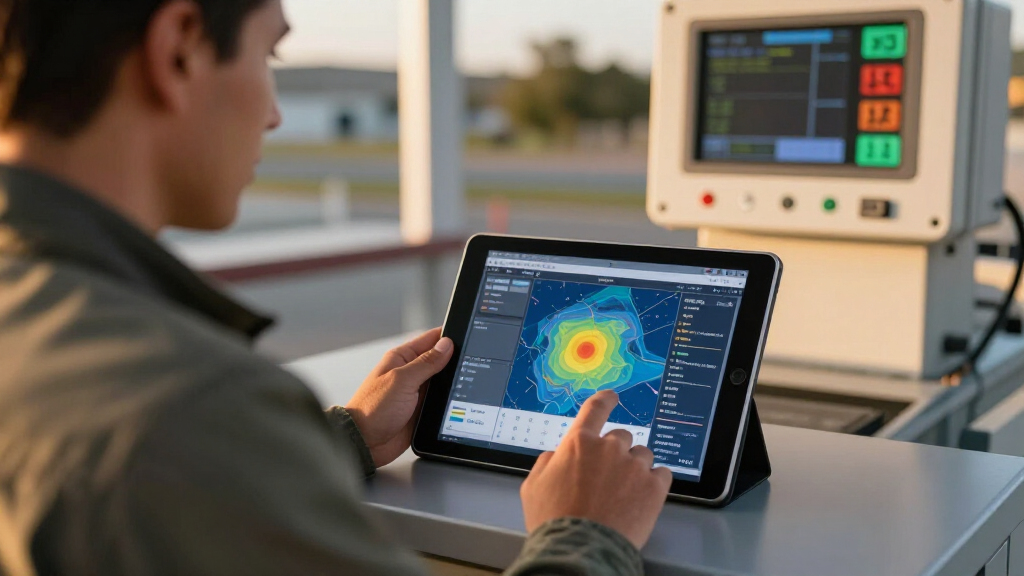

📊 Full opportunity report: Why AI Is Essential For Modern Weather Prediction In A Changing Climate on ThorstenMeyerAI.com — validation score, market gap, and execution plan.

Get the latest gadgets delivered free — and shop member deals
- Fast, free delivery on millions of items
- Access to Prime Big Deal Days deals on October 6–7
- Prime Video, Amazon Music and more included
TL;DR
A report attributed to Huawei Pangu suggests AI is significantly improving weather prediction capabilities, especially for extreme events. However, detailed technical evidence and validation are not yet available. This development could impact emergency preparedness and climate resilience efforts.
A report attributed to Huawei Pangu states that AI-based weather forecasting is transforming predictions as societies face increasing extreme-weather risks. While the report highlights potential for faster and more useful forecasts, it does not provide technical details, model validation, or performance metrics. The claim underscores the growing role of AI in climate resilience, but its accuracy and operational readiness remain unverified.
The report, attributed to Huawei Pangu, suggests that AI can process atmospheric data more rapidly than traditional models, potentially enabling earlier warnings for severe weather events. However, it does not specify the AI model version, training datasets, geographic coverage, or benchmark results. There are no published accuracy scores for temperature, precipitation, wind, or specific extreme events, making it impossible to assess the claimed improvements.
Experts caution that faster processing alone does not guarantee better forecasts. Reliable weather prediction requires validated accuracy and clear communication of uncertainty, especially for high-impact events such as floods, hurricanes, or heatwaves. For more on recent developments, see the original analysis here. The report does not address how AI forecasts compare to existing numerical models in these aspects or whether they have been tested in operational settings.
Potential Impact of AI on Weather Forecasting Accuracy and Timeliness
If AI can reliably produce faster and more accurate weather forecasts, it could significantly improve emergency response, disaster preparedness, and climate adaptation strategies. Communities facing increasing extreme weather events could benefit from earlier warnings, reducing harm and economic losses. However, without validated performance data, the actual operational impact remains uncertain. The development underscores the importance of transparency, independent testing, and rigorous validation before AI-based forecasts can be widely adopted.
As an affiliate, we earn on qualifying purchases.
Current State of AI in Weather Prediction and Industry Claims
AI has been increasingly integrated into meteorology, often used alongside traditional physics-based models. These systems typically learn from historical atmospheric data and can offer computational efficiencies. The Huawei Pangu report claims a breakthrough in forecasting speed and potential accuracy, but it does not specify whether this represents a new model, an enhancement of existing systems, or a commercial deployment. Historically, independent validation and benchmarking are essential before new AI tools are adopted operationally.
Previous efforts in AI weather forecasting have shown promise but remain experimental without widespread operational use. The lack of published performance metrics, model details, or peer-reviewed validation in the Huawei report means the claim of a forecasting revolution is currently unsubstantiated.
“Faster processing could give forecasters more time to analyze developing weather threats, but accuracy and uncertainty communication are critical.”
— an anonymous researcher
As an affiliate, we earn on qualifying purchases.
Unverified Claims and Lack of Technical Validation
The report does not specify the AI model version, training datasets, geographic scope, or benchmark results. There is no independent evaluation or published validation data comparing AI forecasts to current operational models. It remains unclear whether the claimed improvements are based on tested performance or are promotional assertions.
extreme weather alert weather radio
As an affiliate, we earn on qualifying purchases.
As an affiliate, we earn on qualifying purchases.
Need for Transparent Validation and Benchmarking
Future steps should include publication of detailed model documentation, benchmark results, and independent testing across different regions and weather phenomena. Operational deployment will require validation of both speed and accuracy, especially for extreme events. Further research is needed to confirm whether AI can meaningfully enhance weather prediction in practice.
As an affiliate, we earn on qualifying purchases.
Key Questions
Does the report prove AI forecasts are more accurate than current models?
No. The report does not provide accuracy metrics, validation studies, or direct comparisons with existing weather models. Its claims are unverified at this stage.
How could AI improve weather forecasting for communities?
If validated, AI could generate faster forecasts, giving emergency services more time to prepare for severe weather events. Accurate early warnings are crucial for disaster mitigation.
What details are missing to confirm these claims?
Details such as the specific AI model version, training datasets, geographic coverage, benchmark results, and independent validation are not provided. These are necessary to assess the validity of the claims.
When might we see AI-based forecasts widely adopted?
Widespread adoption depends on validation and testing outcomes. Currently, no timeline is available, and further research is needed to establish operational readiness.
Source: ThorstenMeyerAI.com
Fall Picks
fall essentials
As an affiliate, we earn on qualifying purchases.