
TL;DR

Get the latest gadgets delivered free with Prime
- Fast, free delivery on millions of items
- Prime Video, Amazon Music and more included
- Member-only deals all year
IdeaClyst is a local-first, AI-powered tool that acts as a private war room for your ideas. It helps you critique, discover, and prioritize with a structured process, avoiding blind enthusiasm and costly mistakes.
Imagine having a dedicated war room for your next startup idea. Not a physical space, but a digital one. A place where you gather your instincts, facts, and doubts—then battle-test them with structured AI-driven debates.
This is what IdeaClyst offers: a private, local tool that turns chaos into clarity. It’s not just about brainstorming; it’s about making confident decisions based on rigorous, grounded critique. Because in startups, the biggest risk isn’t failure—it’s building what nobody wants.
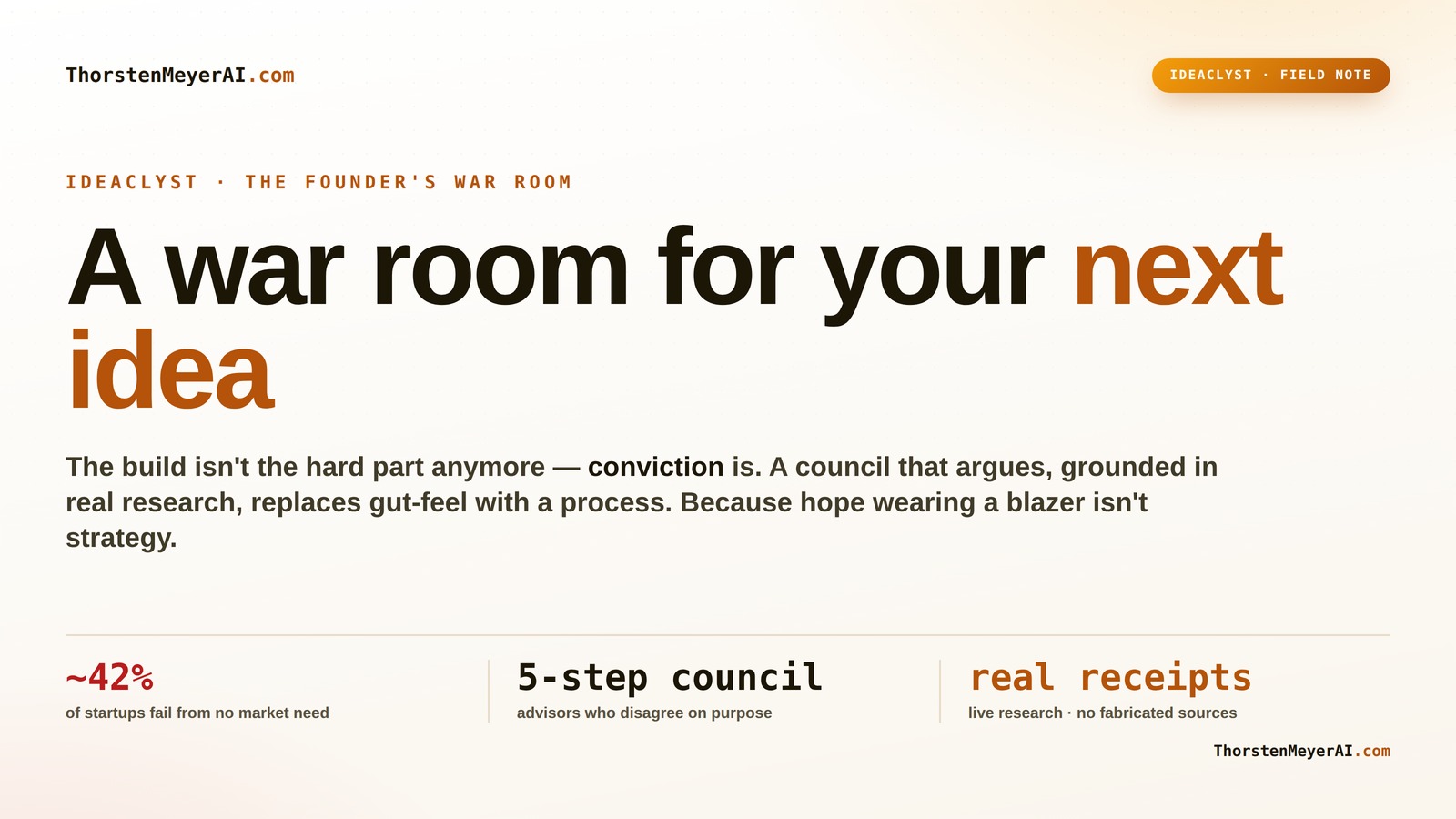
A war room for your next idea
The build isn’t the hard part anymore — conviction is. Knowing which idea deserves the next six months, and being able to defend it. Most founders answer with gut feel and optimistic math. That’s hope wearing a blazer. IdeaClyst replaces it with a process.
The most expensive decision is what to build
The single most valuable thing a tool can do is talk you out of the wrong six months. The numbers make the case better than any pitch.
Three tools in one — on your own machine
Strip away the framing and IdeaClyst is three things at once, all running locally with nothing leaving your laptop.
An AI council
Pressure-tests an idea you bring it — advisors who argue on purpose.
A discovery engine
Finds ideas you didn’t know to look for by hunting real demand signals.
A founder’s workspace
Carries winners from “interesting” all the way to “ready to build.”
Advisors who disagree on purpose
Not one confident, agreeable answer — a structured five-step deliberation where models play different roles and turn on their own work. The disagreement is the feature.
The five-step deliberation
A council that leads with the bad news surfaces the objections you’d otherwise find the expensive way, on month five.
Product strategy
Who’s it for, what’s the wedge, why now, what’s the business model.
Technical architecture
What would it actually take to build — and where’s the risk.
Critique pass
The council turns on its own work. Where’s the hand-waving? What kills this?
Second, independent critique
A different voice, a different angle — so blind spots don’t survive.
Final synthesis
Everything into one coherent founder packet: strategy, architecture, validation, plan.
When IdeaClyst cites a source, it actually fetched it
The hard departure from “ask an AI what it thinks of my startup.” It runs in a strict, real-data-only mode — if it can’t gather genuine evidence, it says so plainly rather than inventing a plausible paragraph.
Confidence with receipts
No fabricated statistics, no imaginary competitors, no made-up citations. The packet survives a skeptical co-founder or a sharp investor because the reasoning has receipts.
Market research first
Scouts the landscape before the council reasons about anything.
Competitor read
Real positioning, pricing signals, feature claims — differentiation vs. reality.
Validation with links
Not “talk to customers” — concrete signals & sources you can click.
From the blank page to build-ready
Evaluation is half the problem; the blank page is the other half. And a plan is worthless if it dies in a tab you never reopen.
Bring a space, not an idea
“AI for accountants,” “tools for indie game studios” — plus your goal and real capacity. It hunts demand signals across HN, Reddit, Product Hunt, GitHub, pricing pages.
- An honest market read — leads with the bad news when a space is hard
- An opportunity map — high pain, thin competition
- Ranked candidates — wedge, who pays, effort, risk, confidence
- each with KILL CRITERIA — when to walk away
A home and a forward path
Every promising idea gets carried forward, with every artifact in plain files on your disk.
- Validation tooling — sprint board, interview list, evidence browser
- Founder profile — a personal-fit lens; same discovery, different advice
- Build workspaces — funnel, personas, landing draft, version history
- “Build this idea” → a PRD + task queue, ready for a coding agent
Key Takeaways
- IdeaClyst turns the messy process of idea validation into a structured debate—reducing costly mistakes.
- Its local-first design keeps your raw ideas safe, private, and under your control—no cloud leaks here.
- The AI council’s five-step process ensures your ideas are thoroughly challenged from multiple angles.
- Grounding critiques in live web research prevents decisions based on hype or outdated info.
- Getting started is simple: download, input your idea, and let the council do the heavy lifting.
AI-powered startup idea validation software
As an affiliate, we earn on qualifying purchases.
As an affiliate, we earn on qualifying purchases.
Why a War Room Matters for Your Ideas
Starting a new project without a clear, disciplined process is like going into battle blind. You need a strategic space where your ideas face real scrutiny. IdeaClyst creates that space—an environment where your concepts aren’t just tossed around but are rigorously challenged and refined.
Picture this: you bring a half-formed product idea, and instead of relying on gut feeling, you get structured feedback from an AI council. It points out gaps, risks, and opportunities—much like a seasoned board of advisors sitting around a digital table. That’s the power of a war room for founders.
Research from CB Insights indicates that 42% of startup failures happen because there was no real market need. Using a structured war room like IdeaClyst helps you avoid that trap—saving months and hundreds of thousands of dollars. Using a structured war room like IdeaClyst helps you avoid that trap—saving months and hundreds of thousands of dollars.
local AI research and critique tool
As an affiliate, we earn on qualifying purchases.
As an affiliate, we earn on qualifying purchases.
What Makes IdeaClyst Different from Regular Brainstorm Tools
Most brainstorming apps are like colorful sticky notes—fun, but shallow. IdeaClyst goes deeper. IdeaClyst goes deeper. It’s a local tool that simulates a council of advisors, each playing a different role. It doesn’t just generate ideas; it critiques, questions, and tests them.
Here’s how it stands out:
| Feature | Traditional Tools | IdeaClyst |
|---|---|---|
| Location | Cloud-based | Local-first, on your machine |
| AI Role | Single chatbot or none | Multi-model council with conflicting opinions |
| Validation | Limited, often superficial | Grounded in live web research & evidence |
| Decision process | Gut feeling or scattered notes | Structured debate & final synthesis |
This approach avoids the echo chamber—your idea gets challenged from multiple angles, just like a real war room.
digital founder's war room software
As an affiliate, we earn on qualifying purchases.
As an affiliate, we earn on qualifying purchases.
How the AI Council Debates Your Idea — Step by Step
Imagine bringing a sketch of an idea. IdeaClyst’s AI council then kicks into gear, stepping through five deliberate phases:
- Strategy: Who’s the customer? What’s the market? Why now? These questions pin down the core of your idea.
- Technical Feasibility: What’s needed to build this? What are the risks? It’s like vetting your construction blueprint before pouring concrete.
- Critique: The council attacks your idea—spotting assumptions, weak links, and blind spots. Think of it as an internal audit.
- Second Critique: A fresh set of models from a different angle. It’s like bringing in a second opinion to catch what was missed the first time.
- Final Synthesis: All the critiques, strategy, and research are woven into a clear, actionable plan. Your idea now has a backbone.
This step-by-step debate turns gut feeling into a rigorous, defendable strategy—saving you from costly missteps.
idea prioritization and critique tool
As an affiliate, we earn on qualifying purchases.
As an affiliate, we earn on qualifying purchases.
Grounded in Evidence: How IdeaClyst Uses Live Web Research
One of the biggest pitfalls in idea validation is taking praise from an AI at face value. IdeaClyst avoids this by anchoring its critiques in live web research. IdeaClyst avoids this by anchoring its critiques in live web research. Instead of relying on static data or assumptions, it pulls current facts from across the internet—market trends, competitor moves, customer feedback.
For example, if you propose a new SaaS tool, IdeaClyst verifies if the market is indeed growing and whether competitors are gaining or losing ground. This grounding prevents you from chasing illusions or outdated trends. According to data, 42% of startup failures happen because of “no market need” [1], so real-time research can save you from that fate.
By constantly updating its understanding, the tool ensures your decisions are based on the latest facts, not just gut instincts or outdated reports.
Your Ideas Stay Private and Local—Why That Matters
Most AI tools run in the cloud, handing over your raw ideas to third parties. IdeaClyst runs entirely on your own machine. Not IdeaClyst. It runs entirely on your own machine, writing everything to local files in plain Markdown. That might seem like a small detail, but it’s a game-changer for privacy.
Imagine you’re working on a disruptive hardware prototype or confidential market strategy. You don’t want your secrets floating around on someone else’s server. With IdeaClyst, your raw ideas, critiques, and plans stay locked on your disk—under your control.
This local-first approach offers peace of mind, especially for teams handling sensitive information or startups wary of leaks. IdeaClyst is developed privately and is not publicly available.
Getting Started: Turning Chaos into Clarity
Ready to set up your own war room? Here’s a quick guide: Learn more about creating your own war room.
- Download the IdeaClyst software from their website.
- Install it on your machine—no complicated dependencies, just straightforward setup.
- Input your initial idea—no need for perfect phrasing. Just get it down.
- Run the council debate. Watch as your idea gets dissected from multiple angles.
- Refine based on critiques, then synthesize into a plan ready for action.
Within minutes, you transform a hazy concept into a validated, battle-tested plan—ready to ship or shelve with confidence.
Frequently Asked Questions
Is IdeaClyst suitable for team collaboration?
Yes, IdeaClyst supports team workflows by allowing multiple users to contribute ideas and critiques, all stored locally. For larger teams, syncing data or sharing files manually keeps everyone aligned without sacrificing privacy.
How much does it cost to use IdeaClyst?
IdeaClyst is developed privately and is not publicly available. You only pay if you want custom features or support, but the core tool is entirely free.
Can I customize the AI council’s roles or questions?
Absolutely. You can modify the scripts, add new roles, or tailor the critique process to your industry or preferences. It’s built to be adaptable for different kinds of ideas.
Is it safe to run on my laptop with sensitive data?
Yes. Because everything runs locally and no data leaves your machine, IdeaClyst is inherently secure. Just ensure your device is protected with standard security measures.
Conclusion
Imagine having a dedicated war room, where your ideas face relentless scrutiny, grounded in real facts, and protected from prying eyes. That’s the promise of IdeaClyst—turning uncertainty into confidence.
In a world where building the wrong product can cost hundreds of thousands, having a local, structured debate partner might just be the smartest investment you make. Your next idea deserves that kind of battlefield.
Fall Picks
fall essentials
As an affiliate, we earn on qualifying purchases.