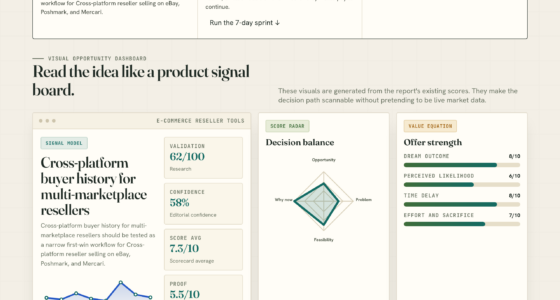

📊 Full opportunity report: What The Cloud Reveals About AI's Potential And Challenges on ThorstenMeyerAI.com — validation score, market gap, and execution plan.

Get the latest gadgets delivered free — and shop member deals
- Fast, free delivery on millions of items
- Access to Prime Big Deal Days deals on October 6–7
- Prime Video, Amazon Music and more included
TL;DR
Cloud computing history offers key insights into AI’s potential and hurdles. The market is an oligopoly with winners building on top of giants, not a race for a single victor. Challenges remain, but opportunities abound.
Recent insights into the evolution of cloud computing highlight how AI could develop, emphasizing that the market will likely be shaped by a few large players rather than a single dominant company. For more on this, see Unmasking AI’s Management Challenges After Correct Answers. This understanding is crucial as investors and companies navigate the AI landscape, revealing both opportunities and challenges ahead.
Thorsten Meyer, drawing from the history of cloud computing, explains that the cloud market did not evolve into a monopoly but settled into a stable oligopoly with three major firms — AWS, Azure, and Google Cloud — holding about 67-68% of the market share as of 2026. This structure has persisted despite the market’s rapid expansion, suggesting that AI might follow a similar pattern rather than becoming a winner-take-all scenario.
He notes that the most significant value creation in cloud was not from the giants themselves but from companies building on top of these platforms, such as Snowflake, Datadog, and others, which often compete directly with the hyperscalers. This layered approach indicates that in AI, the most durable winners may be those offering neutral, cross-platform solutions, rather than the labs themselves. This layered approach indicates that in AI, the most durable winners may be those offering neutral, cross-platform solutions, rather than the labs themselves.
Furthermore, Meyer emphasizes that the term ‘commodity’ is misleading; what appears as simple hardware or models often involves deep expertise and specialization. This pattern suggests that AI layers like inference, fine-tuning, and orchestration are likely to be lucrative, not because they are trivial, but because they require scarce, defensible skills.
Finally, the history shows enterprise adoption of cloud initially lagged but then accelerated rapidly, hinting that AI adoption will follow a similar trajectory, with early challenges giving way to widespread integration.
The cloud era was mispredicted in both directions by the sharpest investors alive. Both errors were the same mistake: dividing a fixed pie that was about to explode.
Understanding AI Market Structure and Growth Patterns
This analysis matters because it challenges the common narrative of a winner-take-all AI market, suggesting instead a landscape of a few large, differentiated players and layered winners. Recognizing this pattern can help investors, entrepreneurs, and policymakers better anticipate AI's evolution, identify lucrative niches, and avoid overhyped assumptions about inevitable monopolies or commoditization.
enterprise cloud computing solutions
As an affiliate, we earn on qualifying purchases.
As an affiliate, we earn on qualifying purchases.
Lessons from Cloud Computing's Market Evolution
The history of cloud computing, from its uncertain beginnings in 2007 to its current $400 billion scale, offers a blueprint for understanding AI's potential. Initial predictions underestimated AWS's growth, and fears of monopolization proved unfounded, as the market settled into a stable oligopoly. Companies like Snowflake and Datadog thrived by building on top of the giants, often competing directly with them, illustrating the layered nature of platform markets. These lessons suggest that AI's future will likely mirror this pattern, with a few dominant platforms and a vibrant ecosystem of specialized builders.
"The market as a fixed pie is the wrong math; it’s about expansion, not division."
— Thorsten Meyer
cross-platform AI development tools
As an affiliate, we earn on qualifying purchases.
As an affiliate, we earn on qualifying purchases.
Unclear Aspects of AI Market Dynamics and Adoption
While the cloud analogy offers valuable insights, it remains uncertain how exactly AI will evolve in terms of market dominance, innovation pace, and enterprise adoption. The pace of technical breakthroughs, regulatory responses, and the emergence of new players could reshape the landscape in unpredictable ways. It is also unclear whether the layered, multi-platform approach will fully materialize in AI as it did in cloud computing.
cloud infrastructure management software
As an affiliate, we earn on qualifying purchases.
As an affiliate, we earn on qualifying purchases.
Next Steps for Investors and Developers in AI Ecosystem
Stakeholders should monitor the development of cross-platform, neutral AI solutions, as these are likely to be the most durable winners. Continued investment in specialized inference and orchestration capabilities will be critical. Additionally, observing enterprise adoption patterns over the coming years will clarify how quickly AI integrates into mainstream workflows, potentially revealing new dominant players or ecosystems.
AI inference and fine-tuning platforms
As an affiliate, we earn on qualifying purchases.
As an affiliate, we earn on qualifying purchases.
Key Questions
Will AI markets follow the same oligopoly pattern as cloud computing?
Based on historical trends, it is likely that AI will develop into a market dominated by a few large, differentiated platforms, with many specialized companies building on top of them, rather than a single winner or a fully fragmented landscape.
Are AI layers like inference and fine-tuning truly commoditized?
No, these layers require deep expertise and specialization, making them valuable and defensible, despite appearances of simplicity or standardization.
What does this mean for startups aiming to compete in AI?
Startups should consider building neutral, cross-platform solutions or specialized services that leverage existing large platforms, rather than trying to dominate the entire stack or compete directly with labs.
When will enterprise AI adoption become widespread?
History suggests initial lag, but adoption tends to accelerate rapidly once technical and organizational barriers are overcome, likely within the next few years.
Source: ThorstenMeyerAI.com
Fall Picks
fall essentials
As an affiliate, we earn on qualifying purchases.