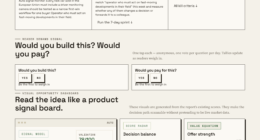
📊 Full opportunity report: GLP-1 Pharmacy Index: A Snapshot Of Access Across The US on IdeaNavigator AI — validation score, market gap, and execution plan.

Get the latest gadgets delivered free — and shop member deals
- Fast, free delivery on millions of items
- Access to Prime Big Deal Days deals on October 6–7
- Prime Video, Amazon Music and more included
TL;DR
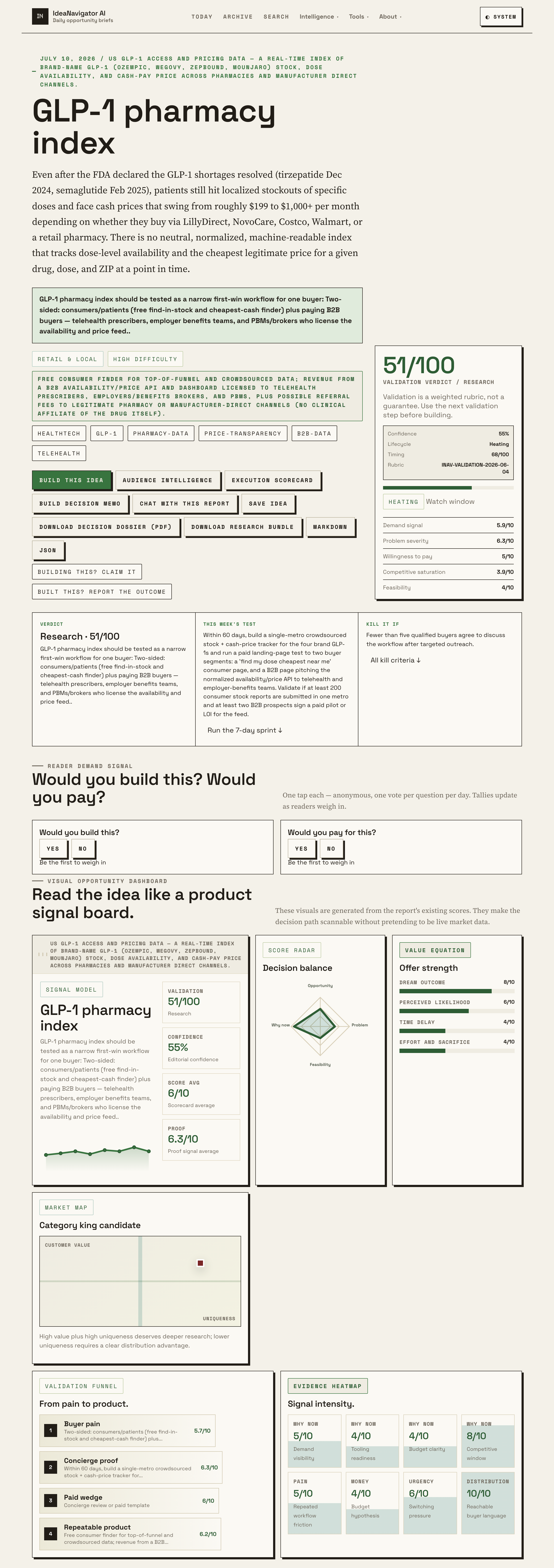
A market analysis from IdeaNavigator AI proposes a ‘GLP-1 pharmacy index’ — a real-time, dose-level tracker of availability and cash prices for Ozempic, Wegovy, Zepbound and Mounjaro across US pharmacies. The analysis argues the market has shifted from a shortage problem to a fragmentation problem, with cash prices ranging from roughly $199 to over $1,000 per month and no neutral source normalizing the data.
A new market analysis from IdeaNavigator AI proposes building a GLP-1 pharmacy index — a neutral, machine-readable tracker of dose-level availability and cheapest cash prices for the four brand GLP-1 drugs (Ozempic, Wegovy, Zepbound and Mounjaro) across US pharmacies and manufacturer-direct channels. The proposal responds to a market that, according to the analysis, has shifted from a nationwide shortage problem to a fragmentation problem: even after the FDA declared GLP-1 shortages resolved, patients still face localized stockouts of specific doses and cash prices that swing from roughly $199 to more than $1,000 per month depending on the purchase channel.
The analysis identifies a two-sided customer base: consumers and patients, who would get a free “find-it-in-stock and cheapest cash price” tool by drug, dose and ZIP code, and paying business customers — telehealth prescribers, employer benefits teams, and pharmacy benefit managers (PBMs) or brokers — who would license the underlying availability and price data feed. Revenue, under the proposed model, would come from a B2B API and dashboard, with possible referral fees to legitimate pharmacy or manufacturer-direct channels.
The problem the index targets is specific: the FDA removed tirzepatide from its shortage list in December 2024 and semaglutide in February 2025, but the analysis states that patients still encounter localized stockouts of particular doses. At the same time, cash prices vary widely across channels including LillyDirect, NovoCare, Costco, Walmart and traditional retail pharmacies. No existing source, the analysis argues, normalizes dose-level availability and the cheapest legitimate price for a given drug, dose and ZIP code at a point in time.
The proposed minimum viable product would launch the free consumer finder seeded with crowdsourced stock reports plus normalized public price data from manufacturer direct sites, Costco and Walmart cash programs, and a GoodRx-style price layer. Dose-level availability alerts would follow. The validation plan sets two thresholds within 60 days: at least 200 consumer stock reports submitted in a single metro area, and at least two B2B prospects signing a paid pilot or letter of intent for the data feed.
Why Price Fragmentation Now Hurts Patients
The proposal lands at a moment when GLP-1 demand has outgrown the infrastructure that supports it. Employers report that GLP-1s account for roughly 20% of pharmacy spend, according to the analysis, and benefits teams increasingly need cost-steering data they currently lack. A normalized feed of dose-level availability and cash prices would give telehealth prescribers a way to point patients to stocked pharmacies, and give employers and PBMs visibility into where the same drug can be bought for hundreds of dollars less.
For patients, the stakes are concrete. A monthly cash price gap stretching from about $199 to more than $1,000 translates into thousands of dollars per year for people paying out of pocket, and dose-level stockouts can interrupt treatment even when the drug is technically available in a market. A free finder tool built on crowdsourced reports and public pricing data could reduce both friction points — if the underlying data proves reliable.
Top picks for "pharmacy index snapshot"
As an affiliate, we earn on qualifying purchases.
How GLP-1 Supply Went From Shortage to Sprawl
:The GLP-1 market transformed rapidly across 2024–2026. The FDA’s shortage declarations ended first for tirzepatide in December 2024 and then for semaglutide in February 2025. Those resolutions triggered regulatory deadlines that forced compounders out of the copycat GLP-1 market, removing a cheaper gray-channel supply that many cash-pay patients had relied on.
Simultaneously, manufacturers launched competing direct-to-consumer cash channels — LillyDirect and NovoCare — joined by big-box cash programs at Costco and Walmart and, in February 2026, the TrumpRx portal. The result, per the analysis, is a sprawl of prices and dose-level supply gaps across channels that no single neutral source consolidates. This is the environment the proposed index is designed to normalize.
Open Questions About Data and Demand
The proposal is unvalidated. No product has been built, and the 60-day validation plan — one metro, 200 crowdsourced stock reports, two signed B2B pilots or letters of intent — has not been executed. Whether crowdsourced stock reports can achieve the accuracy and freshness needed for dose-level availability data is untested, and the analysis does not address how reports would be verified or how stale data would be flagged.
The reliability of public price data also presents challenges the analysis does not fully resolve: manufacturer-direct prices, big-box cash programs and discount-card layers can change frequently, and the index’s value depends on staying current. Demand-side assumptions — that telehealth prescribers, employers and PBMs would pay for such a feed — remain claims until design partners sign on. It is also unclear how existing players in drug-pricing data would respond, or whether manufacturer channels would permit systematic scraping and normalization of their prices.
The 60-Day Test Ahead
Under the validation plan, the next step would be building a single-metro crowdsourced stock and cash-price tracker for the four brand GLP-1s, paired with paid landing-page tests aimed at two segments: a consumer page pitched as “find my dose cheapest near me,” and a B2B page pitching the normalized availability and price API to telehealth and employer-benefits buyers. The analysis sets clear pass/fail criteria — 200 consumer stock reports in one metro and two paid B2B commitments — which would determine whether the index moves beyond concept.
If validation succeeds, the proposed roadmap calls for layering dose-level availability alerts and expanding the B2B feed to one or two design partners before broader licensing. If it fails, the analysis implies the concept would be shelved rather than iterated indefinitely.
Source: IdeaNavigator AI
Key Questions
What is a GLP-1 pharmacy index?
As proposed by IdeaNavigator AI, it would be a real-time, machine-readable index tracking which pharmacies have specific GLP-1 drugs and doses in stock, and the cheapest legitimate cash price for each drug, dose and ZIP code at a given moment.
Are GLP-1s still in shortage?
No. The FDA removed tirzepatide from its shortage list in December 2024 and semaglutide in February 2025. However, the analysis reports that patients still experience localized stockouts of specific doses.
Why do GLP-1 cash prices vary so much?
Prices differ across manufacturer-direct channels (LillyDirect, NovoCare), big-box cash programs at Costco and Walmart, discount-card layers, and traditional retail pharmacies. The analysis cites a range of roughly $199 to over $1,000 per month for the same class of drugs.
Who would pay for the index?
Under the proposal, consumers would use a free stock-and-price finder, while telehealth prescribers, employer benefits teams, and PBMs or brokers would pay to license the underlying availability and price data feed.
Has the index been tested?
No. The proposal includes a 60-day validation plan — at least 200 consumer stock reports in one metro area and two signed B2B paid pilots or letters of intent — but this has not been executed.
Source: IdeaNavigator AI
Evergreen bestsellers Picks
bestsellers
As an affiliate, we earn on qualifying purchases.