
📊 Full opportunity report: Effective Strategies For Blended Billing In Agency Software on IdeaNavigator AI — validation score, market gap, and execution plan.
Get ready for Prime Big Deal Days — try Prime free
Exclusive member deals on October 6–7, plus fast free delivery. Cancel anytime.
Start your free trialAs an affiliate, we earn on qualifying purchases.
TL;DR
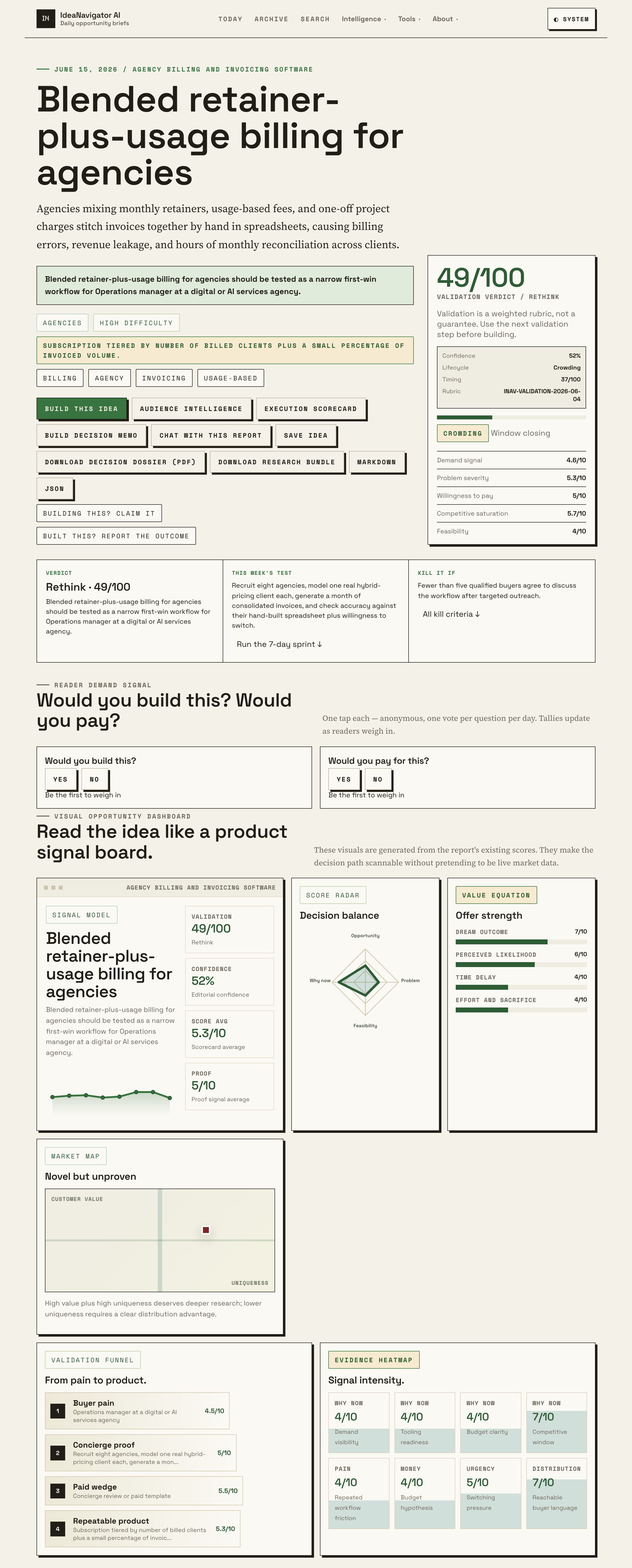
Agencies are testing new blended billing workflows that combine retainer, usage, and project charges into a single invoice. This approach aims to reduce errors and streamline revenue collection. Validation is ongoing with early adopters.
Agencies are beginning to adopt a new workflow for blended billing that consolidates retainer, usage, and project charges into a single automated invoice, aiming to reduce manual errors and improve revenue accuracy. This development is part of a broader effort to modernize agency billing systems to better reflect complex service models.
The opportunity for agencies lies in implementing a blended billing approach that combines multiple billing types—monthly retainers, usage-based fees, and one-off project charges—into a single invoice. Currently, many agencies manually stitch together invoices using spreadsheets, leading to errors, revenue leakage, and time-consuming reconciliation.
IdeaNavigator AI reports that a new MVP (minimum viable product) is being tested, which offers a dedicated billing workspace. Operations managers can define one client with a retainer line, a usage meter, and ad hoc project charges, then generate a consolidated invoice automatically. Early validation involves recruiting eight agencies, modeling real hybrid clients, and comparing automated invoices against their manual spreadsheets for accuracy.
This approach addresses a key limitation of existing subscription tools, which often cannot model clients with mixed billing structures in a single invoice. The new workflow aims to streamline billing, reduce manual work, and improve accuracy.
Why Blended Billing Matters for Agencies
This development is significant because it tackles a persistent pain point in agency operations—manual billing errors and revenue leakage caused by complex billing structures. Implementing an automated, consolidated billing workflow can save agencies hours each month, improve cash flow, and enhance client trust through more accurate invoicing. As agencies increasingly bundle AI and digital services into their retainers, the ability to model hybrid billing in software becomes critical for financial health and operational efficiency.
As an affiliate, we earn on qualifying purchases.
Growing Need for Hybrid Billing Solutions in Agencies
Over recent years, agencies have shifted toward flexible billing models, combining recurring retainers with usage-based charges for AI and digital services. However, existing billing tools often fall short in modeling these hybrid arrangements, forcing manual workarounds that are prone to errors. The push for automation and accuracy has motivated software providers to develop new workflows tailored for agencies managing complex billing scenarios. Early testing of these workflows indicates promising results, but widespread adoption remains in progress.
“The ability to generate a single, accurate invoice from multiple billing components could significantly reduce manual effort and errors for agencies.”
— an anonymous researcher
automated invoicing tools for agencies
As an affiliate, we earn on qualifying purchases.
As an affiliate, we earn on qualifying purchases.
What Aspects of Blended Billing Are Still Unproven
It is still unclear how well the new billing workflow will scale across different agency sizes and service models. The validation process involves only eight agencies, and results may vary. Additionally, long-term adoption depends on how seamlessly the workflow integrates with existing accounting and CRM systems, which remains to be tested in real-world environments.
hybrid billing management software
As an affiliate, we earn on qualifying purchases.
As an affiliate, we earn on qualifying purchases.
Next Steps for Adoption and Validation
Following initial pilot testing, the next phase involves expanding the rollout to more agencies and refining the workflow based on user feedback. Developers plan to monitor accuracy, ease of use, and integration capabilities over the coming months. If successful, this approach could become a standard feature in agency billing software, addressing a critical market need for hybrid invoicing solutions.
As an affiliate, we earn on qualifying purchases.
Key Questions
How does blended billing improve agency operations?
Blended billing consolidates multiple billing types into a single invoice, reducing manual work, errors, and time spent on reconciliation, thereby streamlining agency cash flow and client billing processes.
What types of charges can be combined in this new workflow?
The workflow supports combining monthly retainer fees, usage-based charges (such as AI compute or API usage), and one-off project fees into one automated invoice.
Is this workflow suitable for all agency sizes?
It is currently in pilot testing with a small number of agencies; scalability and suitability for larger or more complex agencies are still being evaluated.
When will this blended billing workflow be generally available?
There is no confirmed release date yet; wider adoption depends on ongoing validation and integration testing results.
Will existing billing tools be able to support this workflow?
Most current subscription billing tools cannot model hybrid billing in a single invoice, which is why new workflows and possibly new software features are being developed.
Source: IdeaNavigator AI
Fall Picks
fall essentials
As an affiliate, we earn on qualifying purchases.