
📊 Full opportunity report: Managing Family Permissions In Youth-Service Platforms on IdeaNavigator AI — validation score, market gap, and execution plan.

Get the latest gadgets delivered free with Prime
- Fast, free delivery on millions of items
- Prime Video, Amazon Music and more included
- Member-only deals all year
TL;DR
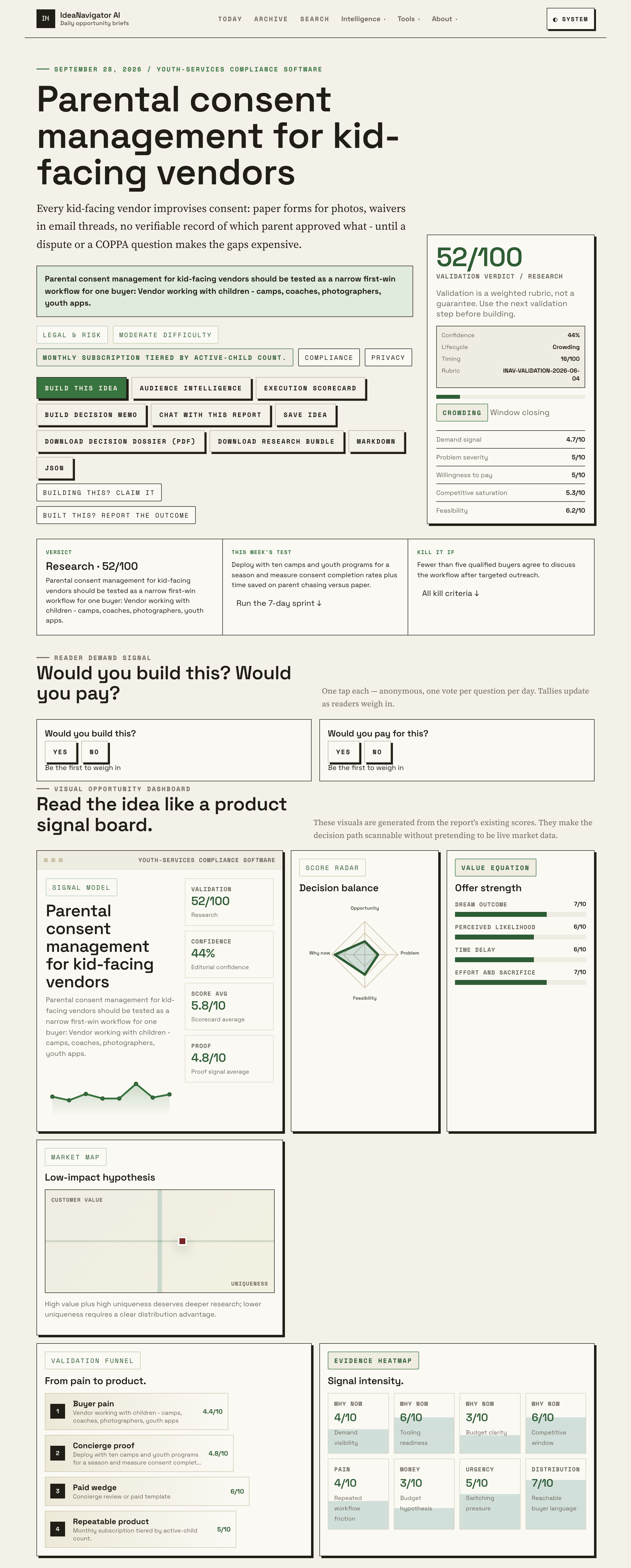
IdeaNavigator AI has described an opportunity for phone-based parental consent software aimed at camps, coaches, photographers and youth apps. The proposal outlines potential product features and a ten-program seasonal pilot, but gives no evidence that a product has launched or that a pilot has begun.
IdeaNavigator AI has outlined a proposed consent-management product for businesses and programs that work with children, including camps, coaches, photographers and youth apps. The proposal describes a possible software workflow and a way to test demand, but does not report a product launch, participating customers or pilot results.
The proposed service would let vendors create branded consent forms that parents complete on their phones. The suggested forms cover photo use, data collection, medical information and liability. IdeaNavigator AI’s proposal identifies a problem it says youth-service providers may face: relying on paper forms or email threads without a readily verifiable record of which parent agreed to which use.
Other features IdeaNavigator AI proposes include identity checks matched to the risk level, a consent ledger for each child, tracking for expiring approvals and an exportable audit record. The outline does not specify how identity would be checked, which records would be retained, or how a vendor would correct an inaccurate or disputed entry.
IdeaNavigator AI proposes a monthly subscription priced by active-child count. To assess the idea, its outline suggests deploying it with ten camps or youth programs for a season and measuring form-completion rates and time spent following up with parents compared with paper processes. The proposal does not say that these deployments have been arranged or that the measures have been collected.
Making Parental Approval Traceable
For a vendor serving children, a searchable record could make it easier to show which permission was granted and when. Separating approvals by purpose may also help staff distinguish consent to use a photograph from permission to collect information or handle medical details. Those distinctions matter when a parent asks what was authorized or requests a change.
The potential benefit depends on how the system works in practice. A digital record does not by itself establish that the right adult gave permission, that the form was understood, or that the vendor’s use matched the approval. The proposal’s suggested identity checks and audit exports address parts of that problem, but it offers no test results showing whether the design would reduce errors or disputes.
Small organizations may also weigh the subscription cost and administrative effort against their existing process. The proposed active-child pricing and seasonal pilot focus on that buyer question: whether easier tracking and fewer follow-up tasks would justify adopting another service. No price, measured time saving or customer feedback is provided.
Products Worth Considering

DJI Mini 5 Pro Fly More Combo with DJI RC 2, 1-Inch CMOS

DJI Mini 4K Drone Combo with 4K Camera, 3-Axis Gimbal, and Two Batteries

Samsung 32 Odyssey G5 QHD Gaming Monitor
As an affiliate, we earn on qualifying purchases.
Paper Forms and Privacy Pressure
The idea is aimed at organizations that collect permissions as part of ordinary youth activities. A camp may seek a liability waiver and medical details; a photographer may request approval to use images; an app may collect information from children. IdeaNavigator AI’s proposal groups these needs under parental consent management, while suggesting that records should remain specific to each child and each permission.
IdeaNavigator AI presents privacy enforcement and state laws as reasons vendors may face pressure to keep more defensible records. It does not identify a particular enforcement action, legal change, jurisdiction or date. Its reference to COPPA updates is broad, and the outline does not explain which requirements apply to any particular vendor or product.
The proposed first step is deliberately narrow: focus on one buyer group of vendors working with children, rather than attempting to build a general-purpose compliance system. IdeaNavigator AI suggests a seasonal trial with ten programs as a way to observe completion and follow-up time. That remains a validation plan, not evidence that vendors have adopted the product.
Pilot Status and Legal Scope
No operating product or pilot is confirmed in IdeaNavigator AI’s available description. The outline names a ten-program seasonal deployment as a validation method, but gives no start date, partner organizations, completion data or comparison with paper-based processes. It is also unclear whether a vendor is developing the software or what its current availability would be.
The legal and operational details are likewise unspecified in the proposal. It does not explain how the service would verify a parent’s authority, protect sensitive medical information, handle custody disputes, manage access by vendor staff, or respond to requests to withdraw consent. It also does not identify the laws that would govern a specific customer. Those questions would shape both product design and the evidence a customer could rely on.
Testing Demand With Youth Programs
The next step set out in IdeaNavigator AI’s proposal is a seasonal trial with ten camps or youth programs. The suggested measures are consent completion rates and time saved following up with parents compared with paper. No timing or recruitment plan is given, so it remains unknown whether that trial will take place.
If a pilot proceeds, its results could show whether phone-based forms fit vendors’ existing registration practices and whether families complete them more readily. Details such as pricing, privacy safeguards, identity-check methods and record-retention rules would also be needed for customers to assess the service. For now, IdeaNavigator AI presents a product opportunity and proposed test, rather than a reported launch or demonstrated outcome.
Source: IdeaNavigator AI
Key Questions
Has the consent-management product launched?
No launch is reported. IdeaNavigator AI’s available description presents a product concept and proposed validation plan, without an availability date.
Who is the proposed service for?
IdeaNavigator AI says it is aimed at vendors and programs that work with children, including camps, coaches, photographers and youth apps.
What would the software let parents approve?
IdeaNavigator AI’s proposed phone-based forms would cover photo use, data collection, medical information and liability. The outline does not provide sample forms or explain how each category would be handled.
Has a ten-program pilot started?
No pilot results or participating programs are reported. IdeaNavigator AI presents testing with ten camps or youth programs for a season as a way to validate the idea.
Source: IdeaNavigator AI