
📊 Full opportunity report: A Local Discovery App That Speaks As You Walk on IdeaNavigator AI — validation score, market gap, and execution plan.

Get the latest gadgets delivered free with Prime
- Fast, free delivery on millions of items
- Prime Video, Amazon Music and more included
- Member-only deals all year
TL;DR
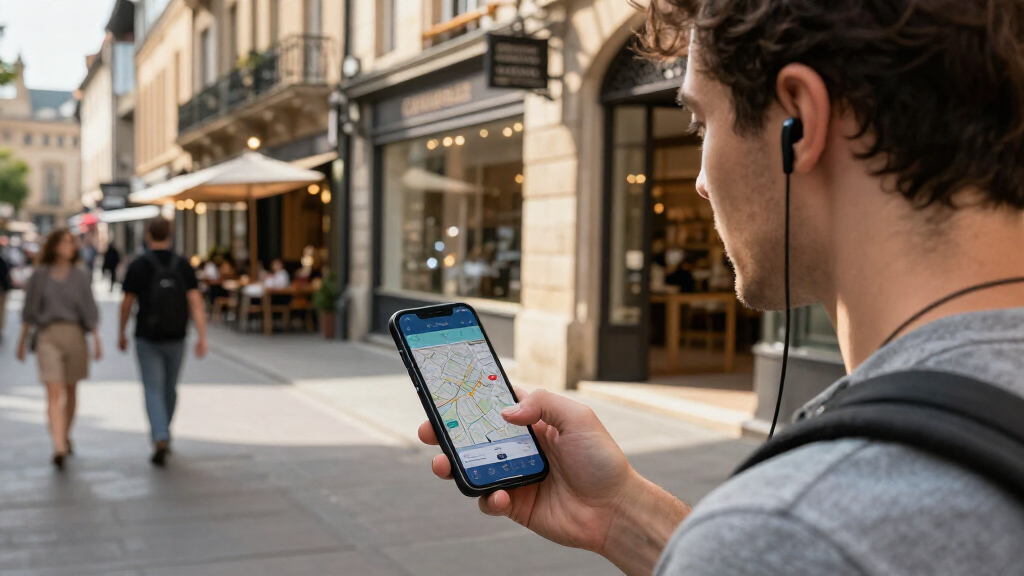
IdeaNavigator AI has outlined a concept for a walking app that generates audio narration about a user’s surroundings and responds as the route changes. The proposal recommends testing the product in two cities, with retention and narration accuracy as key measures; no launch, trial results or user data are reported.
IdeaNavigator AI has proposed a location-reactive audio walking app that would narrate a person’s surroundings as they move, using information about local history, buildings and other places. In its published concept, IdeaNavigator AI frames the app as an early product proposal—not a launched service—and recommends testing it in two cities before making broader claims about demand or accuracy.
In the IdeaNavigator AI proposal, the app would let a user start a walk and receive narration generated along their live route. The concept suggests content that responds to corners and landmarks, with themed modes for history, architecture and nature, as well as an option to save favorite routes. These are proposed features; IdeaNavigator AI does not report that a working app has been built or tested.
IdeaNavigator AI argues that language models could generate route-specific narration from open information, including historical, architectural and place records. The proposal’s premise is that on-demand generation could reduce the cost of producing audio for each route compared with recording tours in advance. It does not identify specific datasets, explain how information would be checked, or provide evidence that automated narration is reliable for this use.
The proposal suggests a consumer subscription combined with a licensing tier for tourism boards. To assess the idea, IdeaNavigator AI recommends tests in two cities, tracking walks per week at week four and auditing narration accuracy on a sample of routes. The proposal specifies no cities, prices, sample size, test schedule or results.
Testing Audio Beyond Tourist Routes
IdeaNavigator AI presents the concept as an attempt to bridge general audio content and conventional guided tours. Its proposal contrasts podcasts, which usually do not change as a listener walks through a neighborhood, with tour apps that often focus on established visitor districts and landmarks. A service that adds context to ordinary streets could make local discovery available beyond curated routes, if it provides relevant and dependable information. The proposal does not include comparative market research to establish the scale of this gap.
For readers, the immediate significance is the test IdeaNavigator AI recommends, not a newly available app. Measuring repeat use by week four could indicate whether walkers find the narration useful enough to return to, while route audits could test generated details against reliable records. No test results are reported, so the proposal does not establish whether users would adopt the service or whether its narration would be accurate.
The concept also raises a practical question about generated narration in public spaces: broad coverage may be easier to produce than carefully verified tour scripts, but an incorrect claim about a building or local history could undermine trust. IdeaNavigator AI proposes accuracy auditing as a validation step, but does not specify an acceptable error rate or audit method.
Products Worth Considering

Bose SoundLink Plus Portable Bluetooth Speaker, Black

Jackery Explorer 2000 v2 Portable Power Station with Two 200W Solar Panels

Jackery Explorer 300 Portable Power Station, 292Wh
As an affiliate, we earn on qualifying purchases.
From Recorded Tours to Generated Routes
In its concept, IdeaNavigator AI characterizes traditional audio tours as content prepared for particular sites or routes. That approach can support detailed, edited narration, but requires content for each destination and may leave everyday streets without coverage. The proposal offers this as a rationale for the idea, not as a conclusion supported by comparative market research or figures on route coverage.
IdeaNavigator AI’s proposed alternative combines location information with generated speech or text. The concept says language models could draw on open data about places to create narration on demand, with a user’s location shaping what is said next. The proposal provides no technical implementation, data partners or independent evaluation of this approach.
IdeaNavigator AI recommends beginning with a narrow use case: a walker who wants their neighborhood or travels narrated. Its suggested two-city test would expose the concept to different routes while keeping the initial trial limited. The proposal does not explain how the cities would be selected, including whether tourism, data availability, language coverage or other factors would guide the choice.
Accuracy, Privacy and Test Design
IdeaNavigator AI reports no product launch or working demonstration. Its proposal does not say whether a team is developing the app, when a pilot might begin, or whether any tourism board or consumer has agreed to participate. The subscription and licensing models it outlines are possibilities, not confirmed revenue arrangements.
The proposal leaves key operating details unanswered. It does not explain how the app would determine a user’s location, how often it would speak, whether walkers could control narration while moving, or what accessibility and offline options might be available. It also provides no information about location-data storage or privacy safeguards.
The quality of the underlying material remains an open issue. IdeaNavigator AI does not name data sources or describe how the app would distinguish verified facts from incomplete or conflicting records. Nor does the proposal define the route sample or scoring method for its suggested accuracy audit. Until these details and results are available, claims about broad neighborhood coverage and dependable narration remain untested.
A Two-City Pilot Would Test Demand
IdeaNavigator AI proposes a pilot in two cities, followed by measurement of walks per week at the four-week mark and a review of narration accuracy on selected routes. These measures could help assess repeat use and the dependability of generated details, but the proposal states no timeline or threshold for success.
Further reporting would depend on whether a developer adopts the concept and shares practical details such as participating cities, data sources, privacy protections and pricing. Until a pilot is announced and results are published, the app should be understood as a product proposal, not a service with demonstrated user demand or verified performance.
Source: IdeaNavigator AI
Key Questions
Has the walking app launched?
No launch is reported. IdeaNavigator AI describes a product concept and recommends a future test; it does not say that a working app is available.
What would the app do?
According to IdeaNavigator AI’s proposal, the app would generate audio narration based on a walker’s route, covering subjects such as local history, architecture and nature. The concept suggests it could respond as the user reaches corners or landmarks.
How would the concept be tested?
IdeaNavigator AI recommends testing the app in two cities, measuring walks per week at week four and auditing narration accuracy on a sample of routes. The proposal gives no test dates or results.
How might the app make money?
IdeaNavigator AI’s proposed model is a consumer subscription alongside licensing for tourism boards. The proposal reports no prices, partners or revenue.
Is the generated information verified?
IdeaNavigator AI proposes an accuracy audit but does not identify data sources, a verification process or audit results. Reliability has not been demonstrated in the information available.
Source: IdeaNavigator AI